
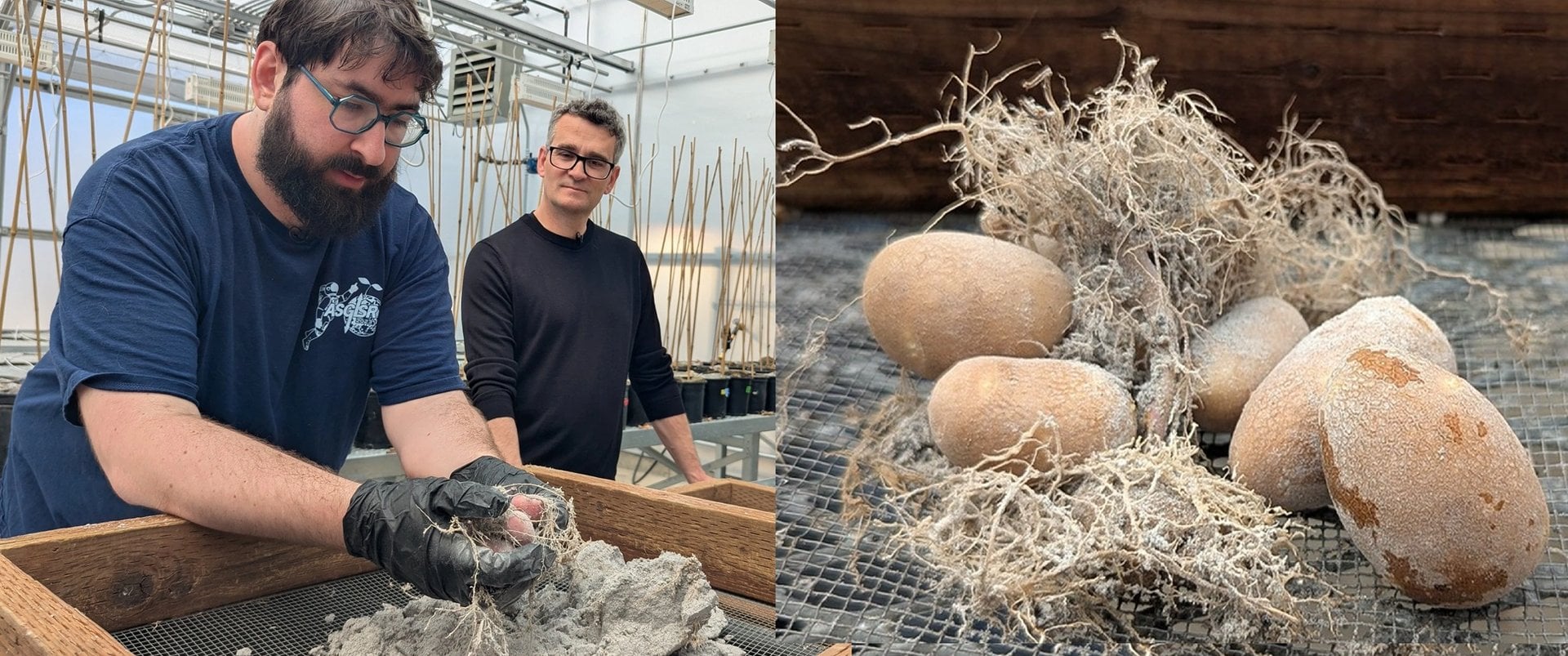
By now, references to Mark Watney and how he grew potatoes in Martian soil have become a tired cliché. Nevertheless, one can't help but recall the scene whenever news breaks about the latest experiment that examines the potential of growing plants in extraterrestrial soils. The latest comes from Oregon State University (OSU), where researchers have shown that potatoes grown in lunar soil simulant (amended with organic matter) are safe to eat and grow just as well as those produced on Earth. This is good news for space agencies like NASA that are actively planning to send astronauts back to the Moon, and this time, to stay. Through the Artemis Program, crews will land around the South Pole-Aitken Basin and begin constructing a permanent base that will enable regular missions in the future (about one per year). China's National Space Agency (CNSA) and Roscosmos also plan on building a base - the International Lunar Research Station (ILRS) - in the same region by the end of the decade. To support long-term missions far from Earth, where opportunities for resupply will be fewer and farther between, a degree of self-sufficiency is required. Whereas the International Space Station (ISS) is resupplied regularly and emergency supplies can be dispatched within hours, missions to the Moon will take at least three days to arrive. As such, any sustained program of exploration on the Moon must rely on In-Situ Resource Utilization(ISRU) as much as possible - i.e., using local resources for building materials and providing astronauts with water and food. Research in the past few decades has led to methods for 3D printing habitats and other facilities using lunar regolith. This can be combined with a bonding agent to create "lunacrete," or sintered with microwaves to create molten ceramic. Either material is then deposited layer by layer by construction robots to form walls and other structural elements. While hydroponics remain a viable way to grow plants (as astronauts do aboard the ISS), the real question is whether Earth plants can be grown in lunar regolith and other extraterrestrial soils. Led by Aymeric Goyer, a professor with OSU's Department of Botany and Plant Pathology, the Oregon team used lunar regolith simulants with different levels of vermicompost, a nutrient-rich organic soil produced when earthworms break down organic matter. With support from NASA's Johnson Space Center Simulant Development Lab, the team produced healthy potatoes with yields comparable to crops grown by farmers in Oregon (the 4th largest potato producer in the U.S.). Goyer and his teams specifically selected potatoes because they produce more calories per square meter of soil than many other crops. They also offer substantial nutritional value: one medium skin-on potato (148 g/5.3 oz) provides roughly 110 calories, 26 g of carbohydrates, 3 g of protein, and 2 g of fiber. They are also naturally fat-free, gluten-free, cholesterol-free, and are therefore considered a practical staple food for long-duration space missions. Since lunar regolith varies across the Moon, the researchers tested five simulants representing lunar mare (fine-grained basaltic soil) and lunar highland (feldspar-rich volcanic soil) regions. They also included soil from Hermiston, Oregon, which produces the world's highest potato yield. The results showed that potato plants grown in simulants containing 30% vermicompost grew as well as those cultivated in Earth soils. In other samples, plants grown without vermicompost were severely stunted and had underdeveloped root systems. The "Moon Village" concept, conceived by MIT in collaboration with the ESA and Skidmore, Owings & Merrill. Credit: ESA/Skidmore, Owings & Merrill Lastly, those grown with 5% to 15% vermicompost showed only partial growth. As Goyer said in an OSU press release: We found that potatoes can complete their entire life cycle in simulated lunar soil when supplemented with organic matter. That's an important step toward developing reliable food production systems that could support long-term human exploration of the Moon. The results also showed that the potatoes grown in lunar regolith simulants maintained their nutritional quality, with no statistically significant increase in naturally occurring potato toxins (glycoalkaloids) often associated with green discoloration. Lunar regolith still presents many challenges for plant growth, which include extremely fine-grained dust and elevated levels of heavy metals. But the researchers are confident that adding organic matter helps bind heavy metals, preventing them from damaging roots, interfering with growth, or leaching into the potatoes themselves. In the future, astronauts could bring compost to the Moon, along with Earth worms, to create their own fertilizer, augmenting soil collected during surface trips to grow their food. "We believe the compost helps balance some of the toxicity we see in lunar regolith by reducing plant exposure to harmful compounds," said David Handy, a postdoctoral researcher in Goyer's lab. Their results are reported in a paper, "Growth and molecular responses of potato to lunar regolith simulants," that appeared in npj Microgravity. Another paper, which reports the results of experiments involving 10 potato varieties to identify which grow best in lunar soil, will be released. Further Reading: OSU
Study Finds Artemis Astronauts Will Enjoy Moon-Grown Potatoes
Full Article
Original Source
Read the full article at Universetoday →KhanList aggregates and links to publicly available news content. We do not host full articles from third-party sources. Always verify important information with original sources.