
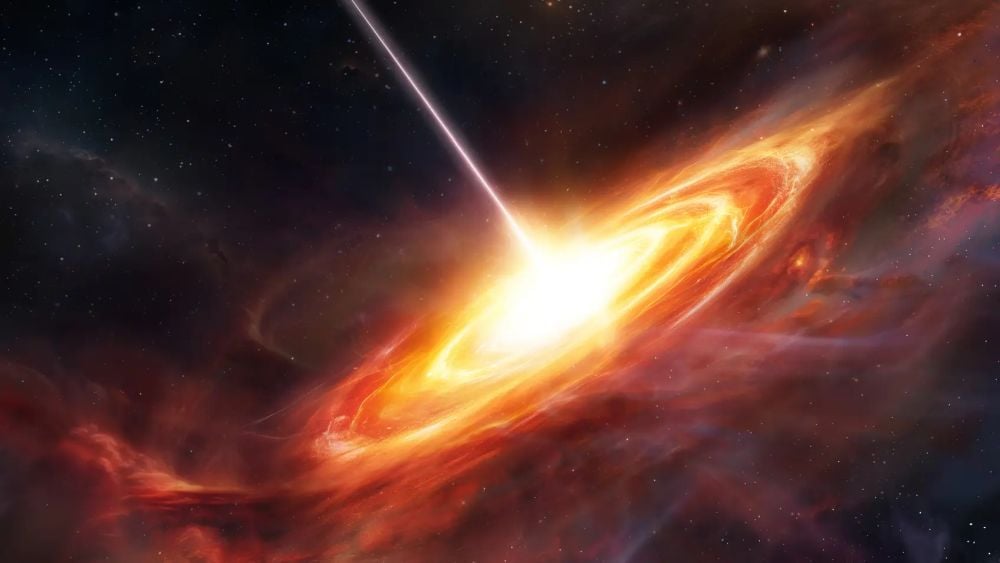
Quasars are the cosmos' most luminous objects, generated by supermassive black holes (SMBH) that are accreting enormous amounts of matter. Astronomers keep finding these massive objects further and further back in time. The ESA's Euclid just found the newest record holder: the telescope observed it 40 million years sooner than the previous record-holder, and it was found at redshift z=8.13, corresponding to about 630 million years after the Big Bang. That's firmly in the Epoch of Reionization. The quasar's technical name is J1504+6252, but it's been given the more recognizable name Dún Aonghasa. Dún Aonghasa is an ancient stone fort on top of a cliff in Ireland, where it looks out over the Atlantic Ocean. The discovery is in research published in Astronomy and Astrophysics titled "Euclid: Discovery of a quasar at z = 8.13 hosting a 360-million-solar-mass black hole." The lead author is Julien Wolf, who was a postdoc at the Max Planck Institute for Astronomy when the research was done. One of the hallmarks of modern astronomy is the discovery of massive objects in the Universe that formed much sooner than astronomers thought they could. The JWST is driving much of this. "Quasars powered by rapid accretion onto supermassive black holes (SMBHs) have been uncovered deep into the first gigayear of cosmic history," the authors write. Now the Euclid Space Telescope is contributing to that trend. Euclid was launched to study dark energy and the expansion of the Universe. A big part of that job is measuring galaxies at different redshifts in its Euclid Wide Survey, to see how their morphologies are different over time. That will reveal how dark energy has changed over time. This is what Dún Aonghasa, the new quasar, looks like in the actual Euclid image. It's the red dot in the center. Image Credit: ESA/Euclid/Euclid Consortium/J. Wolf et al. Euclid found Dún Aonghasa in its Euclid Wide Survey imaging, but didn't confirm it. Follow-up observations by Keck, the Hubble, the Large Binocular Telescope, and especially the JWST provided the confirmation. JWST spectroscopy let the researchers measure "a systemic redshift of zsys = 8.129 ± 0.005, corresponding to only 630 Myr after the Big Bang and shifting the quasar redshift frontier by ≃39 Myr," the authors write. 39 million years is about 6% of the age of the Universe at that epoch. The quasar is now the first quasar observed at z > 8. Dún Aonghasa's luminosity is what lets astronomers observe it at such a great distance. Its luminosity helped researchers measure its mass and its accretion rate, and Dún Aonghasa contains 360 million solar masses. This figure shows absolute UV magnitude as a function of redshift for high-redshift quasars, galaxies, LRDs, LBDs, and other JWST-selected AGN up to z = 11. Orange squares show recently identified Euclid quasars, and the green star shows Dún Aonghasa, which is more UV-luminous than the LRDs, other JWST-selected AGN, and Lyman-break galaxies at comparable redshifts. JWST-selected AGN are shown as circles and colour-coded according to their phenomenological classification: LRDs in red, LBDs in blue, and other AGN in black. Previously known quasars are shown as grey circles. Open purple diamonds are Lyman-break galaxies. Image Credit: J. Wolf et al. A&A Volume 715, November 2026 A356 Dún Aonghasa and its high redshift brethren pose the same familiar question: how did they get so large so quickly? "Assembling a black hole of several hundred million solar masses within the first few hundred million years, despite its currently sub-Eddington accretion rate, requires either a massive seed or sustained, highly efficient early growth," the authors write. While an actual answer to their growth is elusive, finding them helps constrain an eventual answer. “Finding quasars at ever-increasing distances, at the edge of the observable universe, teaches us something about how the black holes in their centres grew,” said lead author Wolf in a press release. “The closer to the Big Bang we find them, the faster their black holes must have grown or the more massive they must have been at birth — or both.” Aside from their puzzling masses, these quasars also open different windows or probes into aspects of the early Universe. They give astronomers long sightlines into the intergalactic medium, letting them study its opacity during reionization, and its metal enrichment. The quasars also serve as probes of how matter was distributed. "Quasars further mark rare, highly biased peaks in the underlying matter distribution and therefore trace the densest regions of the early large-scale structure," the researchers write. On galactic scales, these high-redshift quasars are probes of how SMBH masses and the masses of their host galaxies co-evolved. Both masses tend to correlate, but there's no obvious reason why. AGN feedback could play a role, so could mergers, or a shared source of fuel for growth. But there's no certainty, so finding more high-redshift quasars may lead to an answer. These things are all related, but the main result of finding these quasars is facing the questions posed by their high masses. Finding these quasars and supermassive black holes is forcing astronomers to consider different explanations for how they grew so massive so quickly. One explanation is super-Eddington accretion, but Dún Aonghasa isn't accreting matter that rapidly. Another is massive seeds, but current formation models struggle to accommodate those. Another explanation is that quasars experienced super-Eddington accretion very early in the Universe, under very different conditions. Heavy seeds could explain these quasars, but what could they be? Astrophysicists don't know, but some candidates are Direct-Collapse Black Holes, or maybe sequential runaway stellar collisions in extremely dense star clusters. Another, more exotic and theoretical possibility for heavy seeds is primordial black holes (PBH). These are theorized to have formed in the very first moments in the Universe, when dense pockets of gas collapsed directly into black holes. With such an early head start, these PBH could've formed into heavy seeds without needing physics-breaking levels of accretion. Primordial black holes are only hypothetical. If they're real, they could've formed by direct collapse of dense pockets of matter shortly after the Big Bang. They could've acted as seeds for the very early, very massive SMBH found in the Epoch of Reionization. Image Credit: ESA/Hubble, N. Bartmann., CC BY-SA Luminous quasars like Dún Aonghasa are rare in the Epoch of Reionization. So far, there are only seven of them. The only path to an explanation for their masses is through more observations that find more of these ancient quasars, and hopefully ones even more distant. “And this may happen sooner than we think,” said co-author Silvia Belladitta a scientist at the Max Planck Institute for Astronomy. “This highlights how quickly Euclid is expanding our census of the most distant quasars. Each new discovery brings us closer to understanding how supermassive black holes formed and grew in the early universe.” "Dún Aonghasa establishes a new quasar redshift frontier as the first confirmed quasar at z > 8, providing a powerful new benchmark for early SMBH growth," the researchers write in their paper's conclusion. Its large mass shows that it must have grown a lot before it was observed, but its bolometric luminosity contradicts that. So the mystery of massive early SMBH and their quasars is still a puzzle. Researchers predicted that Euclid will find between 8–23 quasars at z > 8, so hopefully, more are on their way. “It is unclear how far back in time these supermassive black holes powering luminous quasars exist, but Euclid has a good chance of finding out what that limit is,” said MPIA scientist and co-author Eduardo Bañados. It might seem like researchers are chasing a receding horizon, almost like a dog chasing its tail. They build better telescopes in hopes of finding answers to difficult questions. Then their telescopes uncover some answers, but also uncover more questions. It's probably true that there's no end to knowledge and we'll never know everything. But that also means there's no end to learning, no end to Nature, and no end to wonder.
Euclid's Record-Setting Quasar Probes Black Hole Formation
Full Article
Original Source
Read the full article at Universetoday →KhanList aggregates and links to publicly available news content. We do not host full articles from third-party sources. Always verify important information with original sources.