
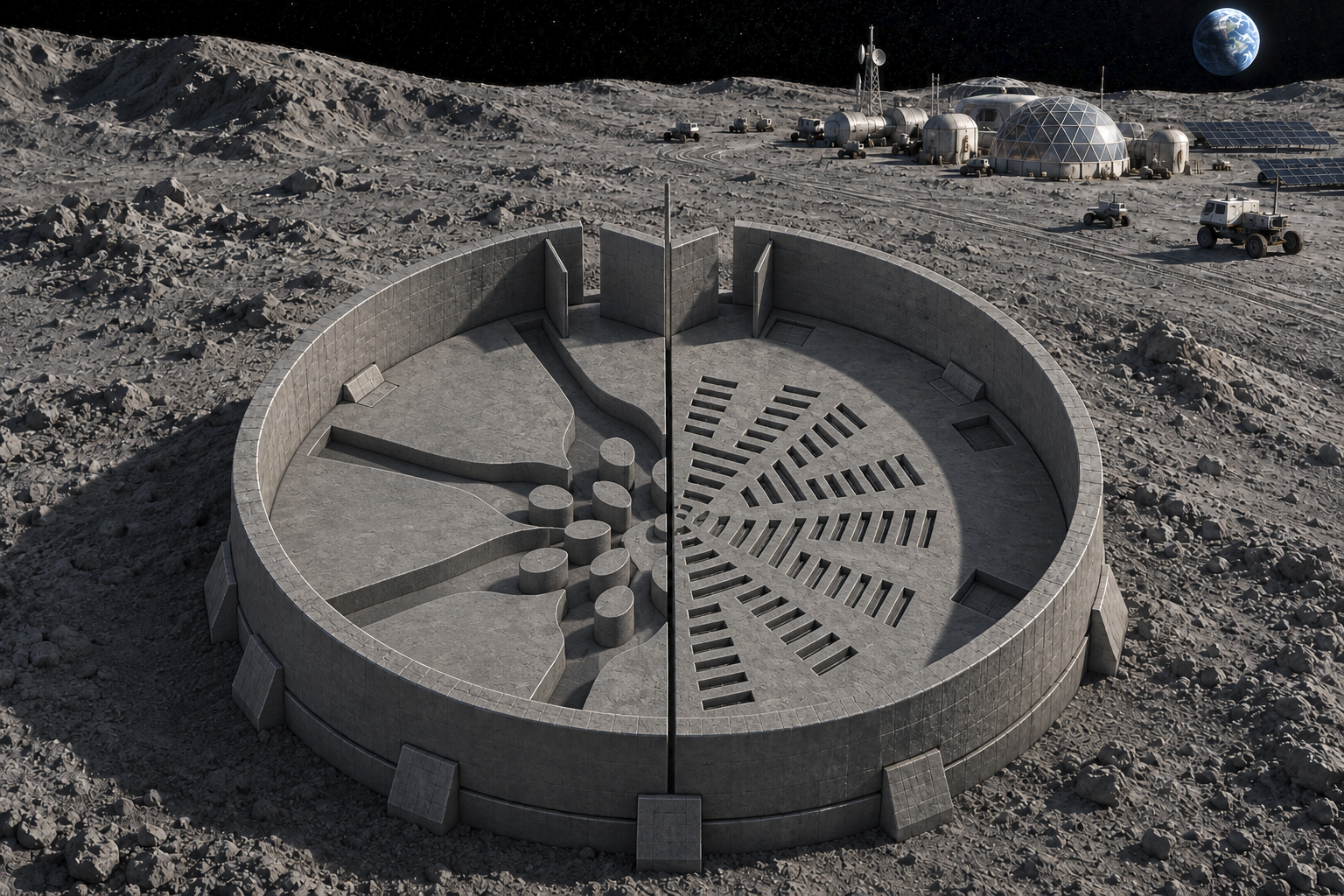
When spacecraft perform vertical landing and takeoff maneuvers from the lunar surface, the results are very messy! Beyond the intense heat produced by the rocket engines, the force also kicks up regolith, the particulate dust that covers most of the lunar surface. With so many crewed and cargo missions planned for the coming years, space agencies are contracting with commercial partners to develop infrastructure that will keep spacecraft, astronauts, and other surface elements safe from all "moondust." This includes landing pads that provide a stable surface and barrier for vertical takeoff and landing (VTOL) vehicles. To help them realize their objectives under the Artemis Program, NASA has enlisted engineers from the University of Alabama in Huntsville (UAH) to create some. Their work is part of a multi-year partnership with Linc Research Inc., a certified engineering company located in Huntsville, Alabama, and supported through NASA's Small Business Technology Transfer (STTR) program. The student research team is led by Dr. Judy Schneider, a professor in UAH's Department of Mechanical and Aerospace Engineering. Their research is focused on developing a design for modular, vented landing pads that will allow for safe transits to and from the lunar surface. This summer, the team successfully conducted three rocket-motor firing tests on a prototype of their landing pad at the university's Propulsion Research Center, demonstrating its ability to capture and redirect rocket exhaust through an integrated vent system. Rocket-motor firing tests on a prototype lunar landing pad at the UAH Propulsion Research Center. Credit: Cadis Ammons On Earth, landing pads consist of a solid structure capable of withstanding the full force and heat of a rocket plume. This can result in significant damage to the pad itself, as demonstrated by the first launch attempt of SpaceX's Starship prototype, including cratering beneath the mounting structure and sending debris flying in all directions. In contrast, the UAH team's design uses interlocking components with channels that help reduce thermal damage and protect the structure as well as the spacecraft. For the tests, the team created individual concrete components and arranged them into a prototype measuring 3.65 m (12 ft) in diameter. The concrete serves as an analog for building materials that could be produced from lunar regolith, either "sintered" to form 3D-printed ceramics or combined with a bonding agent to produce "lunacrete." The components also had integrated sensors to record how the rocket plume's exhaust was channeled through the vent systems during the three firings. The modular design also makes it easier to build on the Moon, where manufacturing centers are likely to be space-constrained. Smaller, individual components also mean future landing pads will be easier to assemble, expand, maintain, and repair over time. Combined with the use of local resources for building materials - aka. In-Situ Resource Utilization (ISRU) - the team's goal could help make large-scale lunar infrastructure more feasible. Earth's fluffy, dense atmosphere also helps prevent rocket exhaust plumes from expanding freely and kicking up dust. Because its only natural satellite is an airless body, dust clouds caused by impacts or rockets can travel all the way to the other side of the Moon. As a result, powerful blasts during takeoff and landing can propel dust at high speeds, potentially damaging nearby habitats, power elements, equipment, and other infrastructure. The dust can also be thrown into orbit, where it could interfere with orbiting satellites, space stations, and incoming spacecraft. This marks a major step in developing landing infrastructure that will enable a lunar base and crewed operations in the near future. As Schneider said in a UHA press release: On Earth, we use water-cooled flame buckets to redirect rocket exhaust. But we won't have those resources on the lunar surface, where water will be in limited supply. Our goal is to redirect the rocket plume so it doesn't damage the landing vehicle or any surrounding structures. The hot-fire tests demonstrated that we could redirect the rocket plume. By using an internally vented structure, we were able to prevent the heat from damaging the pad as it could in a solid structure. With the initial tests complete, the team is now working on a 6 m-diameter (20 ft) landing pad that will be delivered to NASA's Marshall Space Flight Center (also in Huntsville) for additional testing and evaluation. These tests will further assess the design, push its technological readiness, and determine if the vented, modular approach can be scaled and adapted for repeated use. These efforts will bring the technology another step towards realization and deployment on the Moon. Further Reading: University of Alabama Huntsville
Students Test Prototype Landing Pad to Make Lunar Operations Safe
Full Article
Original Source
Read the full article at Universetoday →KhanList aggregates and links to publicly available news content. We do not host full articles from third-party sources. Always verify important information with original sources.