
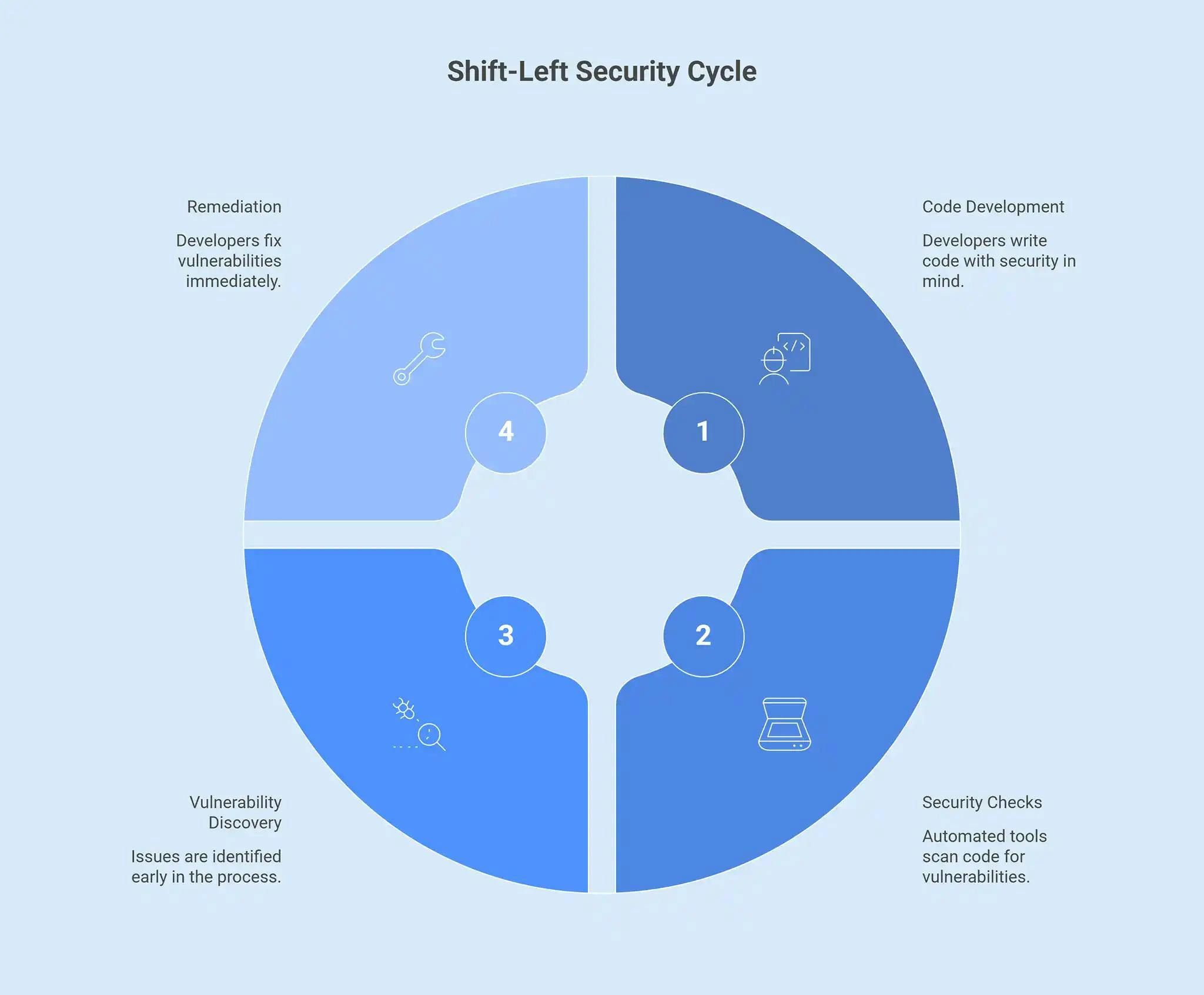
Introduction Most production vulnerabilities are not introduced in production — they are introduced in the Integrated Development Environment (IDE). Yet historically, most security tooling has operated after code is written, after pull requests are merged, or even worse — after deployment. This reactive approach creates costly rework cycles, slows down release velocity, and increases organizational security risk.Modern DevSecOps fundamentally changes this model. Security must exist inside the developer workflow, not outside of it.Over the past decade, the software supply chain threat landscape has evolved dramatically. Organizations today face risk not only from insecure application code, but also from Open-source dependency vulnerabilities, License compliance violations, misconfigured cloud resources, Insecure CI/CD automation pipelines, compromised build artifacts, & Malicious dependency injection attacks.As organizations accelerate toward microservices, cloud-native architectures, and rapid release cycles, traditional security checkpoints are no longer sufficient. Security must become continuous, automated, and developer-centric. There is always a risk when you try to push a bug fix in production overnight, and you overlook security checks in place, which can expose your production system.The most critical data an organization must safeguard is its customers’ information—whether PII or CPNI. Failure to protect this data can expose customers to risk and lead to serious legal, financial, and reputational consequences for the organization.This article describes a pragmatic and scalable approach to secure development using:SonarQube — Real-time SAST and code quality enforcement inside the IDE JFrog Xray — Software supply chain and open-source dependency vulnerability detection GitHub Copilot (and AI coding assistants) — Accelerating secure remediation while maintaining coding standards DevSecOps pipelines — Enforcing security across the entire software delivery lifecycle 1. The Importance of Developer-Friendly Security The majority of vulnerabilities are introduced during coding. Developer-focused security ensures issues are detected at the earliest possible stage — when they are cheapest and fastest to fix. Common vulnerabilities introduced during development include:· SQL Injection · Improper authorization or missing access validation · Hardcoded credentials or secrets · Unsecured crypto algorithms · Outdated or vulnerable libraries When detected early, these issues can be fixed before code review, build, or deployment phases.Modern tools like SonarQube and Xray help developers understand security risks directly within their development workflow, while AI assistants like GitHub Copilot help apply secure coding fixes quickly and consistently.In large enterprise environments — particularly telecom and financial systems — early detection directly helps with lower remediation costs, fewer production incidents, faster release cycles, and higher developer productivity.2. Protecting Your Code via SonarQube (Source-Based SAST) SonarQube is a real-time code quality and security analysis tool that runs inside your IDE (like VS Code, IntelliJ, Eclipse). It helps developers detect bugs, security vulnerabilities, and code smells as they write code—before it even reaches CI/CD. It can help with: · Real-time SAST scanning · Security hotspots detection · Code quality rule enforcement · Secure coding rule suggestions You can use SonarQube for Java, Python, JavaScript, C#, C++, and many other programming languages.Key Practices – 2.1 Implement SAST with SonarQube features: · Real-time linting to show real-time code issues the developer can fix. · Autofix suggestions while the developer is coding. · SonarQube connects to enterprise SonarQube using “Connected Mode.” In this mode, the developer’s IDE pulls the same quality profile, rules, and project settings used by SonarQube. · Mandatory security rule set (OWASP Top 10 + CWE) When developers keep these features enabled, they ensure there are no vulnerable code submissions, that developers adhere to enterprise security guidelines, and that the SAST baseline is unified.2.2 Handling Hot Spots as Security Debt SonarQube shows hazardous code as Security Hotspots, e.g.: Missing or insufficient input validation · Weak cryptography · Potentially unsafe regular expressions · Unsafe file handling Security hotspots should be triaged and resolved before code review, reducing downstream review cycles and preventing security backlog accumulation.The screenshot below shows a catch block issue flagged by SonarQube. In this example, the first catch block handles the parent Exception class, and the second handles a subclass — which can never be reached.Java code in IDE is showing Sonar 2.3 Embed Sonar in CI with SonarQube Combine IDE Scanning with CI Pipelines: - name: Sonar Scan - uses: SonarSource/sonarcloud-github-action@v2 with: projectBaseDir: This mandates: · Quality gates · Zero-critical vulnerability · PR-level SAST scanning Across telecom and financial platforms, internal security analytics often show: 60–70% of vulnerabilities originate during development 20–30% originate from OSS dependency risk Less than 10% originate from runtime misconfiguration This reinforces why shift-left security is essential, not optional.4. Securing Dependencies with JFrog Xray (OSS & Supply Chain Security) Modern applications rely heavily on open-source software. While this accelerates development, it introduces external risk exposure. Xray offers:· Dependency manifest and SBOM generation · License compliance scanning · CVE scanning of dependencies · Real-time notifications about critical vulnerabilities 4.1 Embed Xray Scan into CI/CD GitHub Actions Example: - name: Xray Scan - uses: jfrog - run: jfrog xr scan /path/to/project Above Image shows the Vulnerable jars in Xray plyugin 4.2 Lock Vulnerable Versions Automatically Enabling policy enforcement: · Block builds for critical CVEs · Auto-create JIRA tickets for remediation · Apply auto-suggest patch versions 4.3 Create SBOMs for Compliance In CycloneDX or SPDX format: jfrog sbom generate --format cyclonedx This is important for: · Compliance with Executive Order · Enterprise security audits · Zero trust supply chain methodologies 5. Using GitHub Copilot to Fix SAST Vulnerabilities Efficiently Artificial Intelligence-assisted development: AI-assisted development allows developers to remediate vulnerabilities faster by generating secure code patterns based on context and security rules. 5.1 Use Copilot to Rewrite Insecure Code Example Prompt in VS Code that shows the SQL Injection: Below screenshot: fixing the vulnerability; green-highlighted is the new code which is added by Copilot 5.2 Improve Cryptography Practices Example Prompt: “Instead, replace this outdated MD5 hashing logic with a robust algorithm such as SHA-256 or Argon2.” 5.3 Generate Secure Input Validation Question: “Write Java Spring Boot code for input validation concerning length, type, and sanitized inputs.” 5.4 Auto-fix Code Patterns Identified by SonarQube “When SonarQube points out that a rule has been violated, the message should be copied, and the following question asked” “Rewrite the code in compliance with the SonarQube rule S2068 (Remove hardcoded credentials).” Copilot can also suggest secure configuration patterns beyond code-level fixes. 6. Secure DevSecOps Workflow Step 1: Developer Stage · SonarQube → insecure coding detection in real time · Copilot → provides secure remediation instantly Step 2: Build Stage · SonarQube → SAST + quality · Xray → OSS scanning, dependency scanning Step 3: Deploy Stage · Container scanning · Infrastructure as code checks · Zero-trust validations Step 4: Continuous Feedback Loop · Automatically route SonarQube and Xray findings back to the responsible developer · Leverage developer SDKs to surface security metrics within existing tooling · Enforce release governance policies that block deployments failing security thresholds This helps to ensure that a continuous and closed-loop secure development process is created. 7. Best Practices Checklist Developer · Enable SonarQube connected mode · Fix issues as soon as they arise · Apply Copilot coding patterns safely · Do not hardcode credentials or secrets · All external inputs must be validated Build + CI· Enforce SonarQube · Enforce Xray policy violations · Block releases of code for critical SAST/OSS findings Organization· Shift security left · Train developers to follow secure coding standards (OWASP and CWE) · Maintain an up-to-date SBOM · Drive remediation through standardized secure coding patterns and automated policy enforcement. 8. Secure Developer Workflow The future of secure software development will be shaped by deeper integration within developer tools, AI-assisted coding, and automated security governance. Security signals will be embedded directly into IDEs, giving developers real-time, contextual risk awareness as they write code. There will be an increase in the role of AI in the identification of insecure patterns, remediation, and potential prediction of security issues that will occur, via coding and dependency usage patterns. At the same time, organizations will likely strengthen their models of zero trust for supply chains, which will necessitate verification of software, signed software, and overall validation of compliance.The organizations that will succeed are those that treat security as a developer experience issue, not only as a security team problem. Key Takeaways Secure development is no longer optional — it is foundational to modern software engineering. By combining:· SonarQube (Real-Time SAST) · JFrog Xray (Supply Chain Security) · GitHub Copilot (AI-Driven Secure Remediation) Organizations can:· Detect vulnerabilities earlier · Fix issues faster · Improve security consistency · Reduce production risk · Scale secure development across distributed teams Security must move from pipeline-only enforcement to IDE-first security.AI is not replacing security review — it is accelerating secure development.Open-source supply chain risk is now one of the primary breach vectors. Organizations that embed security directly into developer workflows will achieve both faster delivery velocity and stronger security posture.
Stop Fixing Vulnerabilities in Production — Fix Them Where They're Born
Full Article
Original Source
Read the full article at Hackernoon →KhanList aggregates and links to publicly available news content. We do not host full articles from third-party sources. Always verify important information with original sources.