
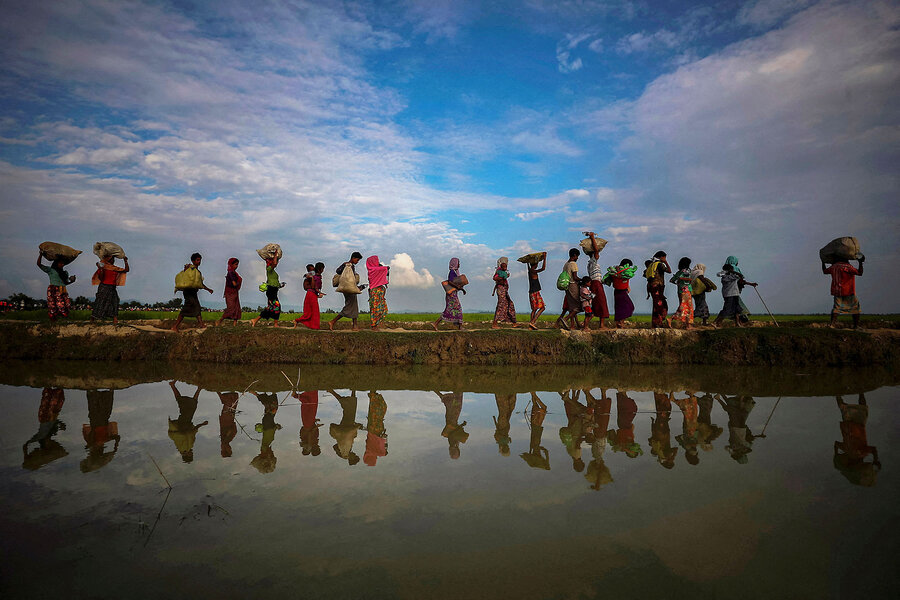
For the first time in its history, the International Court of Justice (ICJ) has found a state guilty of genocide.Judge Yuji Iwasawa, president of the world’s highest court, said Thursday that its judges found “the Republic of the Union of Myanmar has committed genocide against the Rohingya group in northern Rakhine State.” The decision, reached in a 9-6 vote, ends a yearslong international legal battle for the majority-Muslim ethnic group.The court ordered Myanmar to compensate the Rohingya, who have faced decades of discrimination and repression in western Myanmar, including restrictions on citizenship, movement, and access to basic services. The military has also been accused of widespread violence against the community – persecution that escalated during military operations in 2016 and 2017, when villages were burned, civilians killed, and women subjected to sexual violence. Today, about 1.2 million Rohingya live in cramped refugee camps in Bangladesh. Patrick Post/APGambia's Justice Minister and Attorney General Dawda Jallow (center right) and lawyer Arsalan Suleman (center left) speak to the press after the court ruled that Myanmar committed genocide against the Rohingya during 2017 military operations, outside the International Court of Justice at The Hague, Netherlands, Nov. 19, 2026. Proving genocide, as defined by the United Nations after the Nazi Holocaust, requires evidence of specific intent to destroy a national, ethnic, racial, or religious group. Reading the judgment, Judge Iwasawa said the court was “fully convinced” that Myanmar’s government violated the 1948 Genocide Convention “with an intent to destroy a substantial part of the Rohingya population in Myanmar.” Rohingya refugees around the world welcomed the ruling.“This is a historic moment for our Rohingya community,” says Kyaw Min Sabber, director of the advocacy group Rohingya Human Rights Initiative. “We have waited many years for this day, seeking justice, accountability, and recognition of the genocide committed against our people.”The case was brought by Gambia in 2019, marking the first time a country with no direct connection to alleged atrocities filed a genocide case with the court. The resulting judgment establishes an authoritative legal finding of genocide, and formally recognizes the Rohingya as a distinct ethnic group in Myanmar. (The government has previously described them as Bengali migrants.) The court ordered Myanmar to take steps to prevent further violations of the Genocide Convention, investigate and prosecute those responsible, and provide reparations to the Rohingya, including allowing refugees to return home safely and voluntarily. However, the ruling does not automatically bring military leaders to trial or ensure displaced Rohingya can return. The ICJ has no independent enforcement mechanism, and Myanmar’s compliance will depend partly on international pressure and action by the U.N. Security Council. Mohammad Ponir Hossain/ReutersRohingya refugees look through a metal net as they gather to watch the live announcement of a verdict by the International Court of Justice in a case accusing Myanmar of committing genocide against the minority Rohingya population, on a big screen at a refugee camp in Cox's Bazar, Bangladesh, Nov. 19, 2026. Still, the judgment carries considerable diplomatic and symbolic weight. It gives survivors legal recognition of the atrocities they endured, strengthens demands for accountability, and establishes a precedent for how the international community can respond to allegations of genocide moving forward – including how judges assess evidence in South Africa’s genocide case against Israel. Deepen your worldviewwith Monitor Highlights.Politics with respectGet political stories with respectful analysis.There‘s a world of new ideas in everyBooks newsletter.There‘s more to life, enrich yours withCulture & Learning weekly.Follow humanity‘s discoveries withScience & Nature stories in your inbox.Gain a spiritual perspectivefrom the stories in your inbox.Want to understand the deeper impact of critical events? Learn the Monitor‘s insight.Already a subscriber? Log in to hide ads. And it is a rare win for a community that has spent decades fighting to be heard.“Today’s ICJ ruling represents an important step towards establishing accountability and ensuring that those responsible cannot escape justice,” says Kyaw Min Sabber, who fled persecution and now lives in Canada. ALREADY A SUBSCRIBER? LoginReal news can be honest, hopeful, credible, constructive.The Christian Science Monitor was founded in 1908 to lift the standard of journalism and uplift humanity. We aim to “speak the truth in love.” Our goal is not to tell you what to think, but to give you the essential knowledge and understanding to come to your own intelligent conclusions. Join us in this mission by subscribing.
Step toward accountability: Top UN court finds Myanmar guilty of Rohingya genocide
Full Article
Original Source
Read the full article at Csmonitor →KhanList aggregates and links to publicly available news content. We do not host full articles from third-party sources. Always verify important information with original sources.