
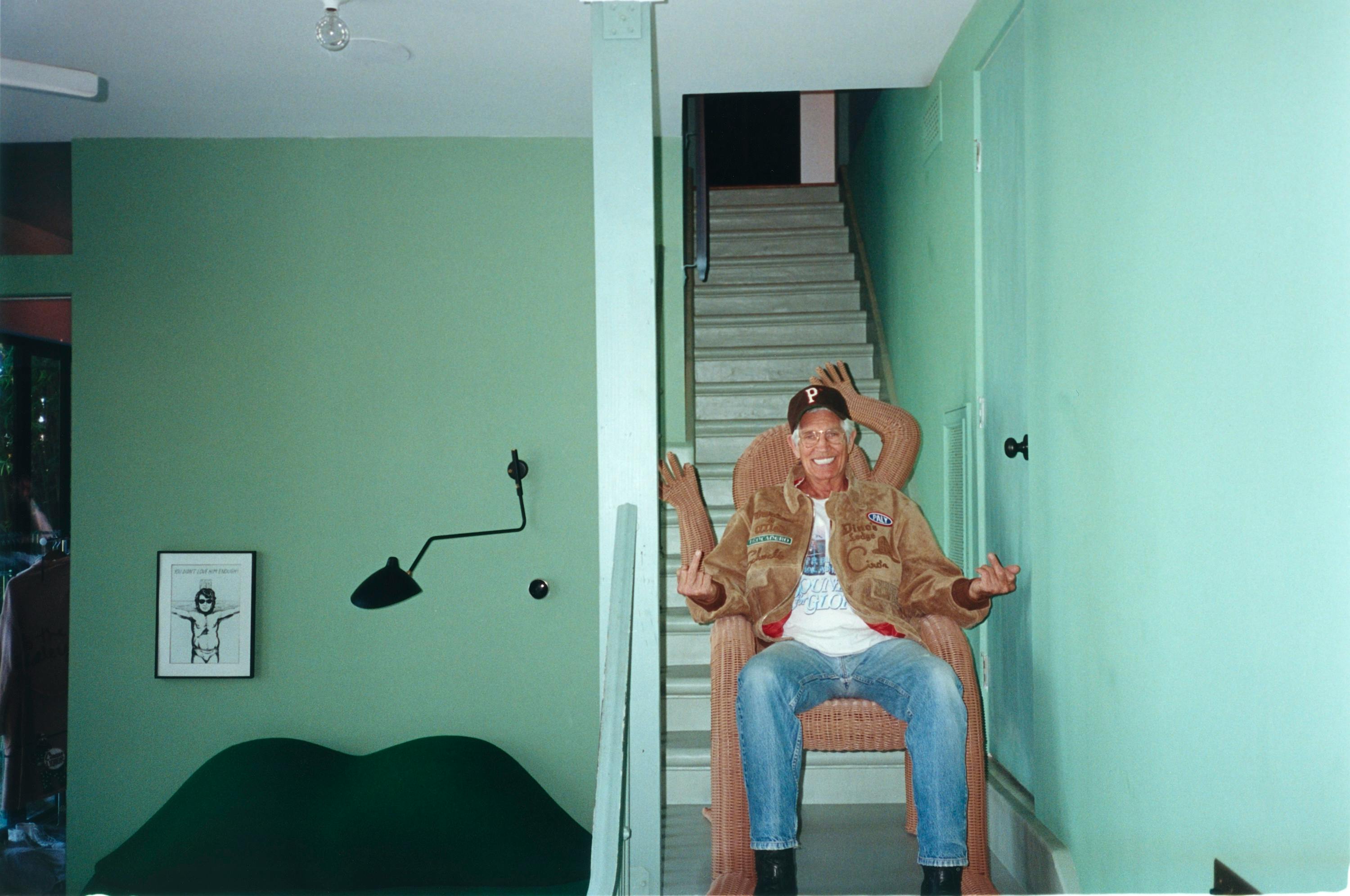
In State of the Art, a column for Highsnobiety, Chris Erik Thomas untangles the crossover between fashion and art.When you create a clothing brand steeped in Hollywood myths and monsters, booking its biggest stars for ad campaigns feels like the logical move. Doubly so if your brand name is literally Paly Hollywood, you count a movie star as a co-founder, and happen to be based in Los Angeles. But PALY, as the brand prefers to be known these days, isn’t much interested in logic or standard-fare stars.Instead, it's built itself up over the past six years as a dreamlike specter, tapping nepo-baby talent from deeply rooted Hollywood families for its lookbooks: people like Landon Barker, Skyla Sanders, and Max Madsen.The casting decision fits PALY’s vibe as a ghost of smoky Viper Room seshes past: a grunge-luxe purveyor of $1,550 ripped jeans and $495 long-sleeve tees with faded, distressed graphics ripped straight from Tinseltown. It’s a winning formula that's attracted an appropriately cult-like following; its releases often sell out in what feels like milliseconds, solidifying the young label as a cultural force on par with Enfants Riches Déprimés.PALY now feels like the sartorial king of LA, a reputation that sticks even when the brand decamps to, say, a spooky animal sanctuary in rural France. In its new Fall/Winter 2026 campaign film, premiering exclusively today on Highsnobiety, PALY has flown the Hollywood coop for a twisty visual tale directed by Pietro Coppolecchia and narrated by Hollywood’s most-credited living actor (and SS26 campaign star), Eric Roberts. Your Highsnobiety privacy settings have blocked this Vimeo video.It's a moody fever dream and a stark vibe shift compared to the brand’s sunny, LA-set ads from just a season ago. “At first watch, the film doesn’t necessarily scream Hollywood,” PALY co-founder Kyle Lindgren tells Highsnobiety. “But [its] influences have shaped the entire process, from production to the film's themes.” With a crew tied to everyone from Luca Guadagnino and Steven Spielberg to Ridley Scott and Luc Besson, the film follows a doomed French couple who find themselves in a surrealist house where humans may or may not be turning into animals. Very “Circe in The Odyssey” coded, sure, but also a perfect metaphor for the transformative power of acting. Compared to the usual crop of fashion campaigns, which tend to involve very famous people wearing clothes from a brand they’d otherwise never be caught dead in, this one actually hits. It’s weird and textured, and it feels more focused on spinning this strange narrative of transformation than on selling clothes (which, ironically, made me want to wear everything this doomed French couple is wearing). Ahead of the film’s release, we emailed Lindgren and called Roberts (and his wife and manager, Eliza) to chat about the making of PALY’s swirling surrealist film.PALY Hollywood, PALY Hollywood, PALY HollywoodKyle, how do you choose who wears PALY, and what does Hollywood lineage bring to a brand built on Hollywood's stories?Kyle Lindgren: We're fascinated with exploring the underbelly of Hollywood through a contemporary lens, and that extends into our creative. So many designers tap the trendiest talent possible. We take a different approach. We’re thinking about what this person represents. Everyone we’ve worked with brings an insanely nuanced relationship to Hollywood and the entertainment industry. These people carry weight, legacy, and history that matter more to us than the newest Netflix star — they represent the lifecycle of the Hollywood dream.And Eric, how did you first get involved with PALY?Eric Roberts: Through my wife. She’s my manager, so she arranges everything. She just told me one day, "You're going to do PALY,” and I said, "Cool, I love PALY,” and she said “Everybody does. Go have fun." I don't know anything about fashion; besides Levi Strauss, I know nothing. My wife educated me on [PALY] and said that it was “the fashion.” So I said, “Okay, here I am.” As an old guy, I can say we're always left out. It's really cool that I, Eric Badass Roberts, show up in a fashion [campaign], saying, "Check it out, guys! This is how to look.”Eliza Roberts: They came to us, which is a trip. All the younger people on the team and our kids were super excited. It was [PALY’s] vision to work with Eric. It was cute because our agents usually say, "Here, you have a job," and this time they're putting exclamation marks and stars and stuff. They were so excited.PALY Hollywood, PALY HollywoodHow was the experience working on the film?Eric: It was a lot of fun. But it was weird because I was watching it again, and my accent was kind of Philadelphia. Why did I do that? I don’t remember if they told me to do that. Did you improvise any lines, or was it all scripted?Eric: I improvised some. They told me to get rougher at one point. I love the last line, “dazzit.” Very slick.Eric: I was very proud of how I did it. I like that.Was that scripted or improvised?Eric: That was me.Putting on clothes can be like playing a role. How does doing a fashion project compare to doing a part in a film?Eric: A lot of people [on sets] ask you to bring your own clothes. I really resent that, because when I get dressed, I'm dressing in character. It's very important to me that my clothes aren't my clothes; they're the character's clothes. Fashion informs my characters. It’s my final little brushstroke of saying, "OK, I am this guy now."PALY Hollywood, PALY Hollywood, PALY HollywoodAs someone who comes from this world, how does it feel to see a brand turn Hollywood lore into clothing?Eric: Just the word "Hollywood" has weight to it. Hollywood means so much to so many. It means good things. It means bad things. It means misses. It means catches. It means a lot of stuff. But it's America. The film is about transformation. How does that theme relate to your own life and work? Eric: To actually, physically change your form and shape is something I have never accomplished. But to become other things is my hobby. So I understand it, and I know how to do it. I've played a lot of unlikable people, but unlikable people don't know they're unlikable. They don't know what's happening around them, and that is the magic of finding a personality: [their] not knowing what they are. [It's] a great thing to grasp and to understand, and it also gives you empathy for other people in your daily life, because you realize we're not all perfect. In fact, we're so imperfect it's embarrassing. We pretend it's not true, but it is.Kyle, what does the fable at the heart of FW26 have to do with Hollywood? Kyle: We are purposely not watching these people’s story firsthand. We are watching a retelling. An embellishment. This is very much how Hollywood has always created its own lore. Stories evolve over time, and legacies are created. Spoiler alert: as the story is retold, the film's main character transforms into an entirely different creature, mirroring how the public turns real people into celebrities, then into characters of themselves, until that person's perception becomes its own reality. We hope the film gets people thinking. And if not, hopefully they like the clothes.Highsnobiety has affiliate marketing partnerships, which means we may receive a commission from your purchase. Want to shop the products our editors actually love? Visit our SHOPPER page and subscribe to the newsletter for recs on all things fashion, footwear, and beauty.
State of the Art: This Hollywood “Badass” Added PALY to His 700-Film Repertoire
Full Article
Original Source
Read the full article at Highsnobiety →KhanList aggregates and links to publicly available news content. We do not host full articles from third-party sources. Always verify important information with original sources.