
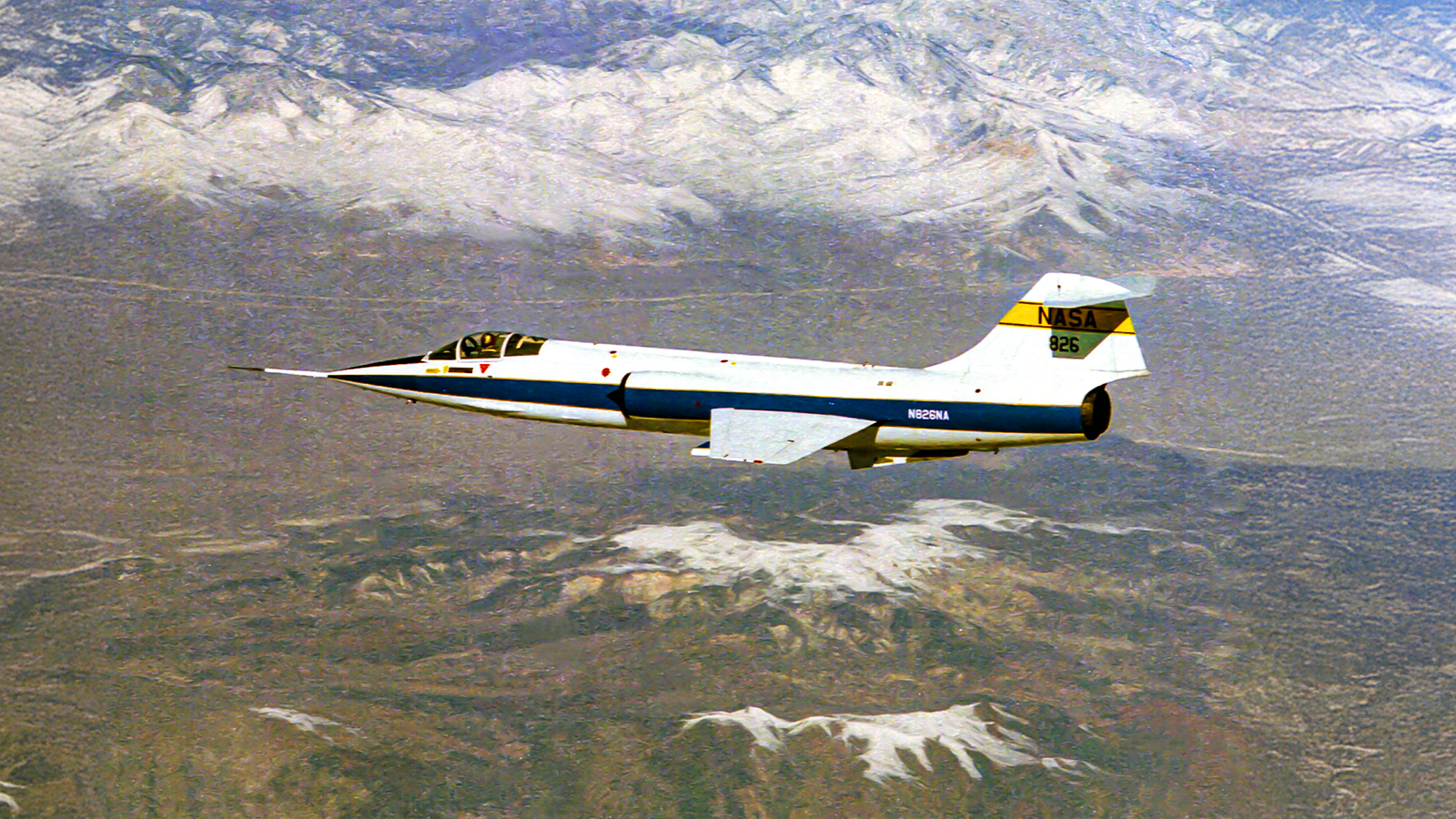
Published Oct 23, 2026, 7:00 PM EDT Luke Diaz is a freelance military writer with experience with active duty experience in the US Navy as well as defense and industrial engineering. He is a former Naval Flight Officer who performed tactical air control on the carrier-based E-2 Hawkeye. Starfighters Space is the proud owner of the world’s only civilian fleet of flight-ready Lockheed F-104 Starfighters. This unique flightline also happens to be based in a hangar right beside the old Space Shuttle runway at Kennedy Space Center. Originally founded by pilot Rick Svetkoff in 1995, the company has spent over two decades keeping these legendary Cold War interceptors in active service. Svetkoff's original intent was to preserve and showcase the F-104 for a three-aircraft precision demonstration team on the civilian air show circuit. Transitioning out of entertainment, the F-104s began flying government and private aerospace defense contracts. Since 2011, the fleet has acted as high-speed photo chase planes, training targets for military exercises, and real-world technology testbeds. Surrounded by the burgeoning commercial space race at Cape Canaveral, Svetkoff saw that the F-104’s rapid rocket-like climb made it a virtual first-stage booster. This shift in business model led to an IPO that garnered $40 million but also led to Svetkoff's split from the company. To this day, the first actual powered air launch remains to be scheduled, but this December will mark a major milestone toward its first suborbital launch. In partnership with Vaya Space, the group will conduct a captive carry flight this winter with the aim of completing a suborbital rocket launch in 2027. A Private Tenant On The Shuttle Runway Credit: Starfighters Space Rick Svetkoff founded Starfighters in 1996 and first flew airshows in former Royal Canadian Air Force CF-104s. He learned to fly after joining the US Navy in 1978. There, he flew A-4 Skyhawk attack jets before leaving in 1984 for an airline career. The big move to Kennedy took place in 2007 and Starfighters Space would make its first flight from the Shuttle Landing Facility that same year, according to SpaceRef. NASA signed a Space Act Agreement with the company after inviting Svetkoff's team to KSC and contracted the F-104s to fly simulated suborbital profiles from the runway to help measure sonic boom effects for future commercial launches. NASA described the flights as a pathfinder for routine use of the site for future projects in development. Today, KSC features one of the longest in the world, which has made it an excellent primary base while Starfighters Space opened a second base at Midland International Air & Space Port in Texas. The runway at KSC matters for more than convenience, because it gives the supersonic F-104s extra tarmac for heavy, unusual loads that can often force long take-off and landing rolls. How Five Italian Jets Became A Test Fleet Credit: Starfighters Space The fleet took its present shape a few years after the move to KSC, in 2011, when five F-104s bought from the Italian Air Force arrived, as Universe Today reported. While the company's ultimate goal remains launching satellites into orbit via the Starlaunch program, the revenue-generating operations have thus far focused on high-speed research missions for defense contractors as well as NASA. The company has since engineered the 'Wind Tunnel in the Sky' platform, which is a specialized, modular underwing pylon system designed to host external customer sensors, experimental materials, and advanced electronics. An F-104 mission can provide up to ten minutes of continuous Mach 2+ exposure during a single flight. This allows clients like the US Air Force Research Laboratory and Lockheed Martin to gather very valuable streams of flight testing data outside of a sterile lab in real-world conditions. In 2025, a Starfighters Space F-104 carried GE Aerospace’s ATLAS test vehicle on three supersonic flights from KSC. The Atmospheric Test of Launched Air-breathing System (ATLAS) program used one of the team's F-104 Starfighters for a three-phase captive-carry flight series. The mission successfully flew an advanced propulsion test vehicle at supersonic speeds that validated performance for next-generation solid-fuel ramjet technology destined for future hypersonic defense programs. The TWR of the F-104 empowers it to climb and accelerate at angles that closely mirror the ascent stages of a spacecraft. The company also offers its two-seat trainer variants to prepare pilots and astronauts for the intense physical demands of rocket travel. The flights can even help validate human-machine interface devices used in the cockpit or evaluate crew physiological limits under hyper-gravity (high-G) maneuvers. Today, Starfighters Space is still branching out to new missions. Adding Capabilities To The Starfighters Portfolio Credit: Starfighters Space Beyond high-speed testing, Starfighters Space has also expanded its flight testing abilities to target microgravity research. Its F-104s achieve 60 to 90 seconds of sustained microgravity per run through steep climbs that climax in parabolic arcs that mimic spaceflight profiles. The jet's thrust-to-weight ratio allows pilots to pull the jet into extreme, steep climbs before pushing the nose over into a kind of controlled free-fall. These flights are highly valued for testing ruggedized, space-bound technology like sensors and rocket components. These missions also inspired the company to sign a major strategic partnership with Mu-G Technologies, which flies a specially modified Dassault Falcon 50 aircraft at Midland International Air & Space Port. Starfighters provide the ground support, FAA certification, and pilots for these test flights while Mu-G manages the payload monitoring software. Another core function that the fleet of Starfighters serves is to provide aggressor and target aircraft for military exercises in the Gulf region, where numerous US Air Force, Navy, and Marine Corps squadrons operate frequently. The F-104 Starfighter possesses a tiny frontal radar cross-section and can sustain speeds above Mach 2, allowing it to replicate the flight profiles of modern supersonic cruise missiles or high-performance foreign fighter jets. Starfighters Space flies its jets against US military units to test radar equipment, air defense interception speeds, and tracking integration across the Joint Force. These drills give radar operators unscripted, real-world experience tracking a supersonic target. Few civilian companies can replicate such specialized military and tactical support roles. From Wind Tunnel Models To A Landmark Test Flight Credit: Starfighters Space Even with work that Starfighters Space does with NASA and defense contractors, companies are still ultimately focused on achieving suborbital launch of spacecraft as its primary mission. The company has already tested its Starlaunch 1 configuration in a wind tunnel run by the joint engineering college of Florida A&M and Florida State universities. This validated how a rocket separates from the jet at speeds between Mach 0.85 and Mach 1.3 and showed clean separation across all tested conditions. A critical design review is a formal checkpoint that confirms a design is mature before builders begin fabrication and integration. In February, Tim Franta, then director and vice president of development, described the program as “a series of practical, documented steps to space.” In September, Starfighters Space partnered with Vaya Defense & Space to begin integration of the Vortex-Hybrid rocket engine technology that will power the Starlaunch 1 suborbital vehicle. The Vaya partnership significantly accelerates the technical path toward powered air-launch operations by utilizing a propulsion system that is throttleable, restartable, and entirely non-explosive. Vaya's hybrid rocket engine is unique because it uses a solid 3D-printed plastic fuel mixed with a liquid oxidizer. This makes it very stable and safe to carry bolted to the wing of a crewed F-104 jet. Starfighters are also helping Vaya by using their jets as high-speed testbeds to fly experimental hardware through the air, gathering real-world aerodynamic data. In October, the company announced it will conduct a December test flight and carry an inert rocket under one wing from Kennedy to the Cecil Spaceport in Jacksonville in Florida. A drop test over the Atlantic Ocean would follow on next with a demonstration of the integrated propulsion system planned as the third test round. As a part of this partnership, the two companies are ultimately working toward a powered demonstration launch of the integrated propulsion system. The goal of the first suborbital demonstration was to reach the edge of space by climbing past the Karman line at an altitude of approximately 100 kilometers. Once the jet with its payload can achieve this goal, it will have effectively proved that the system can reliably carry a small research payload or microsatellite to the uppermost limit of the atmosphere. What To Watch Before The Rocket Flies Credit: Starfighters Space If Starlaunch 1 is successful, Starfighters Space wants to use the lessons learned to begin working on a more advanced Starlaunch 2 in a continuation of its collaborative research and development agreement with Vaya Space. One of the obstacles that could derail the schedule has nothing to do with technology but is actually a $26 million lawsuit that is ongoing between CEO Timothy Franta and former founder Rick Svetkoff. Starlaunch 2 is slated to be the company's ultimate vehicle designed for full orbital satellite delivery. The suborbital test flights will provide critical data on atmospheric separation mechanics, aerodynamic drag at high speeds, and the performance of the Vaya Space hybrid motor. Starlaunch 2 will likely expand on the initial architecture by utilizing a multi-stage configuration. Such a system could consist of a hybrid first stage that pushes the payload out of the dense atmosphere with an upper stage that ignites in the vacuum of space to achieve the velocity required for permanent low Earth orbit insertion. Yet, all of this technical progress faces severe risks from the intense corporate governance battle playing out in court. The company's stock price has taken a massive beating since its initial public offering, and sweeping lawsuits are incredibly expensive. If the court sides heavily with the founder, it could disrupt ownership of the underlying intellectual property or even threaten the physical fleet of F-104 jets that serve as the literal wings of the entire launch program. Still, the new management team is actively pushing ahead to prove operations remain unhindered, but resolving the boardroom fallout is just as critical to reaching orbit as the rocket propulsion itself.
Starfighters Space: Inside The Company Flying F-104s From Kennedy Space Center
Full Article
Original Source
Read the full article at Simpleflying →KhanList aggregates and links to publicly available news content. We do not host full articles from third-party sources. Always verify important information with original sources.