
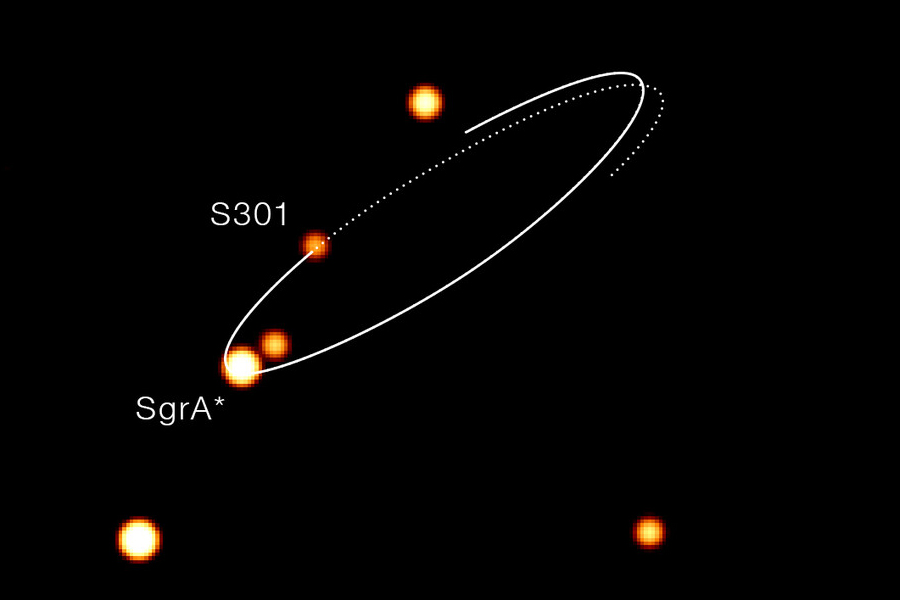
Astronomers have discovered a star that comes so close to our galaxy’s central black hole that it feels the effects of the black hole’s spin. By watching the star whiz around the black hole over the next decade, researchers might be able to measure that spin for the first time. Black holes are cosmic wells, defined by two quantities: mass and spin. Mass determines the size of the well and the steepness of its sides. Spin turns the well into a whirlpool. When a star zooms close by a supermassive black hole, it dips into the gravitational well the black hole makes in the fabric of spacetime. Moving through the warped spacetime shifts the star’s path slightly, changing its incoming angle by a tiny amount. This change moves the location of the star’s closest approach, or pericenter. Over time, these changes shift the orbit, making it draw a rosette around the black hole instead of a single, closed ellipse. Artist's concept of the rosette drawn by a star orbiting the supermassive black hole at the center of the Milky Way. The illustration exaggerates the effect for clarity: the actual shift between the star's farthest points (the tips of the rosette) would be less than a milliarcsecond, or less than 10 millionth of a degree. ESO / L. Calçada But with a spinning black hole, there’s an extra nudge to this pericenter shift. The black hole drags spacetime around with it as it spins. As the star enters this warped, dragged-around region, it’s dragged, too, like a buoy caught in a current. As a result, the pericenter of its orbit moves a little bit more than it would otherwise. At least in theory. Astronomers have previously detected the dipped-into-the-well precession in the orbit of S2, one of a few hundred stars found around the Milky Way’s supermassive black hole by dueling teams led out of Germany and the U.S. The teams have used several dozen of the stars’ orbits to measure the mass of the black hole, called Sagittarius A* (pronounced A-star). S2 has thus far been the researchers’ wonder child, zooming around Sgr A* on a highly elongated path that has enabled them to test Einstein’s theory of gravity in multiple ways. But S2 doesn’t come close enough to be sensitive to the black hole’s spin. So the German-led team went on the hunt. Using the upgraded Gravity+ instrument on the Very Large Telescope Interferometer in Chile, they scoured the galactic center for a star closer to the leviathan. And they found it. The star S301 comes 10 times closer to Sgr A* than S2 does, its pericenter lying a mere 12 astronomical units away from the black hole. That’s slightly larger than Saturn’s distance from the Sun. At pericenter, the star barrels through space at 25,000 km/s (56 million mph), or about 8% the speed of light. It takes only 8.7 years to orbit the black hole. If Sgr A* is spinning, then the close encounter will take S301 through the warped whirlpool region, nudging the star’s orbit slightly. And like a buoy in flowing water, the star will veer ever so slightly from its trajectory. The effect may be one-tenth that of the larger precession effect (which the team already sees by following the star in images taken over eight years). This image shows the path of the S301 star around Sagittarius A*, the supermassive black hole at the centre of our galaxy. The diamonds show measurements performed with the GRAVITY instrument at ESO’s Very Large Telescope Interferometer (VLTI). The size of Neptune’s orbit is shown as a reference. S301 orbits Sagittarius A* every 8 years. As it does so, its orbit rotates forming a rosette. This effect, known as Schwarzschild precession, had already been measured around Sagittarius A*, and it happens regardless of whether the black hole rotates or not. However, if the black hole rotates there’s a different effect at play. As the black hole spins it drags and twists space-time around it, a phenomenon known as Lense-Thirring effect. The S301 star ventures so close to the black hole that it could be affected by this phenomenon. The twisted space-time around the black hole would slightly change the orbit of S301 at each close passage. After several years, the difference between the predicted orbits for a non-rotating black hole and a rotating one would be small, about the size of Earth’s orbit around the Sun, but large enough that it could be measured with the VLTI and ESO’s Extremely Large Telescope (ELT), currently under construction. The star’s last pericenter pass was 2023; its next should be in late 2031, after the long-anticipated 39-meter Extremely Large Telescope (ELT) comes online. By combining ELT observations with those from the Gravity+ instrument, the collaboration hopes to be able to measure Sgr A*’s spin within the next decade, they report August 19th in Nature. S301 should be sensitive to a range of values for both the magnitude of the black hole’s spin and the orientation of its spin axis, says team member Stefan Gillessen (Max Planck Institute for Extraterrestrial Physics, Germany). But he acknowledges that the measurement will take longer if the spin is slower; in that case, they will have to watch multiple pericenter passes before seeing the gravitational nudge. Nevertheless, “I’m pretty sure we’ll talk about an actual spin measurement before we both retire,” he says. Astronomers don’t know anything definitive about Sgr A*’s orientation or spin right now. We know the orientation of the gas disk it wears like a tutu: nearly face-on from our point of view. But that gas likely inherited its angular momentum from wherever it came from, Gillessen explains, instead of being yanked into its current configuration by the black hole’s spin. Measuring Sgr A*’s spin could tell us about the black hole’s past. Major gas-guzzling events can spin up a black hole, for example. The spin will also shed light on jet formation. Astronomers think that black holes power their light-saber-like jets with their spins. Thus far, they’ve found no clear signs of a jet from Sgr A* — certainly nothing like the 5,000-light-year-long structure shooting from the black hole at the center of the galaxy M87. “It would be interesting to see whether the two black holes have substantially different spins,” says black hole researcher Dimitrios Psaltis (Georgia Institute of Technology), who was not involved with the Gravity+ work. “If, on the other hand, Sgr A* is spinning rapidly but doesn’t have a jet, then jet formation may not be related to spin after all.” If successful, the spin measurement could provide useful input for the analysis of data from the Event Horizon Telescope, the world-spanning array of radio telescopes that has given us our first look at black hole’s silhouettes with its observations of Sgr A* and M87*. The EHT cannot measure black holes’ spins, since the spin’s effect on the shadow image is too marginal to show up, Psaltis explains. But EHT astronomers are working on the Black Hole Explorer (BHEX), a mission concept that would launch a satellite into Earth orbit in 2031. Combining BHEX’s data with observations from ground-based EHT stations would enable scientists to measure the black hole’s photon ring, the path light takes just outside the event horizon. The ring’s geometry depends on the black hole’s spin. BHEX could measure Sgr A*’s spin more precisely than astronomers could by watching S301. Reference: K. Abd El Dayem et al. “Discovery of a Star Sensitive to the Spin of Sagittarius A*.” Nature. August 19, 2026.
Star Feels Spin of Milky Way’s Black Hole
Full Article
Original Source
Read the full article at Skyandtelescope →KhanList aggregates and links to publicly available news content. We do not host full articles from third-party sources. Always verify important information with original sources.