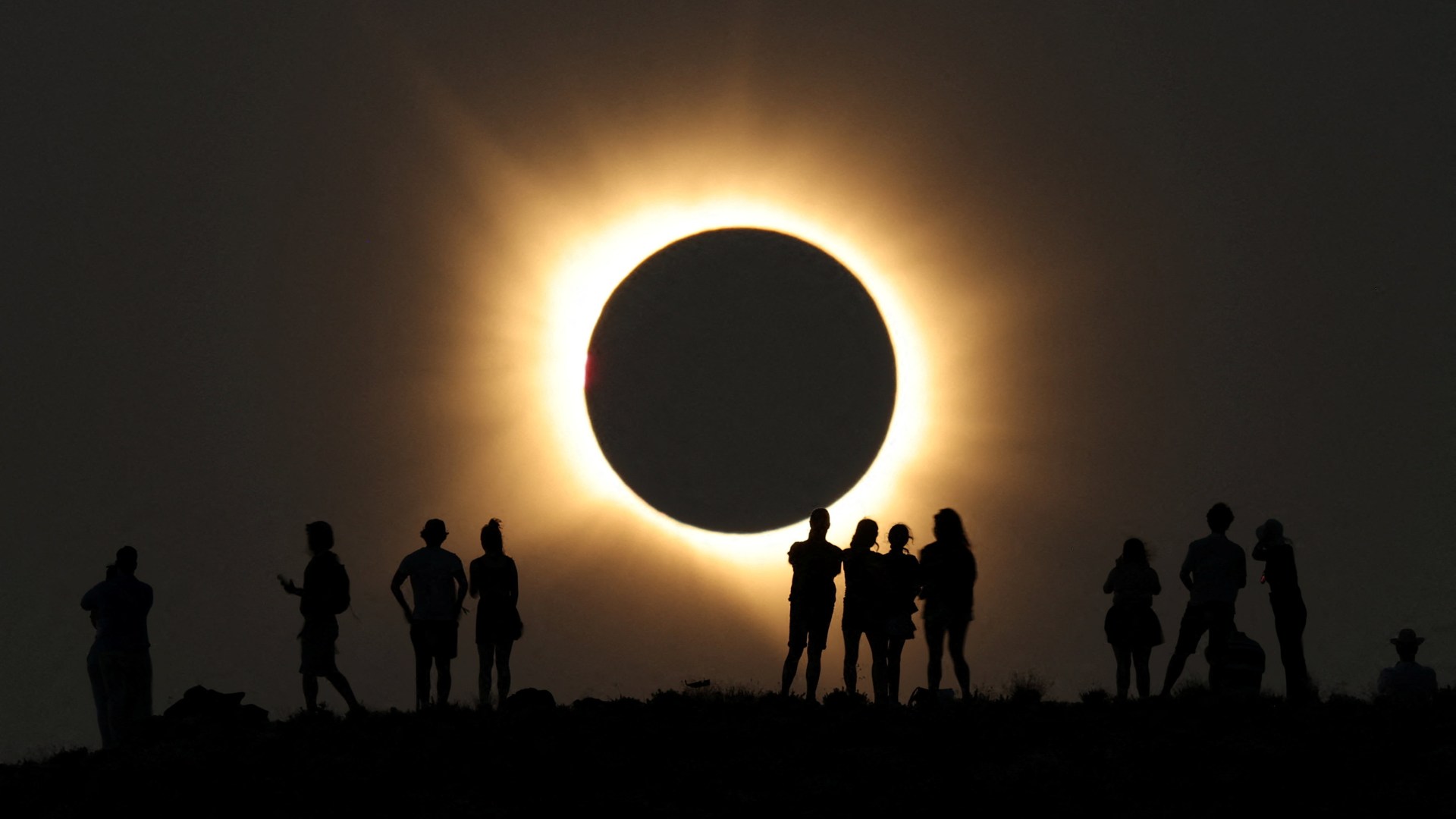
MILLIONS of amateur stargazers stopped in their tracks to witness a once-in-a- generation eclipse of the sun. Minute by minute the moon edged in front of our star, first creating a crescent then blocking it to 90 per cent for most of the UK. People gaze up at the eclipse seen over Glastonbury in Somerset Credit: Alamy The front page of Thursday’s Sun newspaper Brits partied like it was 1999, the last time the phenomenon was seen. The next time it will be obscured so much will be 2081. Sign up for the Tech newsletter Thank you! The Scilly Isles and Cornwall got the biggest eclipse at 96 per cent. Those in the East got 90 per cent of the sun shaded. Countryside residents got the most dramatic effect thanks to minimal light pollution. Parts of northern England missed out because of cloud cover. Millions witnessed a once-in-a-generation eclipse of the sun Credit: Alamy The moon completely masks the sun at Teruel in eastern Spain Credit: Reuters Brits heeded advice to avoid staring directly at the spectacle. Thousands queued at shops in a last-minute bid to get sun-safe goggles. Most read in Tech Others armed themselves with colanders, cardboard contraptions and even welding masks. In cities, crowds took to parks and rooftops as the eclipse brought traffic to a stop while birds ceased singing. Witnesses who joined the Bristol Astronomical Society on the Avon Gorge described an eerie feeling as the temperature cooled and the sky went dark. Expert Dhara Patel, at the National Space Centre in Leicester, said: “For a lot of people, it can be a little bit of an emotional event. “I’ve seen people being drawn to tears or just have a really good moment within themselves when they realise they’re witnessing something you’ve never seen before in your life.” Scotland was first to experience the stellar event from around 6pm when the fringes of the sun began to be covered. The eclipse reached peak darkness around 7.15pm before the full orb of the sun returned after 8pm. Thousands headed to northern Spain, Iceland and Greenland to see a full eclipse. How the eclipse looked as the moon passed in front of the sun Londoners gather at Greenwich Park to witness the rare spectacle Credit: Story Picture Agency Back in the UK, sun-loving Brits held “eclipse parties” and raised toasts at pubs and bars. On Crosby beach in Merseyside a DJ played Here Comes The Sun by The Beatles. Ms Patel added: “We’ve had solar eclipses over the last couple of years, about 30 per cent coverage. “They’ve been good, but this is definitely a different scale. London’s Greenwich Park was full of people gazing up into the sky Credit: Getty Eclipse watchers wait for the magical moment on a hilltop in Somerset Credit: Alamy “And what is really nice is it’s a way for lots of people to come together and connect with nature — looking up at objects we tend to take for granted.” She was among 400 people who counted down from ten and cheered as the eclipse reached its maximum coverage. Benjamin Firmager-Lee, 12, who hopes to work for Nasa, said: “It’s like a once-in-a-lifetime thing to see, so it was quite exciting to see how it changed over time.” Abdul Othman, 28, added: “To see the moon cross the sky and turn the sun into a little crescent, it’s surreal. This pair watched using solar eclipse viewing glasses on the beach Credit: AFP A woman adjusts her eclipse goggles to take in the once-in-a-generation occurrence Credit: Shutterstock Editorial “I can understand why people make so many sacrifices just to see it once in a lifetime.” Anyone worried that they may have hurt their eyes has been told to seek urgent medical attention. Symptoms of retina damage include redness, grittiness or irritation, blurred vision, distorted vision and dark spots. Last night’s event coincided with the annual Perseid meteor shower of up to 100 shooting stars an hour. The next date of a solar eclipse will be November 14, 2050, when 80 per cent of the sun will be obscured in most of England. GASPS... THEN AWE By Tony Lee Moral, a Brit who saw the full eclipse off Iceland THERE are some experiences that even being a wildlife photographer can’t prepare you for. Watching a total solar eclipse from a cruise ship in the North Atlantic off Iceland is one of them. We spent the day chasing the sun through patches of cloud. There was tremendous excitement as everyone gathered on the decks in every available space. Many had travelled thousands of miles for the occasion. We spoke different languages but were united in our shared experience. I put on my solar eclipse glasses and waited. As the moon gradually moved across the sun from right to left, the light began to change, and the crescent sun turned from yellow to a burnt orange. I could feel the wind chill. Then came totality. A gasp went around the crowd and for two minutes we were plunged into darkness. Light flickered around the distant clouds. The sun had disappeared behind the moon and its corona emerged around the black disc. I was able to take off my solar glasses during totality and gaze in awe at a sight I’d never seen before. Then the eclipse was over. The light returned. We had seen the sun disappear in the middle of the day and I don’t think I will ever forget it. TONY Lee Moral is a filmmaker and the author of forthcoming biography David Attenborough: Our Planet, His Voice. Comment now
Spellbound stargazers stopped in their tracks after witnessing historic solar eclipse which won’t return until 2081
Full Article
Original Source
Read the full article at Thesun →KhanList aggregates and links to publicly available news content. We do not host full articles from third-party sources. Always verify important information with original sources.