
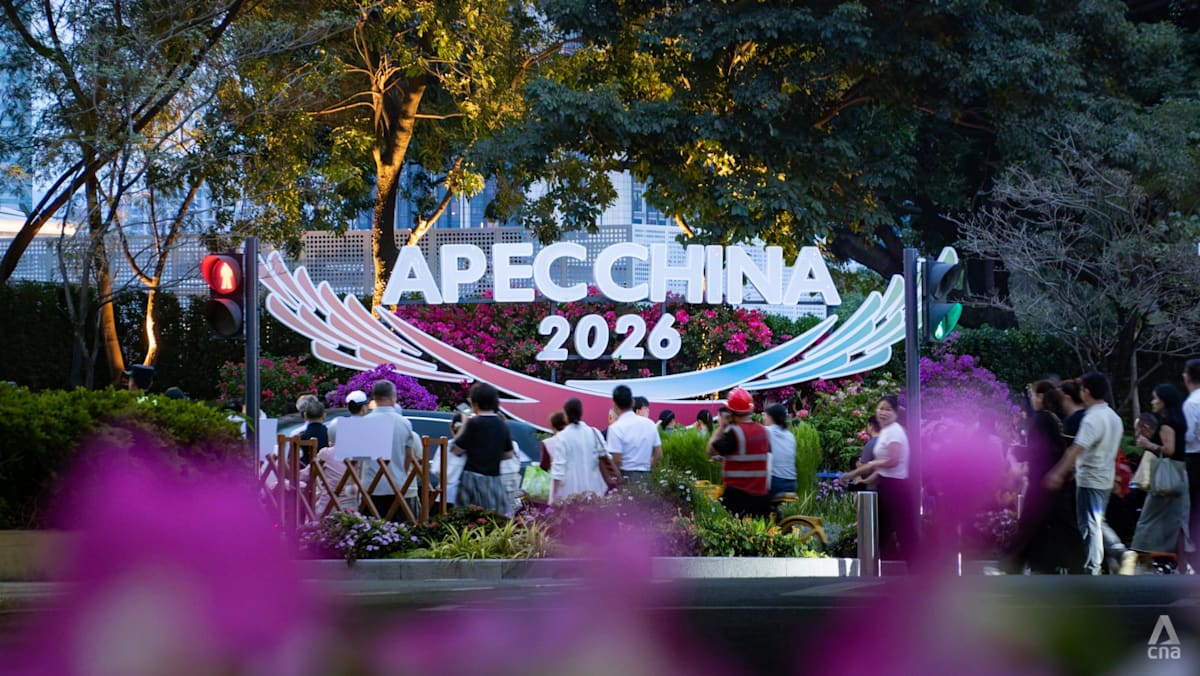
SHENZHEN: An international free trade forum in an age of tariffs - and the prospect of an unprecedented meeting between three of the world’s most powerful leaders.Leaders of the 21 Asia-Pacific Economic Cooperation (APEC) economies gather in Shenzhen this week, with eyes peeled for the first three-way talks between United States President Donald Trump, Chinese President Xi Jinping and Russian President Vladimir Putin on Thursday (Nov 19).Trump is also due to meet Xi separately, the White House has said, in what will be their third meeting this year as the world’s two largest economies continue to grapple with trade and technology disputes.For host China, the summit is an opportunity to champion its vision of an open, integrated Asia-Pacific. But amid the flurry of high-stakes diplomacy on the sidelines, questions remain over what APEC itself can deliver - and whether a forum built to promote free trade can retain its relevance in an increasingly fractured global economy.ONE SUMMIT, COMPETING PRIORITIESAPEC was set up in 1989 to promote trade and investment across the Pacific.Member economies include the US, China and Russia, alongside Japan, South Korea, Australia and several Southeast Asian states such as Singapore and Indonesia.Taken together, they account for about 60 per cent of global gross domestic product and nearly half of world trade, according to the APEC Secretariat.Decisions are made by consensus and commitments are voluntary.China is hosting for the first time in 12 years, with the Economic Leaders’ Meeting taking place on Wednesday (Nov 18) and Thursday. APEC 2026 banner spotted in Shenzhen Bao'an International Airport on Nov 15, 2026. (Photo: CNA/Tan Wen Lin) Beijing wants the summit to affirm its commitment to open trade, analysts said.It has set “Building an Asia-Pacific Community to Prosper Together” as this year’s theme, with openness, innovation and cooperation as priorities.Chinese officials have said they want leaders to adopt a Shenzhen declaration, along with a document on the Free Trade Area of the Asia-Pacific (FTAAP) and a roadmap on artificial intelligence and the digital economy.The FTAAP, a proposed free trade zone spanning all 21 APEC economies, was first endorsed by the bloc’s leaders in 2006 but has yet to materialise.“This year marks the 20th anniversary (of the FTAAP). I think the Chinese side will push for a roadmap,” Xu Qinduo, a senior fellow at Pangoal Institution, a Beijing-based think-tank, told CNA.“China wants to reaffirm that it is committed to an open Asia-Pacific region,” he added. Chinese commerce ministry officials said at a briefing on Monday that nearly 50 economic and trade outcomes - such as roadmaps and pilot projects - had already been achieved during China's year as APEC host, with about half focused on digital trade and AI. China International Trade Representative and Vice Minister of Commerce Li Chenggang (middle) and Director-General of the Department of International Trade and Economic Affairs at the Ministry of Commerce Chen Chao (right) at a press conference during the 2026 APEC Economic Leaders’ Week in Shenzhen, China, on Nov 16, 2026. (Photo: CNA/Tan Wen Lin) Asked by CNA where members had found consensus, Chen Chao, director-general of the ministry's Department of International Trade and Economic Affairs, pointed to a framework on trade digitalisation that China is developing with other members."The aim is to agree on guidelines for digital trade cooperation that suit the realities of the Asia-Pacific and can actually be put into practice," he said, describing the framework as a major deliverable for the leaders' meeting.But any declaration needs agreement from all members, and that might be a formidable task amid growing trade tensions and diverging approaches to economic integration.The top US official for APEC said in May that the FTAAP is “more an agenda than it is a kind of destination”.Last year’s leaders’ declaration, adopted in South Korea, dropped longstanding references to the World Trade Organization and the multilateral trading system. A logo is pictured outside the World Trade Organization (WTO) in Geneva, Switzerland, Sep 28, 2021. (Photo: Reuters/Denis Balibouse) China wants to use the summit to burnish its image on the global stage, analysts said.“(Beijing) wants to project an image of a responsible, stable great power,” Lim Tai Wei, an East Asian affairs observer and professor at Japan’s Soka University, told CNA.“This will be an opportunity, a coming-out party for China.”Washington’s priorities lie elsewhere.Chief among them is ensuring China follows through on its existing trade commitments, particularly purchases of American agricultural goods, said Dexter Tiff Roberts, a non-resident senior fellow at the Global China Hub of US think-tank Atlantic Council.After Trump and Xi met in Beijing in May, the White House said China had committed to buying at least US$17 billion of American farm goods a year, on top of soybeans. In September, the two sides agreed to cut tariffs on US$30 billion of each other’s goods, without setting a timeline.China bought US$7.2 billion of non-soybean US farm goods between January and September, according to a Reuters analysis, raising doubts about whether it can meet its purchasing commitment.China’s commerce ministry said on Nov 5 that it was open to buying more US farm goods, but only if tariff cuts are implemented. SIDESHOWS IN SHENZHENBut the formal APEC agenda is not necessarily what draws leaders to the summit.“The heads of state for each country, when they meet, will pick up their entire agenda, not focus on the APEC agenda,” said Drew Thompson, a senior fellow at the Singapore-based think-tank S Rajaratnam School of International Studies (RSIS).“Their own side meetings with other leaders are as important to them as the attention-grabbing great-power dialogues,” he told CNA.Two potential meetings on the summit’s margins in Shenzhen have drawn particular attention.One is between Trump and Xi. US officials have said the two leaders will hold a bilateral meeting and working lunch on Thursday.The truce was extended on Nov 9 and now runs until Jan 10 next year.“I think best case, the truce renewal continues beyond Jan 10,” said Thompson.But the prospect of a more comprehensive agreement remains uncertain, with Washington pressing Beijing to honour its purchasing commitments and China seeking further tariff relief. US President Donald Trump and Chinese President Xi Jinping are expected to meet on the sidelines of the APEC summit in Shenzhen, in what would be their third meeting this year. (File photo: Reuters/Evelyn Hockstein) AI is another area where the two powers differ in their approach.Beijing is seeking a greater role in shaping global AI governance, while Washington has resisted efforts to regulate AI through international bodies.The other highly anticipated event is the three-way meeting involving Trump, Xi and Putin.Following earlier confirmation from the White House and the Kremlin, China’s foreign ministry said on Monday that Xi will hold a “China-Russia-US heads of state meeting” with Putin and Trump in Shenzhen on Nov 19.It will be the very first trilateral sit-down between the leaders of the three nuclear powers.But the exact agenda remains uncertain, as the three men will enter the talks with differing priorities shaped by their respective national interests.Chinese foreign ministry spokeswoman Mao Ning said on Monday that the three leaders will exchange views on safeguarding world peace and promoting strategic stability in major country relations.Trump, meanwhile, has been more explicit about his priorities.“We're talking a lot of things, including denuclearisation, but we'll be talking a lot of things. We're trying to end the war in Iran," Trump said on Nov 8. US officials have since said Trump wants to talk about reducing nuclear arsenals and will raise the war in Iran, but is not expected to discuss Russia’s war in Ukraine.“The president believes this (nuclear arms) proliferation is very dangerous,” said White House spokeswoman Olivia Wales on Nov 13.Russia has signalled that Ukraine is its priority. Kremlin aide Yuri Ushakov said on Nov 12 that Putin and Trump would continue discussing a settlement when they meet in Shenzhen, Russian state media reported.US officials have said no separate meeting between Trump and Putin is scheduled.China has signalled that it does not want Ukraine on the discussion table. German President Frank-Walter Steinmeier, who met Xi in Beijing on Oct 30, told German broadcaster ARD that the Chinese leader expected to meet Trump and Putin in Shenzhen, but not to discuss the war.Xi described it as a European conflict that needs Europeans at the negotiating table, Steinmeier said.The Wall Street Journal has also reported that Xi is unwilling to join a meeting that allows open discussion of issues such as nuclear arms control, and wants the outcomes settled in advance. A three-way meeting between US President Donald Trump, Chinese President Xi Jinping and Russian President Vladimir Putin on the sidelines of the APEC summit would be the first of its kind. (File photo: AP/Dmitri Lovetsky) China’s foreign ministry said last month that it would not be reasonable or realistic to ask China to join trilateral nuclear disarmament talks at this stage.“Putin … he wants this to happen. China is probably the most hesitant,” said Atlantic Council’s Roberts, who spoke to CNA before the meeting was confirmed. He expects the meeting to be a “showcase” with “no real teeth”.From Beijing’s perspective, the world’s affairs should not be settled by a few big powers, said Pangoal Institution’s Xu.“I don’t think Singapore, (for instance), welcomes a G2 world or a G3 world,” said Xu, who is also an adjunct professor at Renmin University of China. G2, or Group of Two, and G3 refer to the idea of two or three major powers jointly steering global affairs, respectively. APEC 2026 banners spotted in Shenzhen Bao'an International Airport on Nov 15, 2026. (Photo: CNA/Tan Wen Lin) “After all, the APEC summit is about the economy, is about trade. It’s not about international security,” he said.Even so, the mere fact that such a meeting takes place would be a “very powerful symbol”, said Soka University’s Lim.Meetings between the great powers “will probably set the tone for international and global trade”, he added.SPEED DATING OR SUBSTANCE?Analysts were divided on what the APEC forum itself can achieve.“APEC is not really fit for purpose, and I think it’s struggling to maintain its relevance in an era where economic integration is seen as a national security threat or vulnerability,” said Thompson.“This is speed dating for heads of state, and that’s its value.” Visitors taking photos of the APEC decor outside the official venue in Shenzhen, China on Nov 13, 2026. (Photo: CNA/Lan Yu) Lim said disruptions to supplies of critical minerals, rare earths and energy have “put a lot of countries on edge”.But ultimately, most economies in the region, from Southeast Asia to Latin America, want the same thing from the summit, said Pangoal Institution’s Xu.“We are all for more trade, more investment, and more globalisation, more regional integration, rather than more tariffs,” he said, noting that Singapore is “playing a prominent role” in promoting digital trade.To him, a successful summit would reinforce the message of regional openness.“The goal is more trade. The goal is more engagement, rather than isolation, rather than rivalry,” he said.“That would be good enough, probably.”
‘Speed dating for heads of state’: What’s on APEC summit agenda as great-power diplomacy looms large
Full Article
Original Source
Read the full article at Channelnewsasia →KhanList aggregates and links to publicly available news content. We do not host full articles from third-party sources. Always verify important information with original sources.