
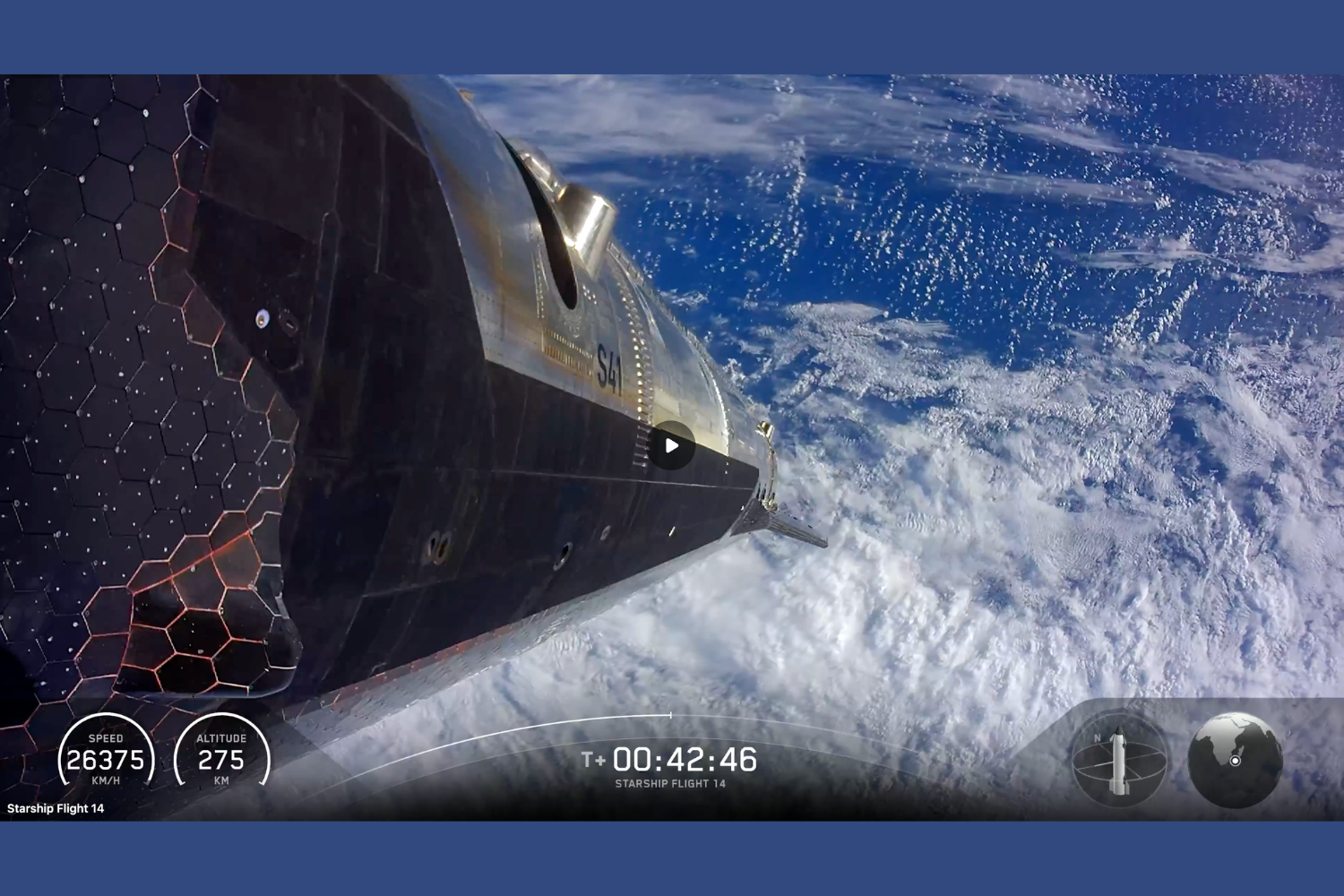
Two aerospace companies are competing to create the lunar lander NASA uses when it returns humans to the moon’s surface. But to reach our lunar companion, a spacecraft will first have to get to Earth orbit September 30, 2026 4:30 p.m. Starship orbited Earth twice, although it was supposed to circle the planet six times. Screenshot from SpaceX livestream On September 28, SpaceX achieved a major milestone as the company vies for a starring role in NASA’s planned missions to the moon. Its Starship—the biggest, most powerful rocket system ever made—reached Earth orbit on its first try after launching from Texas at 7:48 a.m. Central time. During the test flight, the spacecraft looped around the planet twice. But Starship returned to Earth sooner than planned. That’s because before getting to Earth orbit, one of its engines had shut down, forcing engineers to decide whether to continue the test or bring the rocket back without accomplishing its goal. After a tense pause in plans during a livestream, SpaceX communications manager Dan Huot said, “The go/no-go poll for orbit has finished—and we are go for orbit.” Did you know? Need to know: How far to get to Earth orbit? To be in Earth orbit, you need to reach a boundary called the Kármán line that separates the planet’s atmosphere from outer space. It’s roughly 50 to 62 miles above sea level. The announcement was met with raucous applause, after which Starship did accomplish its goal, albeit in an abbreviated trip. It was supposed to come back in about ten hours after circling the planet six times. Instead, the spacecraft splashed down in the northern Pacific Ocean in around three hours, and after releasing 26 Starlink satellites into space. Nevertheless, “this is an important milestone for SpaceX, with Starship successfully reaching orbit, and at the first attempt,” Martin Barstow, an astrophysicist at the University of Leicester in England, tells the Guardian’s Ian Sample. “Having this large launch capability will … be transformational for the whole space industry.”Live views of Starship in orbit brought to you by @Starlink pic.twitter.com/JvmrSDVHg0— SpaceX (@SpaceX) September 28, 2026 Starship is a 407-foot-tall reusable transportation system developed by SpaceX, founded by Elon Musk, and it consists of the Starship spacecraft and Super Heavy booster. It made headlines in 2024 when SpaceX launched the giant system, separated the spacecraft from the booster, and then successfully caught Super Heavy in two huge metal arms on its launch tower—also on the first try. Starship’s performance has significant implications for NASA’s Artemis program, which aims to return humans to the moon and establish an enduring presence there. SpaceX is competing with Blue Origin, founded by Jeff Bezos, for a leading role in these missions. Both are developing systems to help humans land on the moon as part of the program and are vying over whose craft will be used for Artemis’ first crewed mission there, according to Reuters’ Steve Gorman, Akash Sriram and Joey Roulette. Starship’s recent success is significant because entering Earth orbit is a prerequisite for traveling to the moon—and perhaps, one day, Mars. SpaceX is developing a version of this spacecraft for its human landing system. That, however, also gives greater importance to the issues that arose during the test flight. During it, one of the booster’s 33 engines failed as the spacecraft left Earth’s surface, and another engine didn’t ignite later during a maneuver to bring the booster back to the planet, reports the New York Times’ Kenneth Chang. Meanwhile, the separated Starship kept going to space, where one of its six engines stopped working, forcing SpaceX engineers to decide whether to continue to Earth orbit.Liftoff of Starship's first orbital flight pic.twitter.com/vG6QWlpwnY— SpaceX (@SpaceX) September 28, 2026 Experts don’t know yet whether the upper-stage ship’s engine problem was “a one-off failure of a single part” or a broader design issue that will necessitate changes “across the fleet,” Dean Sladen, an aerospace engineer at engineering supply company Accu Components, tells Reuters. Figuring that out will determine how much of a blow this is to SpaceX’s progress overall. Still, Don Platt, an expert in rocket propulsion systems at the Florida Institute of Technology, thinks that with this successful—although flawed—orbital mission, SpaceX is in a better position than before. “Now they can say that the Starship aspect of the Artemis 3 mission at least has been demonstrated at a low … level,” he tells Central Florida Public Media’s Brendan Byrne. Nevertheless, “there’s still a lot of work that has to take place before this Starship is ready for Artemis 3.” NASA’s Artemis 3 mission, slated for 2027, will launch a spacecraft into low-Earth orbit and then meet up with two lunar landers being developed independently by Blue Origin and SpaceX. After that, Artemis 4 is expected to take humans to the moon’s surface as soon as early 2028—a place we haven’t been since 1972. You Might Also Like Get the latest stories in your inbox every weekday. More about: Moon NASA Outer Space Satellites Space Travel SpaceX
SpaceX's Giant Starship Rocket Reached Earth Orbit on Its First Try, but Engine Problems Forced It to Return to the Planet Early
Full Article
Original Source
Read the full article at Smithsonianmag →KhanList aggregates and links to publicly available news content. We do not host full articles from third-party sources. Always verify important information with original sources.