
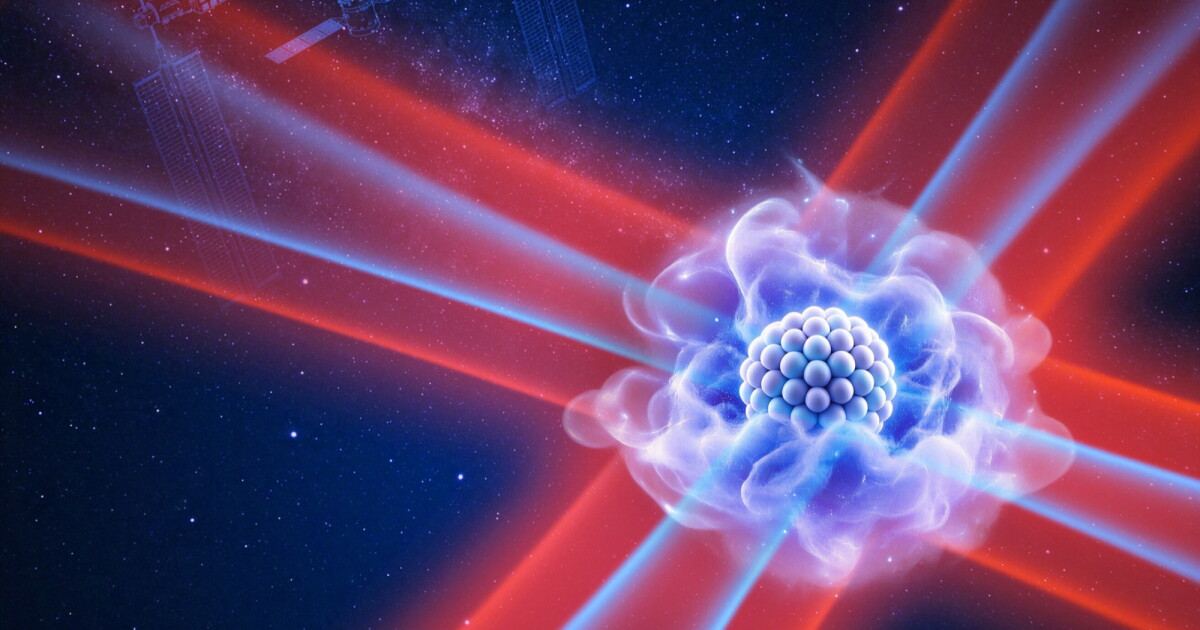
A cloud of atoms has been brought within a whisker of absolute zero in a recent space experiment, shattering the previous record in pursuit of the lowest possible temperatures.Floating hundreds of miles above Earth’s surface in China’s Tiangong space station, researchers coaxed around 20,000 rubidium atoms into expanding with an energy equivalent to just 9.7 trillionths of a degree above absolute zero – four times lower than the record of 38 picokelvin set by researchers in 2021.The cloud’s expansion was also tracked far longer than in previous experiments, offering future researchers an extended window to explore physics at such insanely low temperatures.The race to the bottom of thermodynamics has been reshaping physics for decades. In June 1995, a collaboration between the US National Institute of Standards and Technology and the University of Colorado at Boulder cooled rubidium to 20 billionths of a degree above the theoretical temperature bedrock of absolute zero, dragging enough heat energy from the atoms to create an entirely new state of matter known as a Bose-Einstein condensate.At sufficiently low temperatures, multiple atoms occupy the same quantum state, effectively becoming a single wave of matter. Phenomena that would typically be observed only in individual particles could become accessible on a much larger scale.Today, Bose-Einstein condensates are a standard tool in physics. Yet the quest for ever-colder temperatures and new ways to manipulate this unique form of matter was on. By 2003, an MIT-led team had cooled sodium to just 450 picokelvin using a magnetic trap by weakening its confinement and allowing the most energetic atoms to flee, taking heat with it. As effective as the method is at bringing down the average temperature of a gas, magnetic traps affect a property of the trapped atoms known as spin. Finding ways to further loosen their grip on the buzzing atomic swarm could allow physicists to tweak the magnetic field to reduce this influence while also hitting even lower temperatures.In 2021, researchers used freefall to counter gravity, achieving an effective temperature of just 38 picokelvin. Using a drop tower at the University of Bremen in Germany, the team made their rubidium weightless long enough for a magnetic lens to force it to expand and cool.Orbit offers a longer version of that opportunity. Using intersecting laser beams, the team behind this latest record held atoms in an optical dipole trap. Unlike magnetic traps, these cages confine atoms in a state that is magnetically insensitive.Using a mix of lasers to put the brakes on fast-moving atoms and evaporative cooling, the team produced a condensate.It wasn’t the first of its kind in orbit (that achievement was ticked off on the International Space Station in 2020). But what came next was a first.A gentle gradient in an applied magnetic field was used to expel even faster-moving atoms. The team then transferred the remaining “slow” atoms into a second, wider optical trap and reduced its strength, easing the cloud’s confinement before releasing it.Down on Earth’s surface, gravity would pull the atoms away. In orbital free fall, the researchers could relax that confinement much further. Images taken from two directions revealed how quickly the cloud spread along three axes, providing measurements that suggested the temperature had fallen somewhere between 7.0 and 12.9 picokelvin.It should be noted that this extraordinarily low number is an estimate based on the energy associated with the cloud’s expansion, rather than a conventional thermometer reading.Even so, that slow expansion matters. A cloud that spreads more gently gives physicists longer to interrogate its quantum behaviour before it becomes too diffuse to use. In this case, a whole seven seconds.Together, the lower temperature and longer observation could benefit experiments that use interferometers that split and recombine matter waves to reveal tiny differences in their paths.Such instruments could test whether different atoms fall identically, which could provide new ways to test general relativity. Carefully patterned laser fields could also turn the platform into a simulator for unusual quantum states.Cold matter research is heating up, it seems. While reaching absolute zero is a mathematical impossibility, this new method could expand what we can learn by bringing matter to a virtual standstill.This research was published in Science.Source: Phys.org
Space experiment shatters record for lowest temperature
Full Article
Original Source
Read the full article at Newatlas →KhanList aggregates and links to publicly available news content. We do not host full articles from third-party sources. Always verify important information with original sources.