
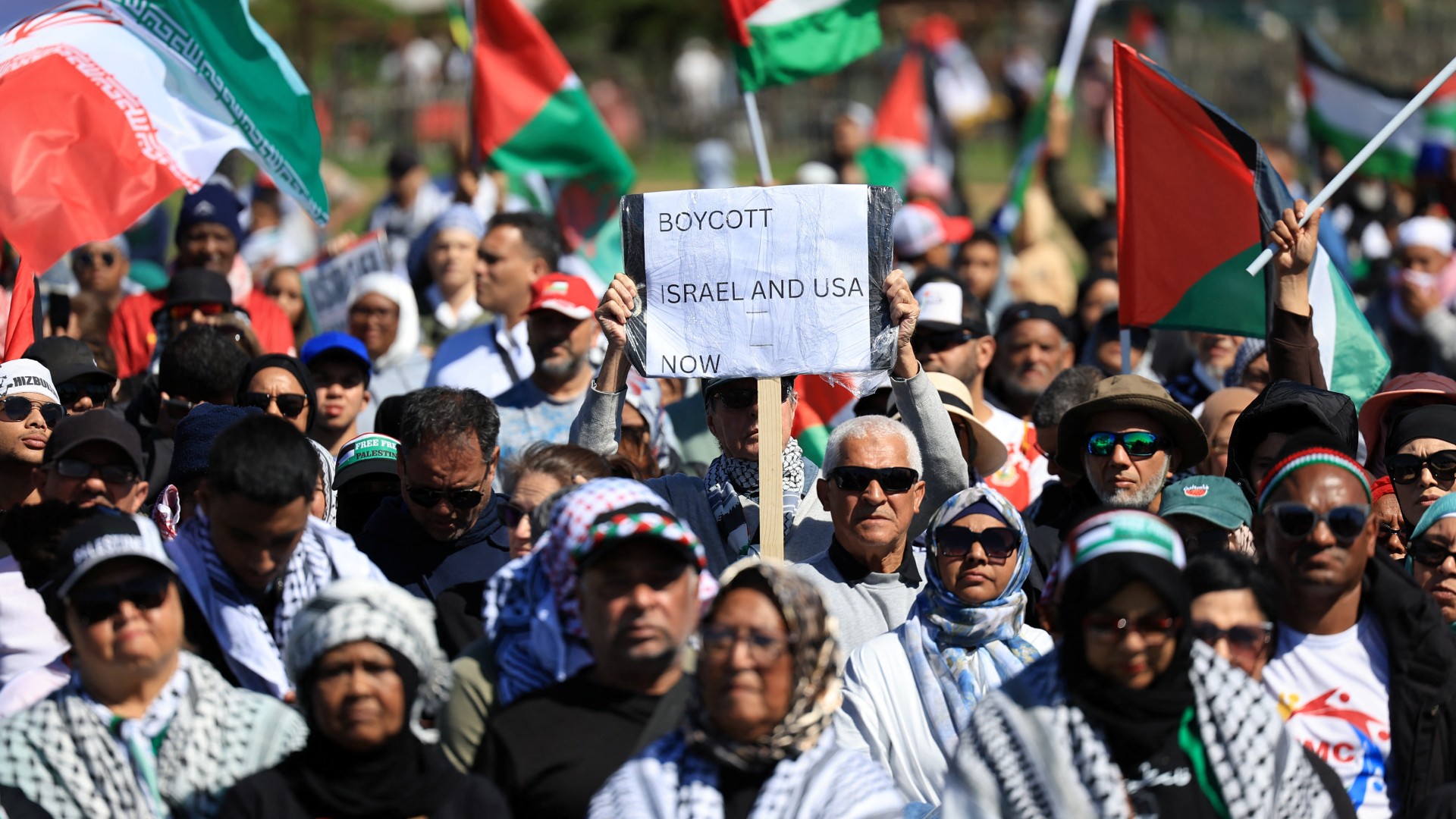
South African activists have accused the government of hypocrisy over its decision to approve an Israeli company's takeover of an offshore oil and gas project, saying the move undermines Pretoria's climate commitments and its case against Israel at the International Court of Justice (ICJ). More than two months after Canada-based Eco Atlantic announced the transfer of its 37.5 percent stake in Block 1 CBK to Israel's Navitas Petroleum, activists say they are still waiting for a clear explanation from the government about why the deal was approved. The offshore concession, transferred in September, is located in the Orange Basin, near South Africa's maritime border with Namibia. The basin stretches along the west coasts of both countries. According to company estimates, the block could contain more than 3.6 billion barrels of prospective oil resources, attracting growing interest from international energy companies. Some have described the Orange Basin as "Africa's Oil Frontier". One publication described the area under Navitas's control as "one of the most active exploration regions on the African continent". New MEE newsletter: Jerusalem Dispatch Sign up to get the latest insights and analysis on Israel-Palestine, alongside Turkey Unpacked and other MEE newsletters But activists monitoring the deal say Pretoria's decision to approve Navitas's entry into the project threatens South Africa's marine environment and the livelihoods of coastal communities. They also argue that the move contradicts South Africa's position at the ICJ, where it has accused Israel of committing genocide in Gaza. "Navitas is an Israeli fossil fuel company that materially benefits the Israeli economy," Tara Nair van Ryneveld of the Climate Justice Coalition told Middle East Eye. "At a time when South Africa is pursuing international legal action concerning Israel's actions in Palestine, granting an Israeli company access to South Africa's petroleum resources raises serious questions about the consistency of our government's actions with its international obligations and stated foreign policy," van Ryneveld said. Activists told MEE that environmental groups had raised concerns with the South African government about the proposed transaction months before Pretoria granted Navitas the necessary approvals. 'Granting an Israeli company access to South Africa's petroleum resources raises serious questions about the consistency of our government's actions' - Tara Nair van Ryneveld, Climate Justice Coalition In an open letter to President Cyril Ramaphosa in June, the environmental justice organisation the Green Connection called on him to explain how the transaction aligned with South Africa's international human rights commitments, particularly as the country pursued its case against Israel at the ICJ. As a signatory to the Paris Agreement, South Africa has also committed to reducing greenhouse gas emissions and transitioning towards a low-carbon, climate-resilient economy. With the deal appearing imminent, a coalition of human rights and environmental organisations, including the South African BDS Coalition, Masifundise Development Trust, Natural Justice and the Climate Justice Coalition, wrote to Mineral and Petroleum Resources Minister Gwede Mantashe and the Petroleum Agency of South Africa (Pasa) in August, urging them to reject the transfer. On 24 September, two days after Eco Atlantic announced that the deal had been completed, the groups submitted a request to Pasa under the Promotion of Access to Information Act, seeking records relating to the approval. Activists say neither the presidency nor Pasa has responded to their concerns in the intervening months. "This is ultimately about South Africa's credibility as a country that upholds international human rights law," a spokesperson for The Green Connection told MEE. Contradictory government policy Over the past three years, South Africa has been among the few countries willing to confront Israel over its genocidal war in Gaza. In December 2023, Pretoria brought a case against Israel at the ICJ, accusing it of violating the Genocide Convention. More than 250,000 Palestinians have been killed or injured, while more than 80 percent of structures in Gaza have been damaged or destroyed. Towards Palestinian Liberation: How resistance travels across borders Read More » Despite its actions at the ICJ, South Africa has continued to sell coal to Israel, even increasing exports and becoming the country's largest coal supplier during the genocide. Pretoria has also refused to prosecute South African citizens who joined the Israeli military, despite national legislation prohibiting citizens from serving in a foreign country's armed forces without prior authorisation. Moreover, the presidency has declined to sever diplomatic ties with Israel, despite a parliamentary vote authorising it to do so. Activists say the decision to allow Navitas to acquire a stake in the offshore exploration block exposes a wider gap between Pretoria's position at the ICJ and its actions at home. "The Navitas project contradicts efforts to sanction Israel for genocide and colonial expansion. It runs counter to what the United Nations has called for, which is the isolation of Israel," a spokesperson for South African Jews for a Free Palestine (SAJFP) told MEE. The activists say they would have opposed exploration in the block regardless of the company involved, citing risks to South Africa's marine environment. However, they argue that approving an Israeli company's involvement deepened their objections. 'The Navitas project contradicts efforts to sanction Israel for genocide and colonial expansion' - South African Jews for a Free Palestine spokesperson "As offshore exploration sites pose a threat to South Africa’s coastal environments and communities, Zionism and the broader infrastructure of global extractive capitalism with which it is interdependent produces severe ecological harm everywhere," the spokesperson for SAJFP added. Activists also argue that approving new oil and gas exploration runs counter to the urgent need to reduce greenhouse gas emissions and limit global warming. They say expanding exploration would encourage further fossil fuel production and deepen dependence on oil and gas at a time when South Africa should be moving towards cleaner energy sources. In the Eastern Cape province, communities have waged a years-long legal battle against Shell's proposed offshore exploration along the Wild Coast. In August, the Constitutional Court ruled against Shell and Impact Africa's oil exploration plans. In its coverage of the legal victory against the multinational energy company, Greenpeace said the ruling "strengthens the case for African governments to move away from an economic dependence on fossil fuels and towards reliable renewable energy and green employment". The myth of economic opportunity Speaking at the South Africa-Namibia Bi-National Commission in July, Ramaphosa described the Orange Basin as "one of the world's most promising new energy frontiers". The South African president said developing the basin could help build a regional energy industry spanning exploration, engineering, refining, petrochemicals, logistics, maritime services and advanced manufacturing. Business leaders have also highlighted the prospects of investment, job creation and energy security in South Africa, where energy costs have soared. But climate justice activists say they are sceptical of claims that ordinary South Africans would benefit from oil and gas extraction. "This lack of transparency is deeply concerning, particularly when decisions of this scale have potentially irreversible consequences for our oceans, climate and coastal communities," van Ryneveld, from the Climate Justice Coalition, said. Several activists pointed to academic studies suggesting that profits from offshore extraction tend to flow out of the country, leaving coastal communities to bear the environmental risks while receiving few lasting economic benefits. 'We should be investing in an energy transition that delivers lasting jobs and broader economic benefits without sacrificing our oceans or public finances' - The Green Connection They said communities and small-scale fishers along the country's western coast were likely to be among those most affected, while benefiting the least. "The oil and gas economy is structured in ways that concentrate and export wealth, while leaving governments and communities to bear the costs," Power Shift Africa, a Nairobi-based think tank working on climate and development policy, said in its May 2026 report: Pipe Dreams: How oil and gas fail to deliver economic development in Africa. The report described oil and gas extraction as an "enclave economy", in which much of the equipment and services are imported while fuel and profits are largely exported. It added that although the oil industry could account for a substantial share of a country's gross domestic product, it did not necessarily generate significant employment. "Meanwhile, fishing and tourism already sustain tens of thousands of livelihoods that could be threatened by seismic surveys, oil spills and other operations," The Green Connection said. "We need to look beyond the promise of investment and ask whether this is the best use of South Africa's natural resources. The evidence suggests that offshore oil and gas risks privatising the profits. "We should be investing in an energy transition that delivers lasting jobs and broader economic benefits without sacrificing our oceans or public finances," The Green Connection added. MEE reached out to Navitas for comment but did not receive a response by the time of publication.
South Africa accused of hypocrisy over Israeli offshore oil project
Full Article
Original Source
Read the full article at Middleeasteye →KhanList aggregates and links to publicly available news content. We do not host full articles from third-party sources. Always verify important information with original sources.