
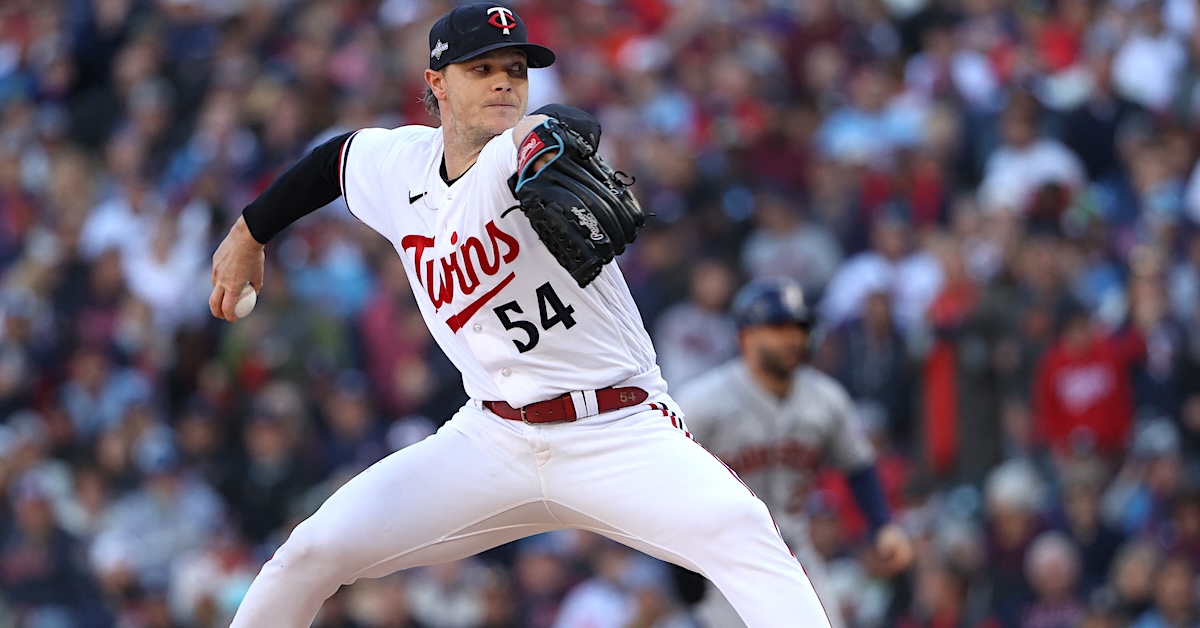
Jesse Johnson-USA TODAY Sports Who doesn’t love a reunion? Sonny Gray, who spent 2022 and 2023 with the Minnesota Twins, has agreed to return to the organization on a two-year, $55 million deal. According to ESPN’s Jeff Passan, the contract also comes with an opt-out clause after the first year. The terms of this agreement are right there in the neighborhood of our median crowdsource estimation of two years, $52 million, a palatable deal for a pitcher who is 37 years old but has also never had a serious arm injury. Not counting 2020, Gray has made at least 24 starts in each of the last seven seasons. Dependability is an enticing quality for the Twins, who used 11 different starters in 2026. Pitching for the Boston Red Sox last year, Gray showed that his dependability doesn’t mean refusal to change. Coming off two straight years of 200 strikeouts and a strikeout rate north of 25%, Gray settled in at 149 and 21.8% in 2026. This didn’t impact his ability to record outs, though, as he traded strikeouts for non-threatening contact. His sinker — a trusty steed he’s ridden since the Obama administration — returned to form in a big way, producing a 56.6% groundball rate, highest in six years. Paired with a 15.4% whiff rate (a decent drop from its career average of 18.4%) Gray has clearly entered the phase of his baseball life where he’s okay with his sinker being put in play. His sweeper remains a reliable swing-and-miss offering, and Gray also used his cutter much more with Boston, even though it got regularly lambasted. Jumping from a 12.6% usage rate in 2025 to 18.8% in ’26, Gray’s cutter had a .286 batting average against (.302 xBA), .446 slugging percentage (.482 xSLG), and .353 wOBA (.369 xwOBA). With a 7.9% putaway rate, it’s also not a pitch that gets him many strikeouts. In fact, just three of his 149 strikeouts in a Boston uniform came on the cutter. How the Twins instruct him to throw that pitch will be one of the more amusing subplots of his second stint in Minnesota. The most troublesome trend for Gray is that his four-seam fastball has dwindled in velocity for three years in a row now. It is also getting pulverized. He has counteracted this by throwing it less and less — when Gray debuted in 2013, he threw his four-seamer 44.6% of the time, a number that has fallen to 23.8%, 21.7%, and 17.3% in his last three campaigns — and taking up residence with all of his pitches in one specific area. Everything you need to know about where Gray’s bread is buttered can be gleaned from these two charts. That glove-side spot — down and away to righties, down and in to lefties, classified as Zone 14 in the Statcast database — is his favorite location. He’ll go there when he needs one of the game’s best right-handed bats to go fishing. And he’ll also dot the cutter in that region when he wants to induce a double play. A known power district for left-handed hitters, Gray avoided trouble down there in 2026, allowing a grand total of zero extra-base hits to lefties on pitches thrown in that zone. Despite going to that well over and over again, lefties could not figure it out. Gray recorded 50 strikeouts against left-handed batters in Zone 14, and whether it’s the sweeper, sinker, or curveball, they love swinging right over top of it. This methodology of pitching gave Gray a 23.6% strikeout rate when facing lefties in 2026, compared to 18.4% against righties. Last time Gray suited up for the Twins, he spun the best season of his now 14-year career. In 2023, the 5-foot-10 righty posted a 2.79 ERA with a major league-best 2.83 FIP, helping him achieve his first (and thus far only) 5-WAR season. An enormous part of that success came from limiting batters to just eight home runs, giving him a 0.39 HR/9 that was best among all big league pitchers while also standing out as a screeching loud outlier. Gray received an All-Star nod and a second-place Cy Young finish for his efforts, becoming a central figure in a legitimately feel-good season for the Twins. However, things have changed dramatically in Minneapolis since then. Gray’s old manager Rocco Baldelli was shown the door, as well as former president of baseball operations Derek Falvey. Minnesota also has a different, freshly hired pitching coach in Brian Reith, meaning Gray does not get to work with Pete Maki or assistant Luis Ramirez anymore, two men who were in his corner for that career year. The fact that a new front office regime and a new dugout braintrust decided to bring Gray back is intriguing, as it points to a clear interest in his recent performance rather than banking on pre-existing relationships. When speaking at his introductory press conference, Reith summarized his pitching philosophy as follows: “Throwing strikes is No. 1,” he said. “Getting to two strikes as quick as possible, then executing a pitch to get a guy out. Just basic philosophy, that would be it. Get to two strikes, then get the guy out as quick as possible after that.” We’ll see how that school of thought marries Gray’s approach. In 2026, Gray ranked 30th among 46 qualified pitchers in pitches thrown within the strike zone and 25th in first-pitch-strike percentage. If strikes are truly what their pitching coach craves, Trevor Rogers or Nick Martinez are the free agents who make much more sense for the Twins, as both were among the best in those statistical categories. Martinez was first in In Zone% at 52.7%, with Rogers right behind him at 51.9%. At 69.7%, Rogers was the leader in first-pitch-strike rate, with Martinez’s 65.4% good for 10th. Of course, Rogers is just 29 years old to Gray’s 37, making the former a deserved candidate for a longer deal worth potentially double the $55 million Gray will collect. The Twins are presumably not handing out any contracts of that size. But Martinez is roughly the same age, and because of a bumpier overall track record — plus some underlying stats that are even redder flags than Gray’s — he could have theoretically been had for cheaper. This is where the human element of free agency must be accounted for, as Gray was very likely drawn to his familiarity with the organization, even if many of the faces have changed. (Martinez, meanwhile, might not have any interest at all in playing for the Twins.) This year in particular, the impending lockout probably played into Gray’s decision to sign in November, and perhaps the Twins preferred to do their business before the work stoppage too. But even if Gray doesn’t perfectly jive with their platonic ideal of a pitcher, make no mistake about it, the Twins had to do something to address their rotation. They ranked 18th out of the 30 teams in starter WAR last season, and were in the bottom half of the league in ERA, FIP, and xFIP from their starting pitchers. Gray’s fabulous 6.7 BB% from last year — which followed even better 5.8% and 5.0% percentages in 2024 and 2025 — should also help the Twinkies bring down their overall starter walk rate, which put them in the middle of the 2026 pack. As their roster stands right now, Gray joins a top of the rotation with Taj Bradley and Joe Ryan that is very formidable when all three are at their best. In an American League Central that took just 85 wins to summit this past year, locking in three above-average arms puts the Twins in a solid position on paper, with Pablo López lurking in the shadows as he recovers from his Tommy John surgery. The Twins have been absent from the postseason since Gray left at the conclusion of that glittering 2023 season, signing a $75 million deal with the St. Louis Cardinals. Both of his years with the Cardinals were strong, just not particularly eye-popping. In his lone year with the Red Sox after the Cards flipped him for three minor league pitchers, Gray made waves with many of his traditional stats, chief among them a 2.72 ERA (fifth in the American League) and an AL-high 18 wins. That shouldn’t be the expectation for him in the future, as most of the pitchers age 37 or older from this century who made at least 20 starts with a sub-3.00 ERA in a season — 2026 Chris Sale, 2025 Jacob deGrom, 2022 Max Scherzer and Justin Verlander, Randy Johnson in Arizona — still had their velocity. But anywhere near that level of production will make Minnesota very pleased with this purchase. The first time Gray picks a runner off, too, get ready for a powerful wave of nostalgia to engulf the Twin Cities.
Sonny Gray Goes Back to Minnesota To Help Twins With Their Pitching Needs
Full Article
Original Source
Read the full article at Blogs →KhanList aggregates and links to publicly available news content. We do not host full articles from third-party sources. Always verify important information with original sources.