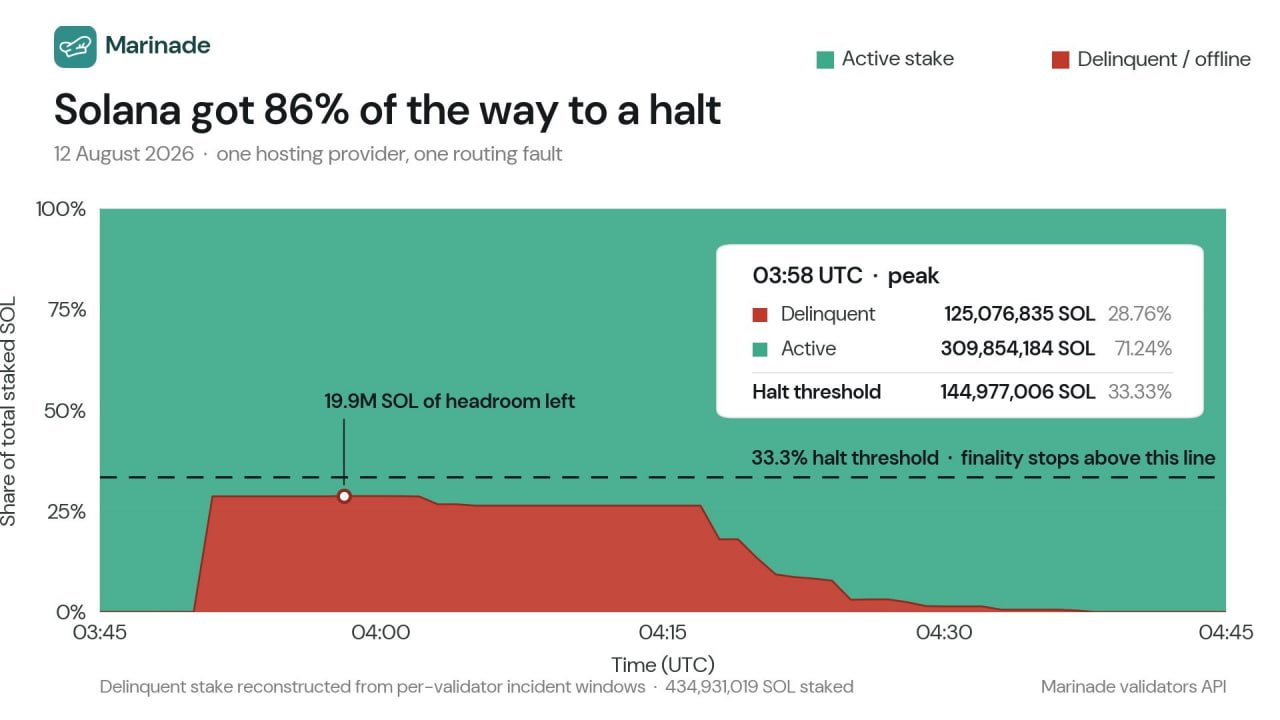
Solana neared a freeze threshold Wednesday, Marinade Finance says. The Foundation says it held up under stress. A routing glitch at a major data center provider knocked nearly 29% of Solana’s staked tokens offline, bringing the network within striking distance of a full freeze, while Foundation executives stressed that blocks and transactions never stopped.Updated 27 min agoPublished 15 hrs agoSolana neared the network freeze threshold Wednesday. (Marinade)A routing failure at a major data center provider briefly knocked nearly 29% of Solana’s staked tokens offline, bringing the network close to a full halt, according to staking platform Marinade.Because Solana stops finalizing transactions if more than one-third of staked tokens go offline, the incident left the network within about 20 million tokens of a freeze similar to a five-hour outage in February 2024.The glitch, traced to a bad internet route originating at Teraswitch’s Miami facility and spreading to data centers in Europe and Asia, exposed the risk of relying on a single connectivity provider that controlled more than a quarter of all staked tokens.Solana came close to a freeze threshold Wednesday morning when a routing glitch at a major data center provider knocked almost 29% of the network’s staked tokens offline, staking platform Marinade said. Finality, the point at which blockchain transactions become irreversible, stops if more than a third of the coins staked go dark. Staking refers to act of locking coins in a blockchain network to secure it in return for rewards. Marinade said that the network came within about 20 million tokens of that threshold. Roughly 90 validators were hit and together lost 333 SOL in rewards, a relatively small sum that will be covered by “validator bonds.”“If delinquency had gone past a third, nothing finalizes for anyone holding SOL anywhere, and there's no bond for that. The February 2024 halt took about five hours to restart,” Marinade said in an explainer post. Solana is one of the leading smart contract blockchains, with assets worth $4.3 billion locked in DeFi protocols operating on the network. The blockchain has built a reputation as a faster and cheaper alternative to industry leader Ethereum, but has faced several outages in the past. The latest issue started with a bad internet route from Teraswitch’s Miami facility that then spread to data centers across Europe and Asia, cutting off validators in London, Amsterdam, Frankfurt, Singapore and Tokyo. North America stayed online. The company fixed the issue in about 10 minutes, and traffic was flowing again by 4:16 a.m. UTC.One single network operator, identified as AS2032, controlled more than a quarter of all the tokens people had locked up to secure the network, which was more than the Solana-prescribed safety limit. Almost all of those tokens went offline at the same time. Other companies lost another 14 million tokens in the same short period. Most of the affected validators, including the big one called Helius, stayed offline for the full 33 minutes because their backup systems never switched on.This whole event is a clear warning: if more than one-third of the network’s tokens ever go offline at once, the entire blockchain freezes for every single person holding SOL, and there is no quick way to fix the bigger damage that would follow.Solana’s network remained operationalSolana Foundation’s VP of Tech Jacob Creech framed the episode as evidence that the network’s design held up under pressure. Put simply, the network came close to the freeze threshold, its performance was unaffected in any way.In a post on X shortly afterward, he wrote that an infrastructure provider used by some Solana validators had failed the night before, yet “You probably didn’t notice, because the network didn’t: blocks kept producing and transactions kept landing.”Creech laid out the key facts. The Solana network remained operational, 597 of 699 staked validators kept voting (roughly 6 out of 7), the affected validators recovered within 40 minutes, and those in the Solana Foundation Delegation Program were completely unaffected. “Because Solana validators are distributed across independent infrastructure providers, the failure of a single provider did not interrupt the network,” he said. “This is decentralization and infrastructure diversity working as intended, and a proof point for Solana’s resiliency through periods of stress.”Aug. 13: 4:01 UTC: Adds comments from Solana Foundation. AI Disclaimer: Parts of this article were generated with the assistance from AI tools and reviewed by our editorial team to ensure accuracy and adherence to our standards. For more information, see CoinDesk's full AI Policy.12345678910Building the Zcash Machine: Tachyon and Quantum ReadinessBuilding the Zcash Machine: Tachyon and Quantum ReadinessZcash’s Tachyon upgrade aims to scale shielded payments, improve quantum readiness, and test whether its funding, security, and governance can hold.Zcash’s Tachyon upgrade aims to scale shielded payments, improve quantum readiness, and test whether its funding, security, and governance can hold.Why it matters:Zcash’s Tachyon upgrade aims to scale shielded payments, improve quantum readiness, and test whether its funding, security, and governance can hold.View Full Report
Solana neared a freeze threshold Wednesday, Marinade Finance says. The Foundation says it held up under stress.
Full Article
Original Source
Read the full article at Coindesk →KhanList aggregates and links to publicly available news content. We do not host full articles from third-party sources. Always verify important information with original sources.