
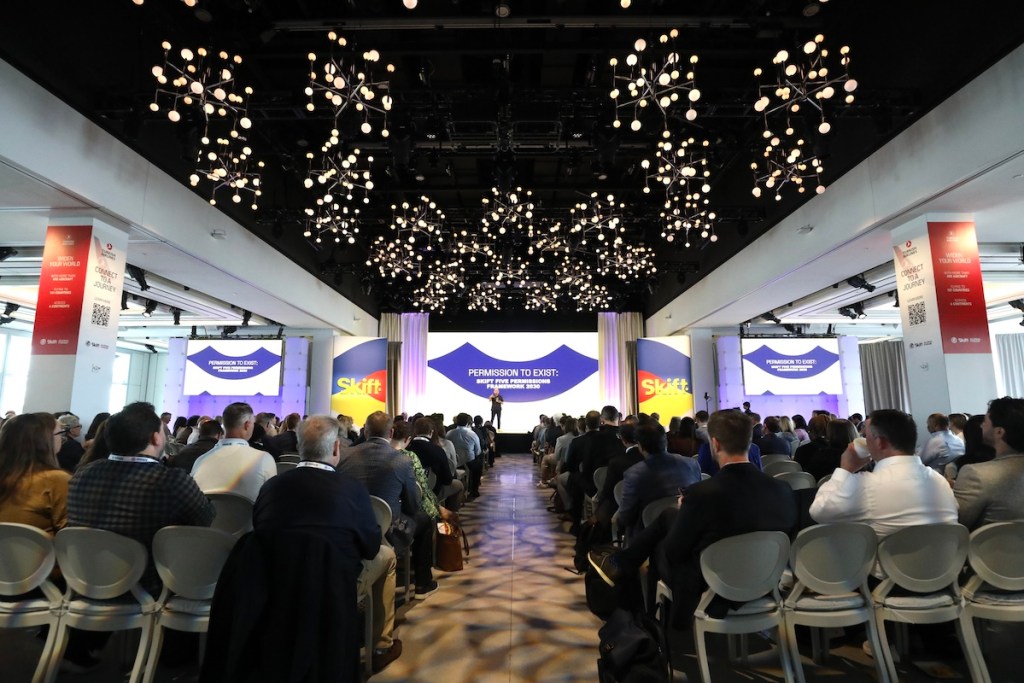
Presented by Skift Global Forum 2026 · Pre-Read Every leader at Skift Global Forum is recalibrating amid technological and economic disruption. The open question is whether they’re doing it for the right decade. Travel demand patterns, distribution, and technology stacks are shifting, and assumptions that once reliably predicted what would happen next no longer apply. Two central tensions have created significant urgency in today’s travel industry: The global travel market continues to grow in size, but its shape is continually changing, and technology is evolving faster than consumer and corporate trust in using it. Each session at Skift Global Forum is built around a consequential decision that top travel leaders are currently facing. Yet, similar tensions will lead to different decisions. An incumbent, a challenger, and an investor may approach them in ways that conflict with one another. The purpose of the Skift Global Forum environment is to surface this friction and challenge preconceived assumptions. “There are four layers to the travel stack: consumers, commerce, operations, and experiences. Every travel company will be challenged to prove its future relevance in each layer, based on whether its brand provides enough value to avoid being replaced.” Skift Research, State of Travel 2026 Watch Skift Global Forum Live: September 22–24 Free for Skift annual subscribers; paid access for everyone else. Register now The agenda The Five Decisions Decision 01Incumbency or Reinvention: Follow the Establishment or the Challenger?→ Decision 02The Funnel and The Agent: What’s the Right Pathway Today?→ Decision 03Premium or Volume: Where’s the Risk When the Two Fall out of Balance?→ Decision 04Human or Machine: How Do Brands Decide When the Guest Still Needs a Person?→ Decision 05Certainty or Speed: Which Is the Right Bet?→ Incumbency or Reinvention: Follow the Establishment or the Challenger? For established travel brands, internal efficiency is leading ROI from AI, while new booking demand from AI agents remains low. Meanwhile, venture capital is betting on the other outcome. AI-enabled companies took 45% of travel startup funding by mid-2025, up from 10% in 2023. [3] Somewhere in the middle, Brian Chesky is rebuilding Airbnb as an AI-native company while the core business still pays the bills. Travel leaders overseeing distribution must decide who to follow when they don’t control their own distribution infrastructure (and few do). Can they scale through the shift to AI booking, or will their legacy systems prevent them from moving forward? Booking Holdings and Expedia own the distribution and hold the cash. Airbnb is wagering that a rebuild beats a retrofit. There’s also a third thing: Could an AI-native start-up come in and compete? Referral traffic from AI agents drives fewer than 1% of room nights at Booking.com. Airbnb cut its support cost per booking by about 16% in a year using AI. [2] The Decisions Being Made Right Now Do we defend the model that currently makes money, or rebuild for the one that might replace it? Where can we still scale, and what has become too costly to maintain? Which AI returns are real today: efficiency, conversion, or new demand? What to Discuss in the Room Where Booking Holdings’ Glenn Fogel believes scale still wins once discovery moves to agents. What Airbnb’s Brian Chesky thinks an AI-native rebuild costs the parts of the business that already work. Which capabilities Expedia Group’s Ariane Gorin says are worth owning and which to plug into. The Funnel and The Agent: What’s the Right Pathway Today? Discovery is moving from search-scroll-compare to ask-shortlist-decide, according to the Skift Research State of Travel 2026. While nearly one-third (30%) of travelers reported “extensive” use of AI for trip planning, and that share rose 17 percentage points, more than doubling in just a single year [3], trust to transact through AI platforms lags considerably. Direct and OTA channels remain the most trusted, while traveler sentiment toward comfort with AI booking is net negative. [1] AI systems shortlist the brands they can read. The rest stay invisible unless requested by name. Structuring data for AI gets more visibility but cedes control over how the brand gets represented. Protecting the direct funnel keeps control but risks disappearing from AI discovery entirely. Only 6% of hotels appear in AI-generated search results, [10] and only 2% of leisure travelers will let AI book for them. [4] The Decisions Being Made Right Now Do we restructure our data for AI discoverability if it would reduce control over our brand story? Do we optimize for AI discovery now, or protect the direct funnel while we wait to see if traveler trust catches up? How do we measure brand health if we lose a huge percentage of travelers? What to Discuss in the Room Whether IHG’s Heather Balsley believes structuring for AI discoverability is a competitive bet or a brand risk. What Dara Khosrowshahi thinks Uber gives up in control the moment a ride becomes bookable by someone else’s agent. What Sierra’s Bret Taylor says a travel brand has to do now to be bookable by an agent later. Premium or Volume: Where’s the Risk When the Two Fall out of Balance? Affluent travelers are floating the industry’s healthy balance sheet. For example, Delta’s premium revenue rose 7% in 2025, but main cabin revenue fell 5%. [5] American and United are rebuilding aircraft around premium seats, aiming for roughly half of future cabins, and premium seats carry materially better margins. [6] At the same time, the price-sensitive traveler is trading down, with 62% of global travelers saying they’ll adjust or cancel plans due to cost, according to Skift Research. [1] Building for the top ostensibly raises the floor in a downturn, but it could also thin the customer base that fills the aircraft and floats occupancy when margins drop. Premiumization is the surest revenue story in travel right now, but it’s also a bet on income inequality. Premium cabin led economy revenue for the first time in Delta’s history in Q4 2025, and almost all of 2026 seat growth is going to premium. [5] The other major U.S. airlines are following the same trend. The Decisions Being Made Right Now How much of our growth should we stake on the premium traveler? What happens to our economy traveler (and loyalty) base if we keep pricing up the experience? How should we plan for the possibility that premium demand won’t hold through the next downturn? What to Discuss in the Room How far Air Canada’s Mark Galardo thinks the premiumization runway goes. How Carnival Cruise Line’s Christine Duffy approaches modernizing and elevating a product while protecting the affordability that defines it. Human or Machine: How Do Brands Decide When the Guest Still Needs a Person? Every hotel brand is trying to strike the same balance: How much headcount can they cut with AI-driven service while protecting human touchpoints that guests say they still want? The instinct is to treat this conundrum exclusively as a cost line. If their customers are willing to pay for it, they can have human service, which will then justify the headcount. Though logical, there’s a danger in applying this uniformly along segmentation lines. If human service becomes a line item only the top of the market can afford, mid-market brands will lose a differentiator they can’t easily rebuild once frontline headcount is gone. AI money is flowing to reservations efficiency, while there’s a labor shortage where the human touch is most needed. [9] The Decisions Being Made Right Now How much does human service have to move loyalty or spending numbers to justify the cost of keeping it? What happens to guest trust when a complaint gets automated instead of being escalated to a person? Are we training staff to do what AI can’t, or are we cutting staff and hoping AI covers the gap? What to Discuss in the Room Where Hilton’s Christopher Nassetta believes human service still moves the numbers at scale. What Wyndham’s Geoff Ballotti says frontline staff need to do now that a chatbot can’t. What Chef Vikas Khanna says gets lost when craft and hospitality get automated out of the guest experience. Certainty or Speed: Which Is the Right Bet? The market rewards leaders who act amid uncertainty, if they can stomach the risk. In the U.S., domestic travel held at 2019 levels in real terms while international volume fell 5.5%. [8] That mix moved faster than most strategic plans could. Meanwhile, global companies like airlines and hotel brands run across geographies where geopolitics have reset the plans quarter to quarter in 2026. Waiting for certainty means moving after the window closes. Acting early means committing capital on data that could totally turn in the next quarter. Every large decision this week sits somewhere on that line. Forecasters pushed full U.S. inbound recovery from 2025 to 2029 in a single revision. [7] The question is whether to act now, try to predict what’s next, or both. The Decisions Being Made Right Now What are we deferring until we have data that may not arrive in time to use? Where do we build fixed strategy, and where do we buy optionality and speed? How do we make a large capital call under permanent volatility? What to Discuss in the Room How Accor’s Sébastien Bazin is deploying capital when the map resets quarterly. What Skift Research’s Seth Borko and the Recalibration Index says leaders should act on first. What You’ll Leave With Are you defending the last decade or building for the next one? You came in knowing the ground is moving underneath you. Leave knowing which decisions you need to make to stabilize and move with it. The travel industry has already recalibrated. Demand is moving from international to domestic, from the U.S. and MENA to South America and Asia, from economy to premium, from search to AI, and between human and machine. Most companies re-forecast for the disruption they’ve already seen. Fewer are building for the one that’s still ahead. By the end of Skift Global Forum, you should know which direction you’re going. Hearing how Booking defends scale, how Airbnb bets against it, and how Accor plans through volatility provides a first-hand view into the most important decisions being made in travel. Discussing these insights with your peers in real time gives you perspective on where your company stands and what your next decision should be. Register for the event Sources [1]Skift Research, “State of Travel 2026”: skift.com/insights/state-of-travel/ [2]Skift, “Travel Has Started Weighing AI’s Worth”: skift.com/2026/08/18/travel-has-started-weighing-ais-worth/ [3]Skift Research and McKinsey, “Remapping Travel With Agentic AI”: skift.com/insights/new-report-remapping-travel-with-agentic-ai/ [4]Skift, “Travel Brands Are Building AI Agents for a Consumer That Doesn’t Exist”: skift.com/2026/03/03/travel-brands-are-building-ai-agents-for-a-consumer-that-doesnt-exist/ [5]Delta Air Lines FY/Q4 2025 results, reported by One Mile at a Time: onemileatatime.com/news/delta-premium-cabin-revenue-exceeds-economy-revenue/ [6]Prism News, “U.S. airlines expand premium cabins to court high-paying travelers”: prismnews.com/news/us-airlines-expand-premium-cabins-to-court-high-paying [7]Skift, “Inbound Travel to the U.S. Expected to Fall for First Time Since 2020”: skift.com/2025/10/03/inbound-international-travel-down-2025/ [8]U.S. Travel Association, Travel Forecast (May 2026): ustravel.org/research/travel-forecasts [9]Skift, “What If AI Doesn’t Fix Travel’s Labor Problem?”: skift.com/2026/07/15/what-if-ai-doesnt-fix-travels-labor-problem/ [10]Skift, “How Hotels Stay Visible and Drive Bookings in an AI-First World”: skift.com/2026/06/03/curacity-ceo-and-co-founder-nick-slavin-at-skift-data-and-ai-summit-2026/ Travel industry sponsors App sponsor Transcription & translation provider Knowledge partner Sponsorship opportunities: sponsorships@skift.com
Skift Global Forum: Five Decisions in the Room
Full Article
Original Source
Read the full article at Skift →KhanList aggregates and links to publicly available news content. We do not host full articles from third-party sources. Always verify important information with original sources.