
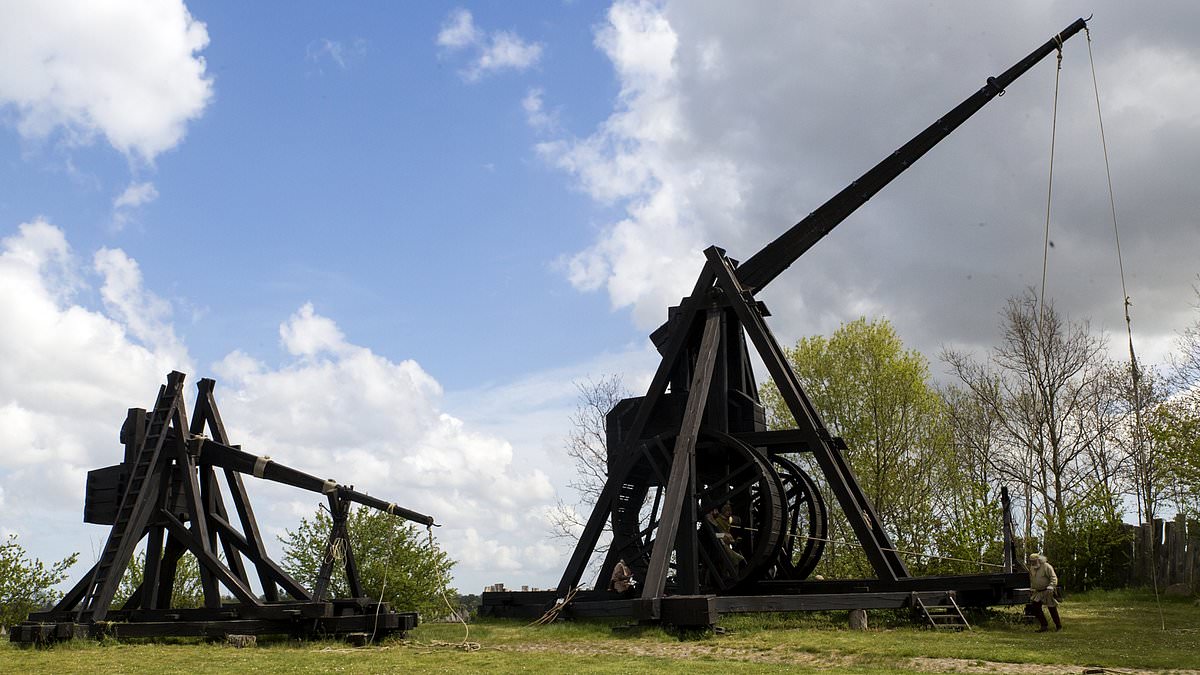
See more Daily Mail on Google - save us as a Preferred Source Published: 20:42 EDT, 23 August 2026 | Updated: 21:22 EDT, 23 August 2026 A skeleton found with more than 160 fractures is now believed to be the first ever identified victim of a trebuchet-style catapult, it has been revealed.The discovery came after medieval warfare expert Dr Jo Buckberry, an archaeologist at the University of Bradford, re-examined a 700-year-old set of human remains known as Skeleton 150, The Times reported. The bones were originally excavated in 1997, found buried beside eight other people beneath the royal chapel at Stirling Castle in Scotland. The pattern and intensity of the bone breaks suggested to Dr Buckberry that the man had been struck by a giant projectile travelling at rapid speed. The ribs also had nearly 60 zigzag-shaped fractures while the shoulder showed signs of a deep break.'I had never seen anything like it, ever,' Dr Buckberry said. 'Every single rib on both sides has at least one fracture. The whole shoulder complex is crushed. The skull alone has over 60 fractures.'The academic later saw a similar break at a forensic anthropology workshop which belonged to a person killed in a car crash.'The reason it's weird is that it's a high-velocity injury, and you just don't get high velocity in the medieval period,' she told the newspaper. A trebuchet at the Medieval Centre in the town of Sundby on the Danish island of Lolland. Trebuchets were used during the Middle Ages by besiegers to bombard a fortress or a city by throwing stones, burning balls and other heavy and damaging items at the enemy A skeleton of a soldier found in Scotland's Stirling Castle has been identified as the first confirmed victim of a trebuchet attack, which broke their skull (pictured) in 60 places Dr Buckberry studied the remains with Patrick Randolph-Quinney of Uppsala University and found that the injuries also did not conform with a fall from castle walls.Instead the fractures suggested that the man had been standing when he was hit by something from behind, killing him instantly, according to Archaeology News magazine. What is a trebuchet? A trebuchet is a type of medieval siege engine used to hurl heavy objects over long distances.It works by using a long wooden arm mounted on a pivot, with a sling attached to one end.A heavy counterweight on the opposite end drops rapidly, causing the throwing arm to swing upwards.The sling then releases its projectile at high speed towards the target.Trebuchets were mainly used to attack castles and fortified towns, often by smashing walls or launching objects over defences.They became especially important in medieval warfare from around the 12th century, before gradually being replaced by gunpowder artillery. England's King Edward I unveiled a trebuchet known as 'War Wolf' in 1304 - which historical records show was used during his siege on Stirling Castle during the Scottish Wars of Independence. Thus it could very possibly have been the weapon that ended the life of Skeleton 150 and led to his unusual injuries. The trebuchet was a medieval siege weapon, operated using a counterweight to propel a long arm, attached to a sling, which could hurl a projectile with great force and accuracy at enemy fortifications. The device struck fear into the hearts of enemy soldiers and was used during the Middle Ages by besiegers to bombard a fortress or a city by throwing stones, burning balls and other heavy and damaging items at the enemy.Frequently it was not used to target individual soldiers but to break down castle walls to gain access to the interior.
Skeleton with more than 160 fractures is first confirmed victim of a trebuchet
Full Article
Original Source
Read the full article at Dailymail →KhanList aggregates and links to publicly available news content. We do not host full articles from third-party sources. Always verify important information with original sources.