
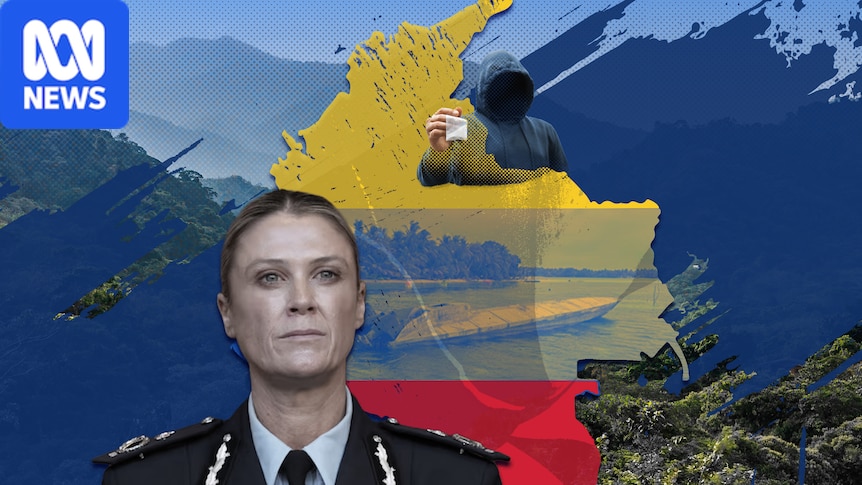
Unanswered questions about the Australian Federal Police's (AFP's) new anti-drugs taskforce in Colombia have sparked concerns the initiative could contribute to the Trump administration's air strikes against alleged trafficking vessels.In May, commissioner Krissy Barrett announced the AFP and New Zealand Police would fund an international joint investigations team (IJIT) "to gather evidence about illicit drug shipments to help stop it coming to our region"."The magnitude and endless maritime trafficking of illicit drugs to, and through the Pacific, has become a serious national security threat for the Pacific and Australia," Commissioner Barrett said in a statement."Our AFP members in Bogota, with Colombian law enforcement, have deployed to remote parts of the Colombian jungle to deliberately destroy cocaine production laboratories."The commissioner said despite more than 20 tonnes of cocaine being seized in Colombia in recent years, and the AFP's presence there since 2000, the IJIT was needed because "it is time for us to be bolder and do more".IJIT officers would work with Colombia's attorney-general's office, national police and navy, as well as "US law enforcement", INTERPOL, Mexican, New Zealand and Pacific authorities, she said.Since September last year, the Trump administration has declared the US is in an armed conflict with Latin American drug gangs and launched lethal strikes against alleged "narco-trafficking" vessels in the Pacific Ocean and Caribbean Sea.The strikes have killed at least 221 people and not reduced the flow of cocaine into the US, The Washington Post reported.Some academics and legal experts call the strikes "extrajudicial executions" that violate US and international law.Greens senator David Shoebridge has called for more transparency about the IJIT's work, and said any Australian complicity in aiding the strikes would raise "warning signs"."Australia should have no part in providing information to the US, and its military and policing authorities, for extrajudicial murder," he told the ABC.Phil Kowalick, president of the Australian Institute of Professional Intelligence Officers and a former AFP senior executive, said "tactical and technical intelligence" sharing in joint taskforces was common.He said it "would be a concern" if Australian IJIT intelligence aided a lethal US strike, but acknowledged it would be impossible to control how partner countries used information shared with them by Australian authorities.Questions about IJIT's budget and expectations shut downThe ABC questioned the AFP in June about the IJIT's allocated budget, operational commitments and measure of how it would be deemed successful, as part of a Freedom of Information request.In its response, the AFP said it had 60 documents that would answer those questions.The documents included budget summaries, executive briefs, internal emails, statements of intent written in English and Spanish, and a memorandum of agreement.AFP officers will be based in Colombia as part of the IJIT. (ABC News: Nick Haggarty)The AFP declined to release the detail of the documents to the ABC, citing national security and international relations concerns.It said the information's publication would be harmful to relations between Australia and Colombia or divulge confidential detail regarding how AFP officers operate."The International Joint Investigations Team (IJIT) operates as a multinational investigation team that is still in the negotiation phase between countries," the AFP's response said."Releasing the operational roles, resource commitments and strategic priorities of the IJIT would significantly adversely affect trust with our international law enforcement partners, intelligence sharing arrangements and ongoing joint operations."Krissy Barrett says the IJIT is needed because of the magnitude of the drugs threat that Colombia poses to Australia and the Pacific. (ABC News: David Sciasci)The AFP did not respond to further questions from the ABC about whether Australian intelligence would be shared with the US as part of the IJIT.Senator Shoebridge said while some sensitive policing information should be kept private to avoid tipping off criminals, he described the AFP's refusal to answer as "overarching secrecy"."It's hard to believe … every single element of every single document needs to be kept secret and, if any of it is released, it will somehow empower Colombian drug lords and imperil our bilateral relationship with Colombia," he said."If the public is paying for police operations in a third country, there should be a well-articulated goal available to the public to work out whether it's value for money or it's a program that Australia should be a party to."A Colombian police officer with sacks of charcoal mixed with cocaine linked seized in the city of Barranquilla. (Reuters: Luisa Gonzalez)Shadow Home Affairs Minister Jonno Duniam supported the AFP's efforts to crack down on illicit drugs being moved towards Australia, but echoed Senator Shoebridge's concerns."Australians are entitled to know whether taxpayer-funded initiatives are actually delivering results," he told the ABC."Operational sensitivities should not prevent appropriate transparency and disclosure around expenditure, objectives and outcomes."Home Affairs Minister Tony Burke did not respond to the ABC's request for comment.In this year's federal budget, more than $1.16 million was allocated to the AFP for "ordinary annual services" in policing assistance efforts abroad and on Australian external territories in 2026-27.That figure is expected to rise to $1.4m next year, before dropping to $1.01m and $1.03m in the following two years, but the budget did not detail how much was set aside specifically for the IJIT.Commissioner Barrett says 17 tonnes of illicit drugs, mostly cocaine, has been seized by "local and international" police since January this year and stopped from reaching Australia through the Pacific.The ABC understands, to July this year, most of the offshore seizures were made in French Polynesia, AFP officers were not physically involved in any interceptions and none were in Australian territorial waters.The Australian Border Force also told the ABC it detected almost 13 tonnes of "major" illicit drugs at the country's ports of entry by May 31.The AFP takes part in intelligence sharing and police development training programs in Pacific countries.Mr Kowalick said while he had not seen the detail of the AFP's IJIT postings, he expected them to include a small team of officers liaising with Colombian police and said the cost to Australian taxpayers could be "quite significant".AFP officers would also likely not be among Colombian police teams sent to the front lines of anti-drug raids in the jungle, Mr Kowalick said.He told the ABC he expected immersive cultural and language training prior to being deployed in order to forge worthwhile relationships with Colombian authorities.Those measures have been tested in the past.A hack of the Colombian attorney-general's department in 2022, reported by The Sydney Morning Herald, revealed the efforts of two AFP officers stationed there were hampered by persistent IT problems and an inability to communicate and assess evidence in Spanish without local translators, who were often overworked or unavailable.Colombia's National Police, on behalf of the Ministry of National Defence, rejected the ABC's request for further comment about the IJIT.Australians consuming 'more drugs than ever'Australians' annual drug use continues to increase, the Australian Criminal Intelligence Commission's (ACIC's) latest wastewater data from 14.5 million people shows.ACIC chief executive Heather Cook said in April a record 26.8 tonnes of methylamphetamine, cocaine, heroin and MDMA was consumed between August 2024 and 2025, marking a 21 per cent annual increase and street value of $14.3 billion.The 2026 UN World Drug Report showed most globally trafficked cocaine flowing into Australia originated in the Americas and Europe, while methamphetamine mostly comes from South-East Asia.Between 2007 and 2023, 10.60 to 12.20 per cent of Australians used drugs, while 4.2 per cent of people in Australia and New Zealand aged 15 to 64 used cocaine in 2024, the UN says.The magnitude of the drugs challenge in Colombia is immense.Colombia has coca bushes, used in the creation of cocaine, spanning an area greater than the Australian Capital Territory. (Reuters: Daniel Becerril)Colombia accounted for 966 tonnes of cocaine made in 2024, representing 40 per cent of the world's total supply, from coca bushes spanning at least 261,000 hectares of land, or more than the entire area of the Australian Capital Territory.Colombian authorities also detected gangs using unmanned aerial vehicles (UAVs) as early as 2017 to fly as much as 130 kilograms of cocaine up to 100 kilometres.Between 1993 and 2023, at least 228 drug-laden semi-submersible vessels were seized by Colombian authorities, the UN says.In 2024, Colombia accounted for at least 40 per cent of the world's total supply of cocaine. (Reuters: Luisa Gonzalez)Abelardo de la Espriella was this month sworn in as Colombia's president after an election campaign that promised a harsh crackdown on crime and drug trafficking, with the vocal backing of US President Donald Trump.UNSW Latin America expert Anthea McCarthy-Jones said the threat posed to Australia by cocaine from Colombia was "a long-standing issue" that has grown "exponentially"."We have quite an affluent population who pays some of the highest prices in the world for illicit drugs," she told the ABC."That's a problem that can't easily be fixed … it's also a problem we can't arrest our way out of."Abelardo de la Espriella came to power after promising to crack down on drug crime, and a vocal endorsement from Donald Trump. (Reuters: Sergio Acero)Dr McCarthy-Jones said the magnitude of the threat justified the AFP seeking to do more, but making a difference could be difficult because of the sophistication of Latin American narco-gangs."There's so much brokerage between different networks that make this complex mosaic as difficult to disrupt as it currently is," she said."The fact that there seems to be an increased interest and activity around developing [and] strengthening existing relationships with key stakeholders in this whole issue is a really good step," she said."It's something that will set Australia up to be in a better position to confront these types of challenges."
Concerns new AFP team could make Australia complicit in US drug boat 'executions'
Full Article
Original Source
Read the full article at Abc →KhanList aggregates and links to publicly available news content. We do not host full articles from third-party sources. Always verify important information with original sources.