
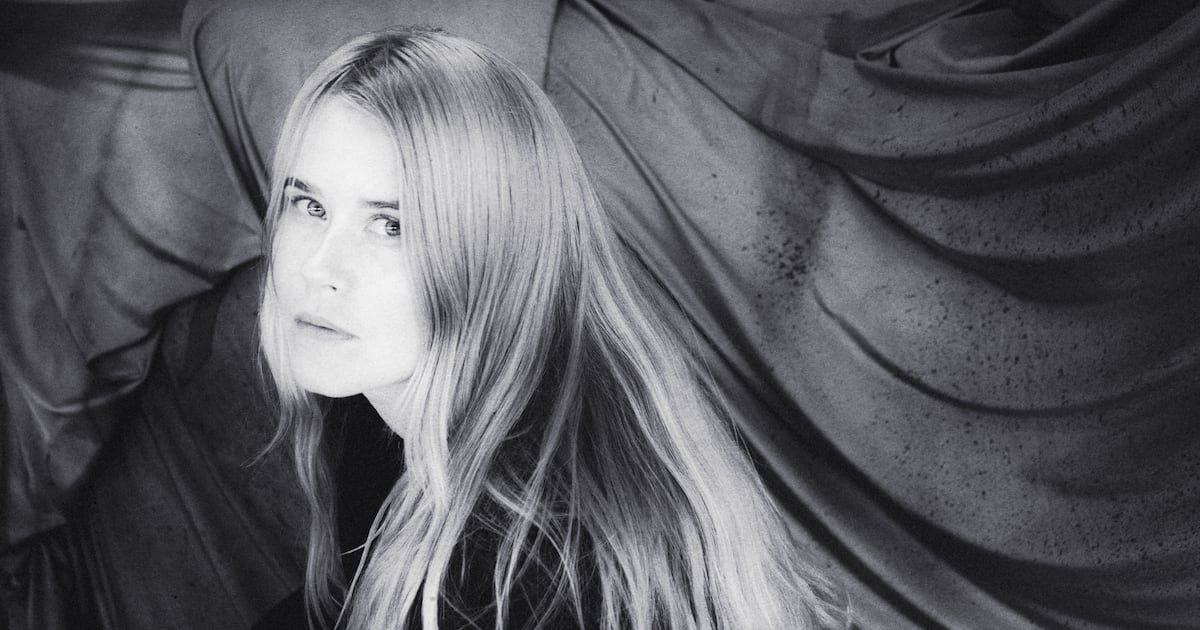
The voices outside the church doors were growing louder and angrier, and Anna von Hausswolff had no idea what would happen next. “I did not feel safe at all. It was scary, and the first time I’m encountering this kind of violence from within a protest towards my work. It was just overwhelming.”It was December 2021, and the cult Swedish musician, whose music navigates a course between Enya and dark metal, had come to Nantes, in northwest France, to perform at the 19th-century Notre-Dame de Bon-Port basilica, where she would play on the neoclassical pipe organ. But hardline Catholics had caught wind that the church was about to welcome an artist whose output The Quietus had described as “post-rock, prog, doom metal, modern classical and high church music all coexist[ing] in uneasy alliance”.READ MOREDenouncing her as a “high priest of Satanic art”, the protesters barricaded the outside of the building, preventing concertgoers from entering. Inside, von Hausswolff sat alone, staring at the organ and finally concluding she had no choice but to cancel.“I had the bishop’s blessing. It was an instrumental work,” she says of the tour, which was also marked by protests in Paris – where she had to switch the venue to a secret location – and in Belgium and the Netherlands. “It was about pipe-organ music and the spirituality within music and being respectful towards that sacred space, working across genres and cultures. All of a sudden I became this kind of iconoclast, and that was really not my intention.”Von Hausswolff is recalling the incident amid a hectic schedule that has seen her perform on three continents in as many weeks and will be followed by her first performance in Dublin, at the National Concert Hall, next week.[ Anna von Hausswolff at All Together Now 2026: Not just brilliant but genuinely surprisingOpens in new window ]Life has been helter-skelter for von Hausswolff ever since the release last year of her album Iconoclasts, a project that, among other things, is a meditation on the trauma she experienced as she became persona non grata to radical Catholics in France.The Nantes incident left a deep mark on her and significantly influenced Iconoclasts, her sixth album, which has become the most acclaimed record of her career. (Among other accolades, it won the Swedish equivalent of the Grammy.)Across its 12 tracks, she embraces and celebrates the idea of being an iconoclast – someone prepared to face down their most fervent critics. It was not a label she sought, but she has now taken ownership of it.Iconoclasts is a beautifully doomy listen, blending von Hausswolff’s signature apocalyptic pipe organ, banshee-like vocals and a maximalist heavy-metal ambience: it is music that would feel equally at home in Tolkien’s Middle-earth and in a mosh pit where things are about to kick off.But for all its unearthly qualities, it ripples with very human pain. On the song The Iconoclast, for instance, von Hausswolff rewinds to the state of mind she was in after the controversy in France, pleading for room to be herself. “Give me some head space, give me a mirror,” she howls. “I need to lean into myself for a while.”Looking back on that controversy, she says that, as a woman bringing heavy-metal aesthetics to baroque church music, she was an all-too-easy target for people trying to whip up a moral majority.[ Stevie Wonder in Dublin: Sky-high ticket price worth it for a few hours with a musical geniusOpens in new window ]“There was an election in France, and there was a right-wing party that wanted to gain votes from Catholics all over France. They wanted to find the most traditional point of view – and used me as a tool,” she says.“And so I became like a little brick in their play, where they would encourage people to come and demonstrate against this concert of mine. It was their way of finding community within the integralists” – who believe Catholic law should have legal status – “and the extreme Catholic community. “Then of course you have traditional Catholics; they are not all extremists, perhaps – but maybe they don’t approve of contemporary or not strictly religious music within the church.”Anna von Hausswolff This wasn’t von Hausswolff’s first brush with infamy. In 2013, she posed for a photograph wearing a T-shirt emblazoned with the name of the Norwegian black-metal band Burzum, whose far-right founder, Varg Vikernes, was convicted in 1994 of the fatal stabbing of a rival musician – and who was later convicted in France of inciting racial hatred.“I have had a great share of controversies throughout my career. The first one was me just being a little bit stupid, [wearing] a Burzum T-shirt for a photograph for an interview. “I was not thinking about how that could be interpreted. I did not think about how people would think I could potentially be a supporter of his views. It didn’t cross my mind, and it sounds so naive, but I was truly very naive when that happened. That became like a lesson of presentation, and how important it is,” she says.[ ‘Simon Amstell was horrible to me on Never Mind the Buzzcocks. He was mean’Opens in new window ]Von Hausswolff acknowledges that wearing Burzum merch was a mistake. In the case of what happened in France, however, she was in the right. She is proud to have stood up for her beliefs and continued with her tour. “It encouraged me to stick to what I’m doing, be proud of what I’m doing and not let extremist views come between me and my work – and stand my ground if I believe strongly in what I do.”Blending saxophone, organ, guitar and Kate Bush-goes-crowd-surfing vocals, von Hausswolff’s music is a collision of the modern and the ancient, the comforting and the terrifying, the dark and the fantastical. She has been compared to neogoths such as Dead Can Dance, while on Iconoclasts she collaborates with hell-raisers old and new in the form of Iggy Pop and Ethel Cain.But amid all this beautiful bombast, her songwriting is capable of remarkable sensitivity. On Aging Young Women, her haunting orchestral duet with Cain, she reflects on the pressures put on women as they age, observing, “We’re getting older by the hour, and every year we have more fear.”“It can be tough. If you’re a man, you’ll never understand what it means to be a woman. You’ll never understand the struggles that we have, what it means to be a woman, especially my age,” says von Hausswolff, who recently turned 40. “It’s a delicate age. You have to make a lot of important decisions about who you are, where you want to be, if you want to have a family, if you don’t want to have a family. You’ve come to that kind of edge of a cliff.”These issues occur throughout society, but especially in arts and entertainment. [ The Music Quiz: Which type of Japanese dish is favoured by Spanish singer Rosalía?Opens in new window ]“Everybody wants to try and look younger than they really do,” she says. “And I think women are scared to present themselves as their natural selves, as their natural, beautiful older selves. They’ve been told by commercials and society that they don’t ‘do’ when they’re 45.”Von Hausswolff grew up in Gothenburg, where her father had some notoriety as an avant-garde artist. She has a vivid childhood memory of watching him perform a piece in which he locked himself in a bathtub and apparently set it on fire. She now lives in Copenhagen, where she began work on Iconoclasts almost a decade ago. During that time, she has witnessed the world turn topsy-turvy in all sorts of ways.“The first thing that happened was that Trump was elected as president. So that was a little bit of a shocker. And then came a lot of activist movements with that. Black Lives Matter came, and the whole Greta [Thunberg] environmental movement. And then, of course, the pandemic. And that shut everything down. All these great movements were silenced by a pandemic. And then came inflation.”She sighs, as if temporarily overwhelmed by it all: the memories of Nantes, the world and all its strife, her jet lag. “It was a roller coaster of emotions and political happenings throughout the years I wrote this album. It has most definitely affected the outcome. There are a lot of things that are falling apart that are a very integral, important part of the democratic society. It’s a confusing, scary time to witness, to see how a lot of beautiful things are crumbling.”[ I didn’t get to see George Michael’s Faith tour. Can a new concert film make up for that?Opens in new window ]But von Hausswolff still has hope – and, cheesy though it may sound, she believes music and community can help bring about spiritual healing. After a decade of watching the world fall apart, the musician wants to give her audience something to hang on to. “I wanted the album to feel like encouragement, about rising up against the titans in a way, within and without,” she says. “Writing this album was a cathartic and healing way of finding strength and courage in place of numbness and hopelessness.”Anna von Hausswolff is at the National Concert Hall in Dublin on Wednesday, November 11th
Singer Anna von Hausswolff: ‘A right-wing party wanted to gain Catholic votes. They used me as a tool’
Full Article
Original Source
Read the full article at Irishtimes →KhanList aggregates and links to publicly available news content. We do not host full articles from third-party sources. Always verify important information with original sources.