
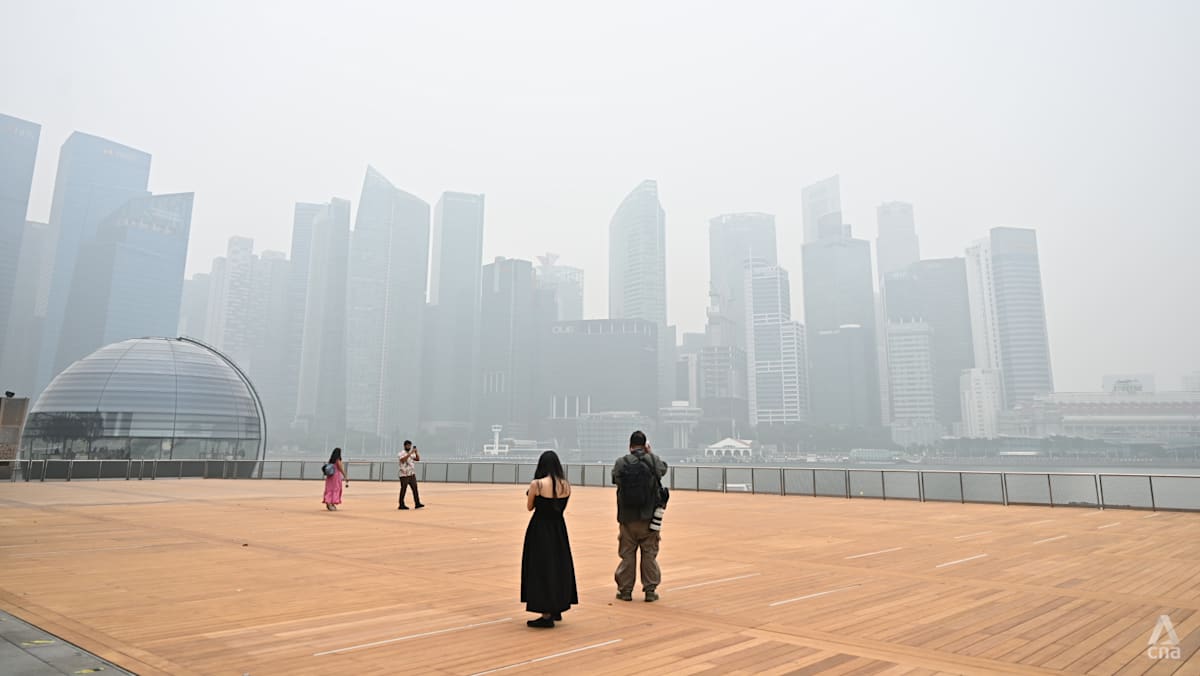
SINGAPORE: After about two months of its worst haze episode since 2015, which pushed air quality into the unhealthy range, Singapore is ending most of its haze mitigation measures on Saturday (Nov 7), following a sustained improvement in conditions. The move will see the end of daily haze advisories, N95 mask distribution and the closure of designated haze shelters, while the inter-agency Haze Task Force will stand down. Subsidised treatment for haze-related conditions will cease from Nov 12.This year’s haze was less severe than in 2015 at its peak, but unhealthy air quality persisted for longer. Yet Singapore avoided some of the widespread disruptions seen over a decade ago, including school closures and food delivery suspensions.The government also stepped up its response as the haze worsened, distributing masks to vulnerable groups, providing subsidised medical treatment and announcing tougher measures against companies potentially linked to the fires. Experts told CNA that Singapore had generally handled the public health response well, although questions were raised about the pace of regulatory action.In addition, holding companies accountable for fires beyond Singapore’s borders remains a formidable challenge.CNA looks back at how this year’s haze compared with previous episodes, how Singapore responded and whether the country is better prepared for the next one. HOW BAD WAS THIS YEAR’S HAZE?The haze returned to Singapore in September, with the 24-hour Pollutant Standards Index (PSI) entering the unhealthy range on Sep 4 for the first time since Oct 8, 2023.From Sep 4 to Nov 6, Singapore recorded 38 days when the 24-hour PSI was in the unhealthy range in at least one region.Air quality deteriorated further in October, with the 24-hour PSI reaching 230 in western Singapore on Oct 18 - the highest reading since 2015 when air quality reached hazardous levels.Hourly PM2.5 readings, which offer a more immediate indication of air quality, also surged to their highest levels since 2015 on Oct 14. While neither the 24-hour PSI nor hourly PM2.5 readings surpassed the peaks recorded in 2015, this year's haze stood out for its persistence.In 2015, the longest stretch when the 24-hour PSI stayed above 100 in at least one region was 164 hours. This year, it remained at those levels for 422 hours - more than 17 days.The prolonged haze this year led to cancellations and postponements of outdoor events, but Singapore avoided some of the more disruptive measures seen in 2015, including school closures and food delivery suspensions.The episode was the latest reminder of Singapore's vulnerability to transboundary haze, which has affected the country repeatedly since the 1970s.Caused largely by forest and land fires in Indonesia, and exacerbated by dry weather conditions, previous episodes have disrupted businesses, forced schools to close and prompted investigations into companies suspected of contributing to the pollution. HOW DID THE GOVERNMENT RESPOND?As air quality deteriorated, the government rolled out a series of measures to protect public health.The National Environment Agency (NEA) began issuing daily health advisories on Sep 4, when the 24-hour PSI first entered the unhealthy range.The government had initially planned to distribute N95 masks to vulnerable Singaporeans if the 24-hour PSI exceeded 200. But this was brought forward to Oct 14 following a sharp rise in hourly PM2.5 levels.In a second round of distribution, the age threshold for free masks was lowered from 67 to 60.Subsidised treatment for haze-related conditions was also rolled out at Public Health Preparedness Clinics and polyclinics. A vending machine which dispenses masks being set up by a contractor at Ang Mo Kio bus interchange on Oct 15, 2026. (File photo: CNA/Marcus Mark Ramos) People queueing to collect N95 masks at Bishan Community Club on Oct 15, 2026. (Photo: CNA/Marcus Mark Ramos) Experts CNA spoke to broadly praised the government’s public health response, particularly its communication on the health risks and efforts to protect vulnerable groups.“In any health crisis, there are two competing goals that governments have to balance - the need to act and the need to calm people down so that they do not overreact and panic,” said Emeritus Professor Ang Peng Hwa from Nanyang Technological University (NTU).“I thought the government did well in balancing those competing goals,” he said.The availability of hourly PM2.5 readings and public health advisories to provide practical guidance helped people make more informed decisions about their daily activities, said Assistant Professor Tan-Soo Jie-Sheng, director of the Institute for Environment and Sustainability at the Lee Kuan Yew School of Public Policy.“Measures such as providing masks to vulnerable groups and ensuring that schools have access to air-cleaning equipment are also important components of Singapore’s preparedness,” he added. REGULATORY ACTION UNDER SCRUTINYBut beyond protecting residents from the immediate effects of the haze, the government's response to those potentially responsible for the pollution came under greater scrutiny.In June, the Singapore Institute of International Affairs warned that Southeast Asia faced a high risk of severe transboundary haze because of hotter and drier conditions associated with a strong El Nino.Yet it was only around mid-October, as the haze intensified, that the government began announcing a series of regulatory actions against companies potentially linked to the fires.Singapore said it was issuing preventive measures notices to 10 companies in Indonesia that could be connected to fires contributing to the haze.It subsequently issued notices under the Transboundary Haze Pollution Act to 10 Singapore-registered companies, seeking information about their land concessions, corporate links and firefighting efforts in Indonesia.This marked the first time such notices had been issued to Singapore-registered companies. A specialist panel to probe firms possibly tied to the fires was announced in late October. Singapore Foreign Minister Vivian Balakrishnan shakes hands with Indonesia's Foreign Minister Arrmanatha Nasir during their meeting in Jakarta, Indonesia, on Oct 27, 2026. (File photo: Reuters/Ajeng Dinar Ulfiana) That same month, Foreign Affairs Minister Vivian Balakrishnan travelled to Jakarta, where he and his counterpart Arrmanatha Nasir unveiled plans to set up a joint task force to investigate companies linked to forest and land fires behind the transboundary haze.In November, parliament passed amendments to the Transboundary Haze Pollution Act, raising the maximum penalty by tenfold and giving the relevant authorities the power of arrest in Singapore, to enable them to secure the cooperation of persons of interest more effectively.Associate Professor of Law Eugene Tan observed that the government’s initial muted response had gathered momentum as public frustrations grew."It was the palpable public unhappiness that compelled the government to act with a slew of measures, including activating the haze task force and upping the ante on companies suspected of causing the haze," the Singapore Management University professor told CNA.While the haze started as an external issue, it later became a domestic one with political implications, he said. “How the government deals with this severe and regular health and economic threat will impact … public trust and confidence in the government's ability to deal with the haze.” But could Singapore have acted earlier, given the advance warnings?Asst Prof Tan-Soo doubted there was much Singapore could realistically have done to prevent the fires themselves.“This is fundamentally a transboundary issue. Even if we receive early warnings of an increased risk of haze, that does not necessarily provide sufficient grounds to investigate particular companies or demand information about their land-management practices,” he said.However, he noted that the latest amendments to Singapore’s transboundary haze law could allow authorities to intervene earlier in future, when overseas fires pose a credible risk of haze reaching Singapore, even before the pollution arrives.Prof Ang, meanwhile, said he would be surprised if contingency planning did not begin last year, when fires occurred but prevailing winds kept most of the smoke away from Singapore.NTU Albert Winsemius Chair Professor of Economics Euston Quah said he found Singapore better prepared for this year's haze compared to past episodes, noting that there were no real N95 mask shortages, more information on air quality levels and "a greater determination to do more with what can be done dealing with the transboundary haze". "We must always remember too that we don't want to over-prepare, as there are costs involved," he added. "There will always be haze damage costs, but this must be considered with haze prevention costs and adaptation measures." WILL TOUGHER LAWS MAKE A DIFFERENCE? Experts said Singapore's recent moves to strengthen its haze legislation and enforcement powers could help deter companies from contributing to the pollution.But significant challenges remain, particularly when the sources of the haze lie beyond Singapore's borders.Since the Transboundary Haze Pollution Act was introduced in 2014, there have been no prosecutions. Of six investigations opened in 2015, two have been closed while four remain ongoing.Prof Quah said the latest measures could impose additional costs on firms, potentially encouraging them to adopt land-clearing methods that do not involve burning.“(But) whether this will work effectively or not would very much depend on the probability of getting caught and convicted,” he said.As the cases involve jurisdictions outside Singapore, gathering evidence and carrying out enforcement remain difficult, said Prof Quah.“Looking back over the years, the success rate in bringing culprit firms to court remains elusive and, on the whole, not encouraging,” he said. Assoc Prof Tan similarly cautioned that the fundamental obstacles to enforcement remain.“All possible gaps have been addressed to varying extents, but they cannot surmount the reality that the sources of the haze pollution are not in Singapore and that the gathering of evidence that can increase the prospects of a successful prosecution are outside of Singapore,” he said.And stronger regulations could have unintended consequences.Asst Prof Tan-Soo cautioned that tighter regulations could prompt firms to relocate their Singapore-based operations elsewhere.As land-clearing activities are already taking place in Indonesia, firms could instead shift their headquarters, financing arrangements or trading operations out of Singapore, he said.“In that scenario, Singapore could lose some of its regulatory leverage over these companies without actually reducing the fires,” he added. REGIONAL COOPERATION, CIVIL SOCIETIESFor all the stronger laws and enforcement powers, experts agreed that Singapore cannot solve the haze problem on its own.Asst Prof Tan-Soo said the ultimate goal should be to change the economic incentives and land-management practices that contribute to the fires.“Ultimately, the goal should be to improve transparency and change land-management practices at source, rather than simply reducing Singapore's exposure to companies associated with deforestation,” he said.He and Prof Quah pointed to a need to make non-burning land management methods and forest conservation more economically viable.This could involve supporting fire-free land preparation, developing commercially viable forest-based businesses, and creating credible financing mechanisms that reward conservation, said Asst Prof Tan-Soo. Prof Quah suggested that countries affected by the haze could establish a shared fund to purchase machinery and equipment for farmers and plantations in Indonesia, reducing their reliance on fire to clear land.“The setting up of this fund and the cost sharing can be likened to a form of foreign aid from victim countries to Indonesia itself,” he added.But regional cooperation should not come at the expense of accountability, Assoc Prof Tan cautioned.He pointed to the principle of customary international law that countries have a responsibility not to cause environmental harm beyond their borders.“A country has the sovereign right to exploit its natural resources within its territorial boundaries. However, that sovereign right does not justify its actions and activities that cause harm or damage to another country. If it does, it is legally liable,” he said.“We cannot lose sight of this important customary international law. Otherwise, the haze crisis will continue with a patent lack of responsibility and accountability among stakeholders.”Beyond governments and businesses, civil society could also play a greater role.Prof Ang recalled how the Singapore Environment Council and Consumers Association of Singapore had previously urged consumers to boycott companies whose land-clearing practices contributed to forest fires.“Involving civil society groups has the salutary effect of empowering individuals,” said Prof Ang.“That is, each Singaporean must feel that they are able to do something to fight the haze, not just to accommodate it by wearing masks or staying indoors with the air conditioner and air purifier on.”
Singapore’s worst haze since 2015: What went right, and what are the lessons?
Full Article
Original Source
Read the full article at Channelnewsasia →KhanList aggregates and links to publicly available news content. We do not host full articles from third-party sources. Always verify important information with original sources.