
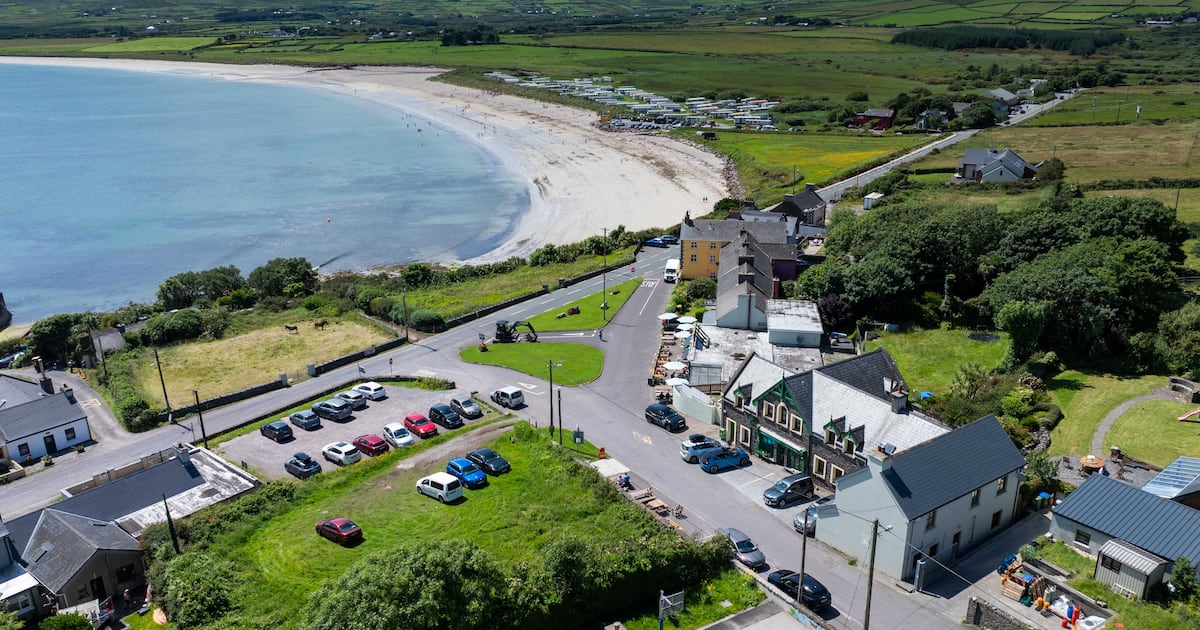
In Ventry, Co Kerry, there’s a man who has lived on the R559 for 25 years. From his livingroom window, he has watched cars fly past at over 100km/h on a road with a speed limit half that. But these cars aren’t just breaking the limit outside his house. They’re passing a primary school and post office with no footpath. Despite writing to gardaí asking for speed bumps and a speed display sign, nothing has happened.This summer, in a submission to Kerry County Council’s speed limit review, he even offered to pay for the sign and ramps himself. “Please do something now,” he said, sounding weary after watching the problem worsen for a quarter-century.He is not the only person in Ventry – or Ceann Trá – who has had enough. Twelve of the 47 submissions to the county’s draft special speed limit bylaws came from this village, including the local school, community development committee and a man whose front door opens directly on to the road. I downloaded and analysed all 47 submissions, translating many written in Irish.What I learned is that the national debate on speed limits has been getting quite a lot wrong.READ MOREIn the media, you often hear lower speed limits described as a Dublin idea, conjured up as a moralistic pretence in a city where traffic barely moves fast enough for them to matter, then imposed on rural communities that do not want or need them. The Kerry submissions say otherwise. Roughly three-quarters supported the lower limits, and almost all wanted more: the draft did not go far enough.Residents of Cahersiveen, Killarney, Tralee, Dingle, Listowel and Milltown all wrote to ask the same question: why had they been left out? Why had their particular street, school road or estate been left at dangerous levels of 50km/h or 60km/h while a road half a mile away was going to 30km/h?More interestingly, I looked at who had taken the time to submit a response, and was struck by the lengths they had gone to simply to be heard. A staff member at a primary school near Dingle describes near-misses at school gates, where the limit is 50km/h and there is no crossing for children. A mother in Milltown walks her pram past the school twice a day, and writes that “there is no way that 80 per cent of the cars and farm machinery on that stretch of road are sticking to the 60kph limit, let alone the 50kph limit closer to the primary school”, and the digital signage confirms this. A Killarney resident logged the speed counter at the end of his road and found that more than 90 per cent of vehicles broke the limit, with a top reading of 95km/h. He then measured the footpath against the Design Manual for Urban Roads and Streets and found that it, too, fell below standard. A Tralee man filed 12 separate observations, sheet reference by sheet reference. [ Seven years after asking, gardaí cannot access driving licence photosOpens in new window ]Another resident pulled the Road Safety Authority collision map for a single road and counted the injured: five drivers, five pedestrians, two cyclists and a motorcyclist.At some point, engrossed in these mini-stories told through a single road speed limit, I began to wonder what exactly was happening here. Had Kerry accidentally assembled a civilian road-safety investigation unit? Residents were counting collisions, measuring footpaths, recording speeds and cross-referencing design standards – effectively doing the evidence-gathering long abandoned by Government.There were sceptics, too, worrying about congestion, enforcement and jarveys on Ross Road. But the most interesting objection came from the Irish Cycling Campaign, which opposed the bylaw on analytical grounds. Its submission asked how these limits were decided. No methodology had been published; there was no explanation of transition points, and some streets on the maps had no speed limit at all. Glenbeigh Community Council similarly could not establish whether its village had even been assessed, because it did not appear on the consultation map.Eight people died on Kerry’s roads last year, one of the highest death tolls in the country per thousand people, and the council is attempting to lower speed limits one by one, in the way the Government has told it to. This is a system that makes 31 local authorities each run their own consultations, configure their own maps, painstakingly defend their own choices road by road – and then rely on citizens to figure out what was missed.Why do it this way, especially when an expert review commissioned by government in 2023 recommended a default 30km/h limit in built-up areas? The Oireachtas legislated for it in the Road Traffic Act 2024. Yet two years later, that provision has never been commenced. When I asked senior Department of Transport officials why, in March, I was told there were “legal reasons” the State could not do what other countries had done. Those reasons have never been published.[ Technology solutions to tackle wrong-way driving could be 15 years awayOpens in new window ]Spain made 30km/h the default on most urban streets in 2021, with deaths subsequently falling 20 per cent on those roads and cyclist deaths by a third. Wales made 20mph the default in 2023; deaths on those roads fell 26 per cent in the first year. In both cases, councils could raise the limit where they could justify doing so. To my knowledge, no residents in Seville or Swansea had to spend weekends compiling collision data to feel safe walking down their street.Ireland has done the opposite of these places. In Ventry, that means a man watching cars hurtle past his house for 25 years is offering to pay for the speed sign and ramps himself.Perhaps that is the clearest measure of how backwards the system has become: the State has the evidence and the public demand for change. What it seems to be missing is the will to simply do it.
Sinéad O'Sullivan: What one Kerry road tells us about road safety
Full Article
Original Source
Read the full article at Irishtimes →KhanList aggregates and links to publicly available news content. We do not host full articles from third-party sources. Always verify important information with original sources.