
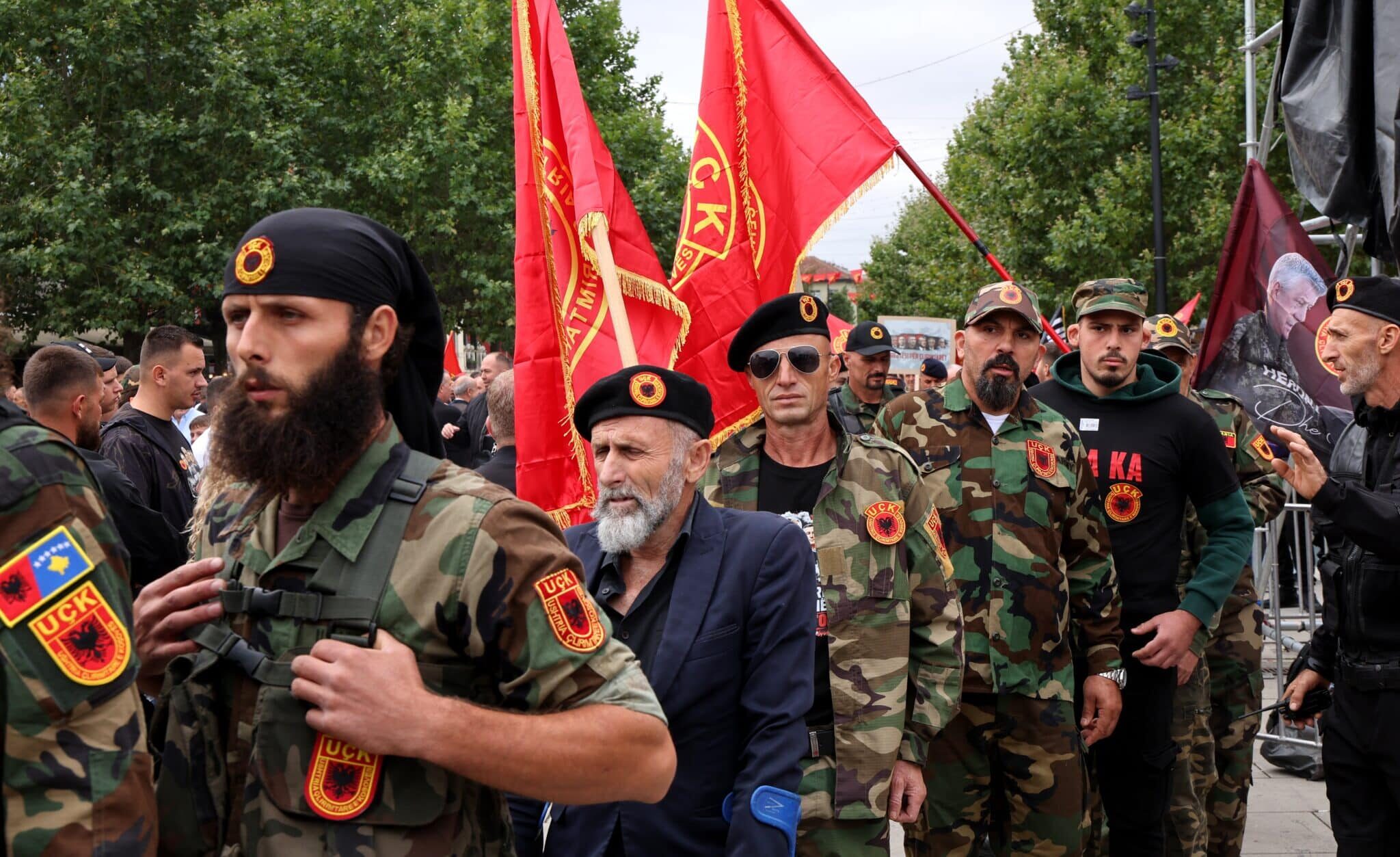
Clint Williamson recalls investigating the four guerrilla commanders recently convicted of war crimes, questions Kosovo’s failure to temper public expectations of an acquittal, and ponders the future of international justice at a time of “dysfunctionality” in the UN Security Council. The man whose initial probe led to the creation of Kosovo’s Specialist Chambers in The Hague is not surprised by the verdict it reached in mid-September, 12 years after he presented his findings. The court, much-criticised in Kosovo, found four former commanders of the guerrilla Kosovo Liberation Army, KLA, guilty of war crimes including arbitrary detention, cruel treatment, torture and murder between April 1998 and June 20, 1999. Hashim Thaci and Jakup Krasniqi, who went on to become president and parliament speaker of Kosovo respectively, were each sentenced to 25 years in prison, Kadri Veseli and Rexhep Selimi to 18 and 13 respectively. Protests against the verdict are still ongoing in Kosovo. US lawyer Clint Williamson led the investigative task force set up by the European Union to investigate allegations of war crimes made in a Council of Europe report by Swiss senator Dick Marty. In an interview with BIRN, he said authorities in Kosovo had failed to temper public expectations that Thaci and his co-accused would be exonerated. “I don’t think much effort was made by authorities in Kosovo, or by those people who are commenting on this, to create expectations among people that it might be a little bit different than this single narrative that these individuals were going to be absolved and released,” said Williamson. In fact, he said, the task force’s preliminary 2014 findings “largely tracked” with the judgment of the Special Chambers. “We found that there had been a number of instances of inhumane treatment, of torture, and of murder that were directed at ethnic minorities in Kosovo as well as Kosovar Albanian political opponents of the KLA and of the accused that were recently convicted,” he said. Criticism has been directed at the pace and cost of the Chambers, but its supporters say it succeeded where the UN-created International Criminal Tribunal for the former Yugoslavia, ICTY, failed – in holding KLA commanders to account for crimes committed by their forces. The ICTY was born at the end of the Cold War, when the West was riding high and so was the idea of international justice. Williamson, who also worked as a prosecutor at the ICTY and is now lead coordinator of the Atrocity Crimes Advisory Group for Ukraine, a joint US, British and EU initiative, said that the experience of the Kosovo Specialist Chambers showed how international justice may now have to come “through regional organisations, through partnerships between the international community and national governments”. “There have been a lot of ups and downs,” he told BIRN. “We have seen a lot of international and hybrid and regional courts that have been created. I think right now it is a tough period for international justice.” Williamson said that while future courts may not look exactly like the Kosovo Specialist Chambers, “things like this will have to be crafted based on the particular circumstances in a given country with a given conflict”. Clint Williamson. Photo: BIRN. ‘Not in My Name’ The so-called ‘special court’ was established under a law adopted in 2015 by the Kosovo parliament, under pressure from Pristina’s Western allies. Thaci was one of those who backed its establishment, saying it would prove the KLA’s war was just. The court is part of Kosovo’s judicial system but located in The Hague and staffed by internationals as part of an effort to prevent witness-tampering. The verdict against Thaci and his co-accused can be appealed, and Thaci’s defence team has already said it plans to do so. For almost two weeks, Albanians in Kosovo and across Europe have been protesting against the verdict. Hundreds have gathered daily on Pristina’s main square. On Friday and over the weekend, parallel protests were organised throughout Kosovo, Europe, and in Australia. Protesters have adopted the slogan ‘Not In My Name’ – a reference to the words of presiding judge Charles Smith III, who, in announcing the verdicts, said “in the name of the people of Kosovo”. Smith stressed the case was not about the legitimacy of the KLA or its fight for independence, but many Kosovars say this is precisely what has been questioned. Williamson stated also that the process “was not directed at the KLA”. “This was looking at the individual guilt of persons who had leadership roles in the KLA,” he told BIRN. “As I said in 2014, as the court went to pains to explain, this was not an indictment of the KLA. This was not a judgment against the KLA as an organisation. This was a court that was set up to look at individuals who are in leadership positions, leadership roles.” Asked whether the court would have enjoyed greater legitimacy in Kosovo if it had not tried only former KLA fighters, Williamson said: “This was not designed to be a court to look at every crime that was committed in Kosovo and nor was the ICTY. So this was in effect a continuation of the work that the ICTY was doing, but which was limited because of jurisdictional mandates. So for that reason, there was never any thought given to creating a court to deal with the wide range of cases.” Rexhep Selimi, Hashim Thaci, Jakup Krasniqi and Kadri Veseli in court the during the verdict on September 16, 2026. Photo: Screenshot/Kosovo Specialist Chambers.Men convicted were long suspected of war crimes Williamson recalled investigating the four men who were later convicted. “Certainly Thaci, Veseli, Selimi and Krasniqi were part of our investigation,” he said, though the EU task force cast its net wider. In the end, the four were convicted of contributing to a “joint criminal enterprise”. Williamson said his task force “really did not get to this issue of joint criminal enterprise during the course of our investigation”. “Had I continued to be involved after that point, I think we certainly would have come to the same conclusion that there was a joint criminal enterprise,” he added. “We were focused very much on the individual responsibility of potential perpetrators. But we did recognise that there was a common purpose that was at play here. There was certainly a high degree of cooperation and collaboration between these individuals.” While acknowledging that some individuals responsible for war crimes during the bloody collapse of socialist Yugoslavia were never brought to justice, Williamson said he considered the efforts of local and international courts successful. The Kosovo Specialist Chambers, he said, marked a new approach to transitional justice. “The precedent here is that this was a rather innovative approach that had to be undertaken to put in place this justice process.” Given the “high degree of dysfunctionality” in the UN Security Council right now, Williamson said there was “absolutely no consensus for any sort of accountability processes there or for much of anything else for that matter”.
US Prosecutor Questions Kosovo’s Failure to Mitigate Thaci Verdict Expectations
Full Article
Original Source
Read the full article at Balkaninsight →KhanList aggregates and links to publicly available news content. We do not host full articles from third-party sources. Always verify important information with original sources.