
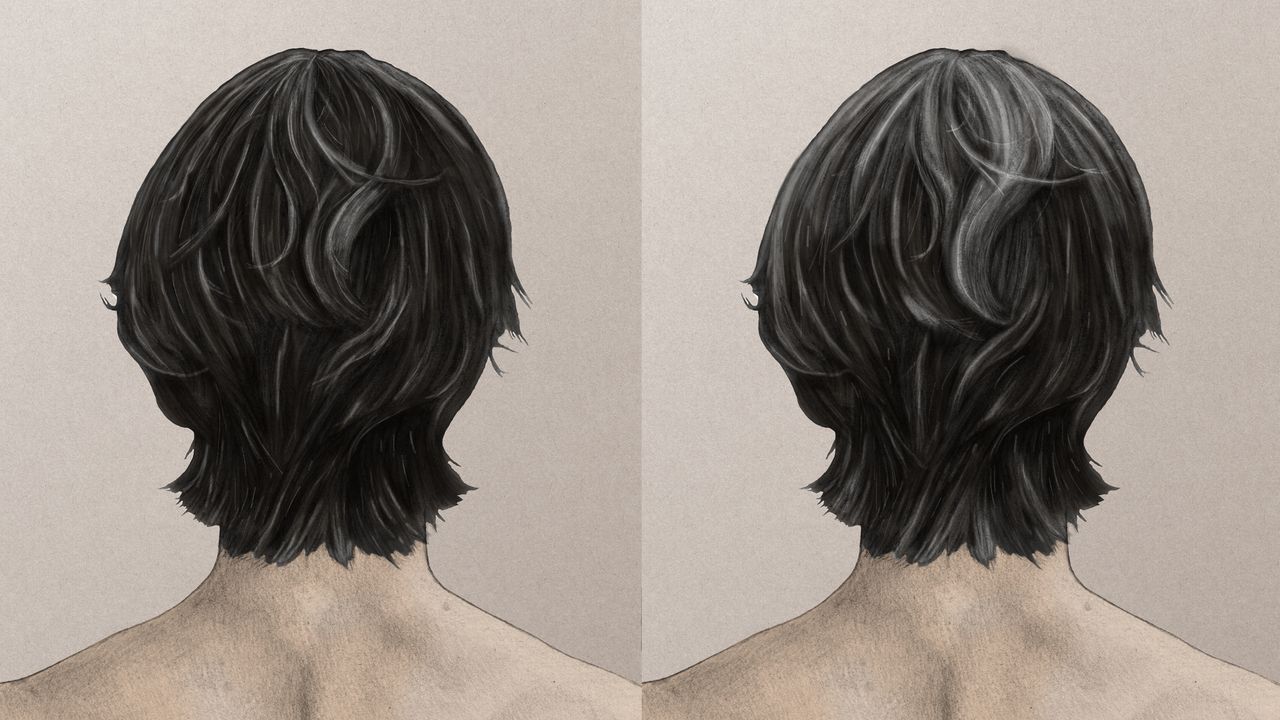
They started going gray in their teens and 20s. Now, instead of reaching for the dye, more guys are learning that silver can mean gold.At 16, James Chudley’s first gray hair was spotted by the girl sitting next to him in Biology. He thought it was a joke. She took a photo to prove it. There it was: one silver thread, just above his ear. “For the rest of the year,” he says, “every Biology lesson, it was: ‘Oh, there’s another one!’”Chudley, now a personal trainer-in-training from Surrey, wasn’t too bothered. “I thought I’d just pluck it out,” he says. By 19, though, there were too many to pluck. An anti-gray shampoo turned his bath blue; dye was another option, but he had reservations: “I didn’t want to end up looking like Dracula.”Away from school, Chudley gradually got comfortable with his grays. Even so, he mentioned them before anyone else could, “almost as a defense mechanism.” Usually the response was playful roasting, sometimes even a compliment. But then someone would catch him off guard. Chudley, now 22, was recently working as a delivery driver when a customer looked him up and down. “Bit young to be going gray, isn’t it?” she said. Almost as an afterthought, she added, “Is it stressing you out?”Gray hair is an inevitability for most men. Live long enough, and the color starts to drain. For many people, that begins in their early 30s and becomes more visible with age. By 50, suggests a study by the British Association of Dermatologists, up to 23% of us will have half a head of gray hair. The science is straightforward. Hair follicles contain melanocytes, the cells responsible for producing pigment. As we age, the stem cells that replenish them become less active, and the color fades. It’s like a printer cartridge running out of ink: the paper keeps coming, but eventually, there’s nothing on there.Going gray in your teens and early 20s, however, is another matter. It’s relatively uncommon, although anecdotes are easy to find. Spend five minutes on TikTok and you’ll see plenty asking why they’re suddenly gray. Reddit has versions too, with users swapping stories and theories about why they—and seemingly everyone around them—are losing their color so young. “I don’t know if you’ve noticed, but people’s hair seems to be turning white really fast lately,” says one post. “How did we end up in the worst century where literally anything can go wrong?”It’s hard to say if we’re actually going gray earlier, or if it’s just that more people are talking about it. The theories, meanwhile, keep on coming—from mineral deficiencies to heavy-metal exposure. There’s also an optimistic explanation: More people are open to embracing it.Young men are spending more money than ever on looking good—even on their grays. Rather than shopping for cheap cover-ups, they are forensically researching science-backed cosmetics. Part of this also means a rejection of chemical-heavy products and a more skeptical attitude towards unnecessary cosmetics. Hair dye, after all, is not entirely harmless.Online communities like “Gray and Proud” and “Silver Revolution” have tens of thousands of members. Paul Mescal and Jeremy Allen White have also done their part for gray-hair representation among young(ish) people: The Times dubbed them “silver fox cubs”.Maybe things really are shifting. But if the demand for anti-gray products is any indication, the revolution is still a way off. Anti-gray serums are becoming big business. The global market is expected to jump from around $1.3 billion to $2 billion by 2031, according to Deep Market Insights. Cosmetics Business magazine calls it the “next men’s grooming trend,” with growing interest in peptide-based products. On the internet, you see both sides. On Reddit, a 26-year-old guy shares a photo of his gray head of hair, saying that he’s already got more than his dad. The top comment reads: “Do your due diligence, of course—bloodwork, diet etc.” Someone else follows up with: “[Guys] with gray hair are [hot].”One person making the case for Gen Z’s grey-haired men is model and musician Charlie Jeer. The 24-year-old first found fame on the Netflix dating show Too Hot to Handle. He has the chiseled jawline and cheekbones of a conventional heartthrob, but there’s another feature viewers can’t seem to get past: his hair. “I feel like it gets brought up in conversation every single day in my life,” he says.Jeer first noticed the grays as a teenager, and mostly shrugged off the comments. Online, it’s a different story. “Why are you going gray?”; “Can’t tell if bro is 15 or 60; ” “Err this old man.” “It’s relentless,” he says.Now, Jeer sees the grays as an opportunity to stand out. They’ve helped build his profile as a model, too, partly because of the “age ambiguity” they give him. He’s picked up credits with brands like Davidoff and Adidas. “There’s a massive commercial potential for me to make a black hair dye and just start marketing that,” he says. “I never did because I was like, ‘No, I’m proud of my hair the way it is.’”On TikTok, Jeer takes on his critics with captions like: “Joke’s on them when I’m a silver fox by 30.” He really likes it when he hears from other young guys going gray. “I’ve had a little gray-haired community of people come forward and present themselves,” he says. “It’s nice to hear someone else say that they’ve had people come at them for being gray-haired and that they’re going to continue to wear it with confidence.”Jeer might be on the young end of the gray-hair population, but as a guy, he’s riding a well-worn track. Men have always been afforded the privilege of associating their grays with looking more distinguished. You don’t have to be George Clooney (or a Too Hot to Handle contestant) to benefit from that. Women, meanwhile, aren’t part of that deal: gray hair is more often simply read as old, an obviously unfair double standard.It still come with baggage for men, though: age, lost virility, fading relevance. “The first gray” is practically a trope in its own right—a visual shorthand in films, books and TV for a character beginning to age, often followed by the inevitable midlife crisis. There are dozens of those scenes, in everything from The Simpsons to Vanilla Sky.Matt Newman is a New York–based hairstylist who hates his gray hair. “There are so many examples of men with premature grays that people love and adore,” he says. “But in your 20s, that might not be an aesthetic you’re ready to dive into.”Perhaps that’s why Jackass star Johnny Knoxville waited until 49 to finally embrace his natural hair color. He started going gray in his 20s and dyed it for most of his life. Then, during lockdown, he asked his wife to give him a buzz cut to reveal the silver underneath, on Instagram. “I should start a challenge but I don’t want to call anyone out,” he wrote on Instagram. Going gray, declared one Mr. Porter headline, was now a “punk power move”.That’s not quite how Saavan Varambhia, 25, a data analyst from Buckinghamshire, would have described it. Not at first, anyway. Like Chudley, he was at school when a group of female friends spotted his grays and tried to pluck them out. “I was like, ‘Hmm, I don’t know how I feel about this,’” he says. A few years later, he had enough gray hairs on his head to “stop people in their tracks.”For Varambhia, the contrast was hard to miss. He’s South Asian, with naturally deep-black hair, so the grays stood out. The Journal of Clinical and Aesthetic Dermatology reports that people of Asian descent also tend to go gray later, often in their late 30s. According to Professor Desmond Tobin, a professor of dermatological science at University College Dublin, many Eastern cultures have traditionally been less accepting of grays than the West, with men and women both more likely to dye them.“At first, I felt like I didn’t want to seem a lot older than my peers,” Varambhia says. Over time, though, he came to see the silver as something that set him apart. “I’ve always been one to stand out, and it was another attributing factor to that.”When there are too many gray hairs to pluck, do you reach for the Just for Men, or join the silver fox cub club? Turning gray at any age can make you wonder why it’s happening. According to Tobin, the answer is usually in your DNA. “The first thing to do is just to look at your [previous] generation of relatives,” he says. “They’re going to give you a road map for where you’re going to be. And if you have early grayers—teens, early 20s—then that’s really mapped out quite starkly in the family.”Other things can speed up the process, too. Stress is a big one. Tobin says it can damage the cells responsible for producing hair pigment, acting like a “sledgehammer” if the process has already begun. Just look at Barack Obama’s hair before and after his time in the White House. Nutrition can play a role, too, and a blood test can pick up any deficiencies. But Tobin says the nutritional deficiencies linked to premature graying tend to show up in countries where malnutrition is more widespread.Crucially, though, Tobin says he hasn’t seen hard evidence that young people are going gray earlier across the board. Modern life might come with its share of chronic stressors, he points out, but humans have been enduring trying times since long before social media, climate change, and cost of living crises entered the picture.Tobin is skeptical of the “overstated claims” made by supplements and serums that promise to “tickle your stem cells.” If you want to slow the process, he says, your best bet is the boring stuff: less stress, plenty of sleep and an antioxidant-rich diet. That might hold things off for a while. But for anyone genetically predisposed to graying, it might not make that much of a difference.“Would maximum antioxidant intake really stop somebody from graying who’s genetically headed that way? It’s not likely to be a very significant contributor,” Tobin says. “It might, in a multi-prong way, add up to something, but if you’re graying significantly in your teens, that is probably the die that’s being cast for you.”The good news? Going gray early doesn’t mean the rest of you is aging at the same rate. In fact, there may be a silver lining. People who go gray prematurely are more likely to keep their hair; “nearly all people who bald [do so] with their natural hair color,” says Tobin.But for anyone who doesn’t want to live with their grays, the hunt for a treatment is on. Research into gray hair has surged alongside the wider boom in longevity science. Tobin says the past five years have felt like a return to the 1980s, when the topical hair-regrowth drug Rogaine first shook up the haircare world. He has consulted for startups developing anti-gray treatments aimed at reducing oxidative stress or extending the life of melanocyte stem cells. The science is promising, but so far, nothing has produced evidence strong enough to satisfy regulators.Researchers are beginning to understand that graying may not be irreversible, as once thought. Melissa Harris at the University of Alabama has studied the melanocyte stem cells behind hair pigmentation, and immunotherapy as a way to reverse graying. Other research has shown that some hairs can spontaneously regain their pigment, with changes appearing to track periods of stress. It hints that some aspects of aging may be less linear than we assume.Dr. Greg Williams, a hair restoration surgeon at the Farjo Hair Institute, has watched the field develop. He hosts conference sessions on gray hair and, a couple of years ago, set up a WhatsApp group where specialists around the world could swap ideas and compare notes. “Gray hair is very poorly understood,” he says. “There’s not a lot of research in humans around it.” Maybe that’s surprising, given how universal it seems to be. But commercial fallout is huge. The global hair-and scalp-care industry is worth nearly $9.4 billion, and Williams thinks anyone who figures it out “would be a Nobel Prize winner”.As for Varambhia, the science seems to fit his experience. Genetics are clearly part of the picture: his dad’s hair has been white for years, and he still has a full head of it. Varambhia also suspects stress sped things up. His grays arrived rapidly as he settled into corporate nine-to-five life. Since hitting the gym regularly, he thinks the process may have slowed.Knowing other people going through the same thing has helped. “I know eventually I’ll go fully gray. I hope it’s a bit later on than sooner,” he says. But when the time comes? “I’ll embrace it.”A version of this story originally appeared in the November 2026 issue of British GQ with the title “Gray Ahead of Schedule”Illustrations by Rosie Toole
Silver Fox at 16. How Men Are Embracing Gray Hair at Every Age
Full Article
Original Source
Read the full article at Gq →KhanList aggregates and links to publicly available news content. We do not host full articles from third-party sources. Always verify important information with original sources.