
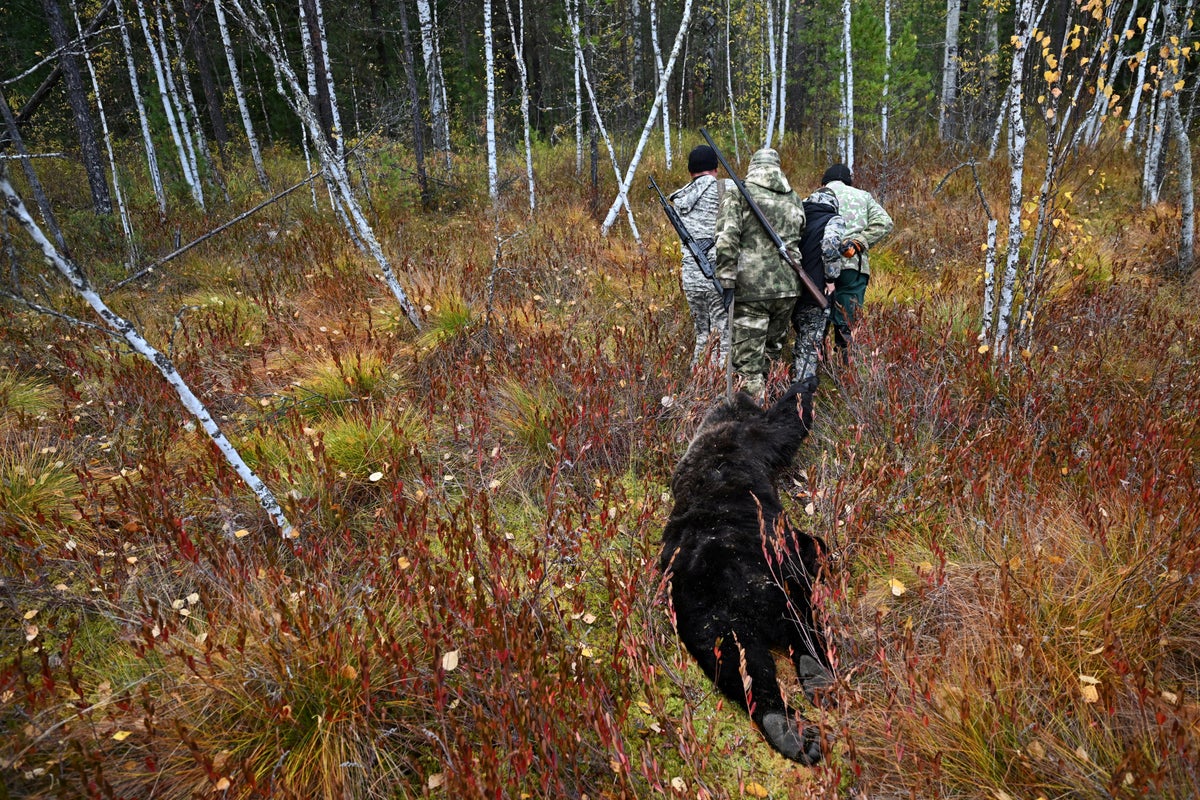
Bounding across the Siberian taiga, a brown bear is tracked by two hunters.Three shots are fired, bringing down the animal into the long grass with a thud.Resting a hand on the dead animal's fur with his rifle held close, hunter Mikhail Kondakov said he and others responded to calls from residents in the nearby settlement of Podtesovo following a fatal attack on local women."The bear situation in the settlement is very difficult at the moment," Kondakov told Reuters. "Bears have increasingly been coming directly into the settlement. This year we had a tragedy — two women who went mushroom picking were killed by a man-eating bear. We decided to start hunting bears because there are so many of them."The issue spans the entire country. State media reported that at least 22 people have been killed in bear attacks since spring, leading the Russian government to draft emergency measures last month to control populations spiralling out of hand in certain regions.The hind paw of a bear shot by hunters outside the settlement of Podtesovo, located on the banks of the Yenisei River amid the Siberian taiga. (Reuters)Official figures show the brown bear population has more than doubled in three decades to 308,000, driven in part by shorter, milder winters.Experts quoted in local media say a dry, early spring starved bears of berries, driving them further afield for food, while uncollected waste and ignored safety rules have further drawn animals to human areas.‘Living in fear’In Krasnoyarsk, the Siberian region where Kondakov is hunting and which is home to nearly 27,000 bears, investigators said last month that they had opened a criminal case into the local environment ministry, accusing it of failing to keep bear numbers under control, negligence which they said had led to the deaths of seven people in September alone.In Podtesovo, a settlement of around 3,500 people perched on the right bank of the River Yenisei, a simple wooden cross stands on the grave of Zoya Gubanova along with a colour photograph of the late pensioner. Gubanova, 67, was killed on August 31 in a bear attack while out gathering mushrooms, a popular Russian pastime.Chatting outside her wooden house, Yulia Markova, a local resident, says the situation has become intolerable."We have been living in fear for almost two months now, we cannot even go out for a walk in the evening. People are afraid to let their children go out alone. This is not a cuddly toy, it is not some soft, harmless teddy bear. It is a wild animal. And who knows what its intentions are, what kind of mood it is in when it comes here. Maybe it is simply curious, or maybe it is looking for its next victim," she said.Markova said that locals, like bear attack victim Gubanova, had not fully understood the danger posed by bears and that people had initially felt sorry for them because they clearly did not have enough nuts and berries to eat this year.But she said hearts had hardened after the bears started coming into the settlement in large numbers."We have never seen an invasion like this before," said Markova.‘Too many of them’Watching her daughter relax at the local playground, pregnant mother Valeriya Efremova said heightened bear activity had changed locals' lives."When the bears started coming out of the forest, we restricted outings as much as possible, even to the park. It was really frightening because bears were even coming into the park where children play. Going out after dark was absolutely out of the question. Even now, although the number of sightings seems to have fallen, at least according to the information we have, you still walk around looking over your shoulder," she said.Nikolai Zhilinsky, another local, said people were waiting for the weather to get colder and for the bears to hibernate, but he said people would still be worried even when that happened."We are not sure that all of the bears will hibernate. There are too many of them and they are hungry," he said. He was afraid to go fishing in his boat in case he was attacked by a bear, he added.Vladimir Vagin, another local, said people feared they could be attacked in their own gardens. He pointed to an area near a raspberry bush in his own garden where he believed a bear had been.Driving through the settlement after dark, he noted how empty the streets were."People don't go out because they are afraid," he said.
Siberian ‘man eating’ bear attack surge prompts hunters to declare open season
Full Article
Original Source
Read the full article at Independent →KhanList aggregates and links to publicly available news content. We do not host full articles from third-party sources. Always verify important information with original sources.