
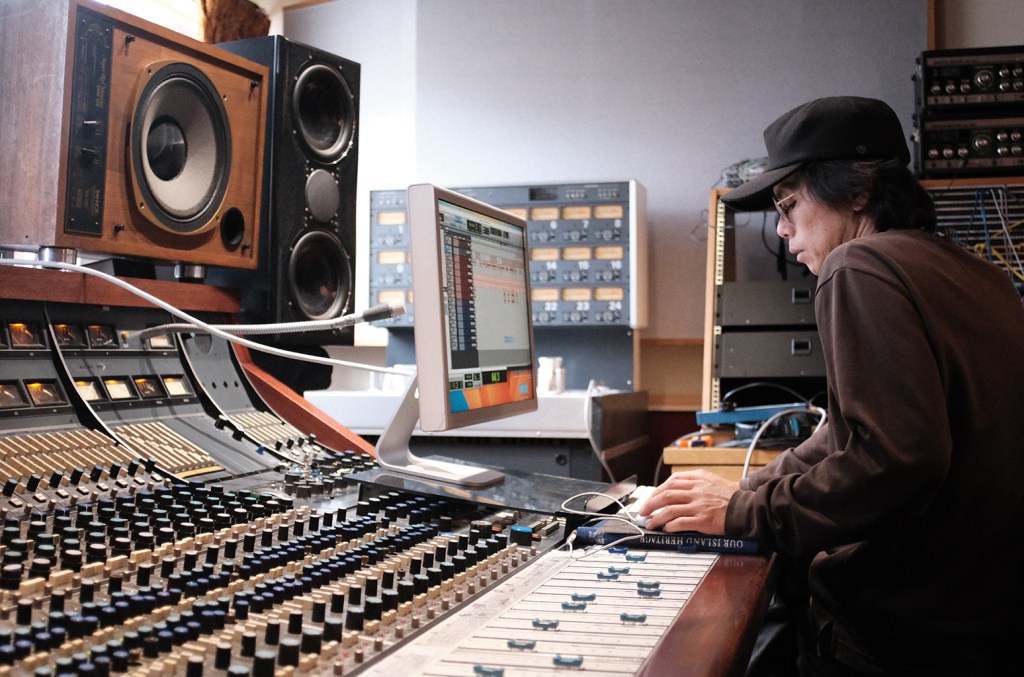
Trending on Billboard Unbound Japan is Billboard Japan‘s new interview series featuring entertainment industry professionals who have built careers on the international stage, and those sending the country’s music out into the world. This installment features London-based record producer/engineer Shuta Shinoda. With over 20 years of experience in the U.K., he spoke with Billboard Japan about the strengths he found in himself as a Japanese person working abroad, the differences between the London and Japanese music scenes and more. Explore See latest videos, charts and news You’ve been in London for a long time. Did you start your career there? I’ve been living in London for about 22 or 23 years now. After finishing high school, I came here for a year to study English and met all kinds of people along the way. One of them happened to be an audio engineer. I’d grown up as a kid who loved music, and it struck me that the work suited my personality, so I decided I wanted to study audio engineering. I went back to Japan, saved up money, returned to London to study at an audio engineering school, then went back to Japan again and started working at a studio. Where do you feel your strengths lie as you work in London now? London draws producers and engineers from all over the world, so to make it as a freelancer here I had to think about what my strengths were. The first thing that came to mind was speed and precision. Foreigners tend to have this image of Japan — the bullet train being incredibly fast, the Japanese being hard workers, that sort of thing. With that stereotype in mind, I made a real point of emphasizing speed and precision in studio sessions. Thanks to that, I think I’ve developed a quickness in decision-making when I’m recording or producing now. When you’re working directly with artists, is there a particular approach you’re conscious of? It’s the artist’s music, so rather than putting my ego into it, I make sure to have a proper meeting before we even get into the studio and really understand the idea of what they want to do. Once I can properly picture that in my mind, the sound is basically 70% finished for me already. After that, it’s just a matter of bringing what’s already in my head to life in the studio. Understanding the other person’s intent in that pre-session meeting is really important. Has there been a recent project that left an impression on you? Anna Meredith is one of my favorite artists, and we’ve made a few albums together at this point. A little while back I was involved in making her third album. I love her signature sound, built on a classical foundation with modern, technology-driven elements added. Over the course of your career, I imagine you’ve developed your own distinctive sound. What music has influenced you along the way? It’s less about music itself and more about producers and engineers, but when it comes to recording, I love Steve Albini. I’m also a huge fan of the style of Bruce Swedien, who worked on Michael Jackson’s music. More recently, I’ve been influenced by mixing engineers like Manny Marroquin and Tchad Blake. How do you feel the London and Japanese music scenes differ? I think the Japanese music scene is, for better or worse, very conscious of its impact on the domestic market. It tends to be inward-looking, made with Japanese listeners in mind. That said, I don’t think that’s a wrong approach as a business model either. On the other hand, artists and bands outside of Japan, in the U.K., for example, just do what they love, and it organically catches on from there. Of course there are trends here too, but those trends tend to have an international axis. Lately, for instance, the perspectives of artists speaking out about LGBTQ issues are being reflected in the music scene. Which means when something takes off, it spreads in a much bigger way. But trends in Japan are unique in that the appeal is something that catches on domestically but doesn’t spread globally. That’s the big difference, I think. That’s true. It’s rare in Japan for a song carrying a social message like LGBTQ issues to actually become a hit. Right. So I think artists in London and countries outside of Japan are better at spreading their music from a broader perspective. Does that tie into what you’ve seen from the U.K. music scene about what Japanese artists could do differently to break through overseas? It might. What I think is that there should be more opportunities to collaborate with artists from outside Japan. You often hear about (Japanese) artists going to record or do sessions with successful local artists or legendary producers to add some shine to their name before heading back, but that act of coming back with added shine actually puts Japanese artists in a lower position. There are plenty of talented bands in London that local A&Rs and record labels haven’t even noticed yet. I think a good collaboration is one where you find artists like that and build a relationship of equals — respecting each other and pushing each other higher. There’s no guarantee it’ll be a hit, so there’s business risk involved, but if it does break out, I think real synergy could come out of it. A lot of the time, people ask a reasonably successful artist for a remix, or a big-name artist for an arrangement, but I feel like there aren’t too many examples of that actually working out. It’d be nice to have someone who could tell you which bands are on the rise locally, like you say. That’s a tricky one too. By the time a name reaches Japan, that artist is usually already fairly successful over here, or the information has come through some third party’s filter. Instead of relying on that, if I were a Japanese artist, I think it’d be better to develop the sense to pick out what you genuinely love directly, with your own eyes. If you were to give advice to someone who wants to work and succeed outside of Japan going forward, what would you say? I really think it comes down to using your own sensibility to directly find what you love. Say you’re in the U.K. — it’s important to find out for yourself what’s happening at local live venues, for example, before magazines, online media, or bloggers get to it, and to sharpen your own sense and sensibility rather than relying on others. In terms of technique, Japanese people are already skilled. So I think what matters is finding something different before anyone else does or looking at things from a different angle. Is there anything you’d like to take on next? I’m already doing what I love now… but one thing I’ve been thinking about a bit is teaming up with labels and A&R people to work on artist development, making all kinds of music together with new artists. And as an extension of that, I’d love to eventually set up my own studio somewhere by the sea, or on a small island. —This interview by Sakika Kumagai first appeared on Billboard Japan
Shuta Shinoda Talks Turning Japanese Stereotypes Into an Advantage in London: Unbound Japan Interview
Full Article
Original Source
Read the full article at Billboard →KhanList aggregates and links to publicly available news content. We do not host full articles from third-party sources. Always verify important information with original sources.