
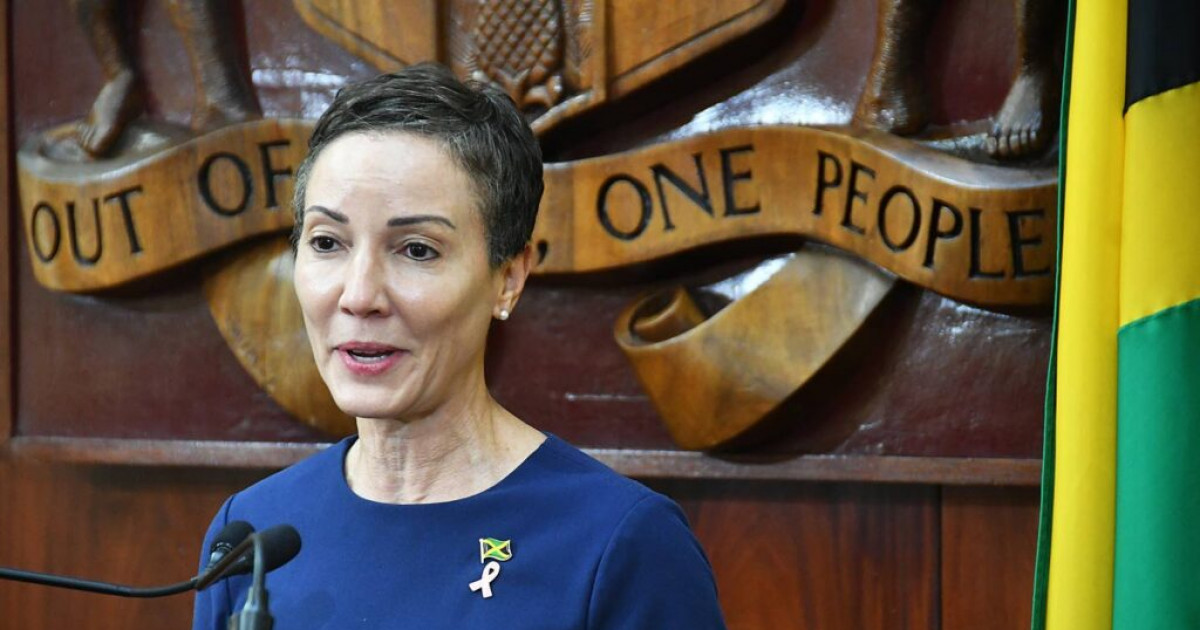
Foreign Affairs Minister Senator Kamina Johnson Smith explains to individuals attending Wednesday’s post-Cabinet press briefing at Jamaica House in St Andrew the country’s decision to abstain from voting on the United Nations resolution calling for an end to the economic, commercial and financial embargo imposed by the United States against Cuba.The resolution was passed on Wednesday but with the lowest level of support in 30 years with 130 countries voting in favor, 17 against, and 25 abstentions. (Photo: Garfield Robinson) THE Opposition People’s National Party (PNP) on Wednesday flayed the Government for its decision to abstain from voting on the United Nations resolution calling for an end to the economic, commercial and financial embargo imposed by the United States against Cuba, insisting that the Administration’s sudden shift in policy was an “inconsistency” which has left Jamaicans in the dark. The outcry followed on indications by Foreign Affairs Minister Senator Kamina Johnson Smith during Wednesday’s post-Cabinet press briefing at Jamaica House in St Andrew that the island was one of 25 countries that abstained on the resolution on the Cuban embargo, entitled the ‘Necessity of Ending the Economic, Commercial and Financial Embargo’, imposed by the United States against Cuba, when the vote was taken taken in the UN General Assembly. Johnson Smith, who admitted that the decision was “a shift in policy”, said, “We did not vote ‘against’ because we do not support unilateral actions in accordance with the UN Charter, and we did not vote ‘for’ because it is clear that continuing to do the same thing each year to support the resolution simpliciter with no improvement in the circumstances is but in fact a deepening of the humanitarian crisis and suffering. This does not serve the benefit of the Cuban people.” She further said the position taken is also consistent with the country’s broader perspective on multilateralism as stated in the national policy statement. “We cannot simply continue to defend it and do the same things and believe that in a changing world it will somehow magically manifest Agenda 2030 and the systems be deemed to be fully effective. We believe that the systems need reform, and this requires us to act differently,” she said adding that an explanation of vote was also presented by Jamaica’s ambassador to the United Nations on Wednesday morning. The vote marked a titanic shift, as historically Jamaica has been voting “yes” in favour of ending the US embargo against Cuba for over 30 years since the annual UN resolution began. The resolution, which was passed, passed with the lowest level of support in 30 years with 130 countries voting in favour, 17 against, and the 25 abstentions. Wednesday, Opposition spokesperson on foreign, regional and diaspora affairs Senator Donna Scott-Mottley, in a statement to the media, expressed grave concern over Jamaica’s decision to abstain. “For decades, Jamaica has joined the overwhelming majority of the international community in calling for an end to the embargo against Cuba. That position has transcended changes of Administration and has reflected our commitment to sovereignty, self-determination, and the right of nations to pursue their development free from external coercion. It is therefore deeply concerning that Jamaica should now depart from that position without any explanation to the Jamaican people,” she said. The Opposition spokesperson pinpointed what she described an apparent inconsistency between Jamaica’s abstention at the UN and the proceedings in the House of Representatives on Tuesday when a motion concerning Cuba, brought by the Government, was passed without objection. Jamaica’s ambassador to the United Nations H.E. Brian Wallace gives an explanation of vote at the General Assembly: 28th plenary meeting, 81st session to the UN Wednesday (Photo: UN TV) “It is difficult to reconcile the position taken in our Parliament yesterday with the decision made at the United Nations today. What has changed in the space of 24 hours? If the Government has determined that Jamaica’s position on this matter should change, then it has a responsibility to explain the basis for that decision. Foreign policy cannot be conducted in a manner that leaves the Jamaican people uncertain about where their country stands,” Scott-Mottley stated. The Opposition spokesperson, in emphasising that Jamaica’s relationship with Cuba has been characterised by decades of friendship, mutual respect, and meaningful cooperation, particularly in health and education, said the principles of sovereignty, non-interference, and respect for international law remain especially important to small states such as Jamaica. “Jamaica is a small State, but we have never regarded that as a reason to surrender our independent voice in international affairs. Indeed, it is precisely because we are a small State that the principles of sovereignty, non-interference, and respect for international law must remain central to our foreign policy,” Scott-Mottley declared. She said Johnson Smith must provide an immediate explanation of Jamaica’s abstention and clarify whether it signals a change in the Government’s policy towards Cuba. “The Jamaican people are entitled to know whether this decision reflects a considered change in national policy and, if so, what circumstances have brought it about. Our international positions must be guided by principle, consistency, and the national interest,” Scott-Mottley added. Johnson Smith on Wednesday in referencing the motion entitled, ‘Motion on the Economic and Humanitarian Situation in Cuba’, which was passed by Parliament, said it was “consistent with the perspective that a broader view of the complex situation in Cuba is needed”. “Rather than simply calling for an end to the embargo as has been done in previous years, the motion called on the Parliament to express its deep concerns regarding the economic and humanitarian challenges confronting the Cuban people and affirms that their welfare and aspirations must remain central to efforts to address these challenges; recognise the importance of intensified economic and institutional reforms as well as respect for fundamental human rights and freedoms as well as other essential elements of sustainable development; and support constructive engagement between Cuba and the United States grounded in mutual respect and peaceful dialogue aimed at reducing economic restrictions and other barriers to international trade, finance and investment while facilitating Cuba’s progressive integration into the international economic system, rather than its isolation under the blockade,” she stated. “These broader contexts are not included in the resolution before the United Nations and there is no scope to adjust the language of the resolution, so we therefore abstained,” the foreign affairs minister told the briefing. She further pointed to remarks by Prime Minister Andrew Holness at the opening ceremony for Caricom heads meeting in St Kitts Nevis in July of this year, at which he expressed concern at the worsening humanitarian suffering, the impact on Cuba’s circumstances on the region, and affirmed solidarity with Cuba, but also called for US-Cuba dialogue aimed at stability and improving the circumstances of the people. Speaking then, Holness called for reform and suggested that, if, possible Caricom member states could play a constructive role in engagement and cooperation.
Shift in policy
Full Article
Original Source
Read the full article at Jamaicaobserver →KhanList aggregates and links to publicly available news content. We do not host full articles from third-party sources. Always verify important information with original sources.