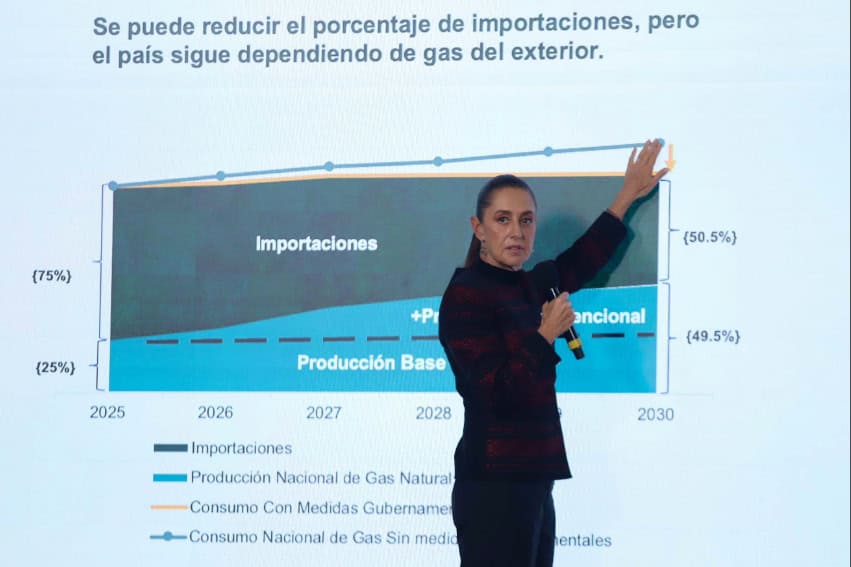
Sheinbaum’s mañanera in 60 seconds 🛢️ Expert committee presents fracking findings: Sheinbaum was joined by the government’s non-conventional gas expert committee, which presented its first conclusions after months of study. She said the group would keep advising on “energy planning” and “energy sovereignty” going forward. 🚫 Committee advises against Tampico-Misantla fracking: Engineering expert José Antonio Hernández Espriú read the committee’s recommendation to prohibit fracking in the Tampico-Misantla basin (Veracruz/Tamaulipas), Mexico’s largest-potential basin. Petroleum engineer Ana Paulina Gómora Figueroa cited environmental, social and biodiversity concerns as the basis for the advice. ✅ Two other basins still under evaluation: Gómora said the committee recommends continuing to assess fracking viability in the Sabinas-Burro-Picachos basin (Coahuila/Nuevo León) and the Burgos basin (Tamaulipas). 🤝 Sheinbaum says government will respect Tampico-Misantla recommendation: She acknowledged the committee’s advice to prohibit fracking there on social and environmental grounds, saying, “Obviously we’re going to recognize that.” 💧 Salt water, not fresh water, required: Sheinbaum said experimental wells must first confirm salt water is present underground, since fresh water is reserved for human consumption and agriculture. 🔄 Sheinbaum explains her shift on fracking: She said she and others previously opposed non-conventional gas production, but new technologies — including biodegradable chemicals and water recycling — have changed the calculus compared to 10-15 years ago. ⏳ No final decision yet: Sheinbaum said the drilling of experimental wells will first determine whether salt water is present in the northern basins. If there is no salt water “we’ll all go home,” she said. If viable, local residents will be consulted before any next steps, Sheinbaum said. Why today’s mañanera matters President Claudia Sheinbaum was accompanied at her Thursday morning press conference by a group of scientists that was tasked with assessing the viability of so-called “sustainable fracking” in Mexico. Sheinbaum first presented the group in April and it was originally slated to provide its recommendations on the feasibility of fracking in June. The news agency Reuters reported on Wednesday that the president was informed of the group’s findings a few weeks ago. However, they weren’t made public until today. Ana Paulina Gómora Figueroa, head of the petroleum engineering department at UNAM, explained why the committee recommended a ban against fracking in the Tampico-Misantla basin. (Presidencia) The group — or expert committee, as it is commonly called — essentially gave its green light to the ongoing evaluation of fracking potential in two basins in northern Mexico. However, it recommended against fracking in another basin in Veracruz and Tamaulipas, the Tampico-Misantla basin, which is believed to have huge oil and gas reserves. Today’s mañanera was significant as it represented another step forward toward the likely commencement of large-scale fracking in Mexico, which could help the country reduce its heavy dependence on natural gas imports from the United States. Sheinbaum previously opposed fracking, but now asserts that it can take place safely and without excessive water use via the employment of new technologies. However, she almost never uses the word “fracking,” referring instead to “non-conventional” gas production. On Thursday morning, Sheinbaum said that no final decision has been made on large-scale fracking in Mexico, although it appears very likely that Mexico will move to use the controversial extraction technique in order to boost domestic production of natural gas. Fracking the focus of Sheinbaum’s mañanera At the start of her mañanera, Sheinbaum told reporters that “the first results” of the expert committee’s “non-conventional gas analysis” would be presented. She said that the committee would “continue working with us because the investigation hasn’t finished.” “We’ve proposed that they continue helping us, not just in the definition of the production of natural gas, but rather in general as a committee of support, advice and research for energy planning in our country and energy sovereignty,” Sheinbaum said. Expert group was divided into 4 committees Science, Humanities, Technology and Innovation Minister Rosaura Ruiz told reporters that the expert group was divided into four committees — an engineering committee, a water committee, an “impact committee” that assessed potential environmental, social, economic and health effects of fracking, and a planning committee. Ruiz thanked the “54 scientists who provided their knowledge and experience to this national effort.” She said that the members of the group reached decisions “by consensus.” “This is not easy in science — the debates are very broad, and when scientists, technologists and humanists debate, it’s complicated,” Ruiz said. Science Minister Rosaura Ruiz explained the process by which the expert panel formed their recommendations. (Presidencia) Committee advises against fracking in Tampico-Misantla basin Among the 10 conclusions of the expert committee was that fracking should not be allowed in the Tampico-Misantla basin, located in Veracruz and southern Tamaulipas. That basin has Mexico’s largest fracking potential. José Antonio Hernández Espriú, an engineering and geology expert, read out the committee’s conclusion No. 4. “We recommend prohibiting natural gas extraction activities from non-conventional fields in the Tampico-Misantla basin region,” he said. Ana Paulina Gómora Figueroa, head of the petroleum engineering department in the National Autonomous University’s Engineering Faculty, explained why the committee was advising against fracking in the Tampico-Misantla basin. “Based on criteria related to environmental protection, social issues, biodiversity and population density, we must consider prohibiting exploitation activities in non-conventional natural gas fields in the Tampico-Misantla basin,” she said. Committee recommends ongoing assessment of fracking viability in two other basins Gómora said that the committee of which she is part “recommends continuing with the evaluation in order to find out the viability of the development of non-conventional natural gas fields in two basins.” Those basins, she said, are the Sabinas-Burro-Picachos basin in the states of Coahuila and Nuevo León and the Burgos basin in northeastern Tamaulipas. Other conclusions of the expert committee Among the other conclusions of the expert committee were that: Potential natural gas reserves in non-conventional fields should be confirmed via studies and the drilling of wells. “Best practices” must be implemented with regard to the management of fracking waste and wastewater, and environmental protection. Local populations must be consulted before any fracking activity commences. Fracking activity should seek to strengthen “regional employment” — i.e. generate jobs for local residents. Fracking activity should be monitored by an “external, independent” organization that considers things such as water use, the impact on seismic activity and protection of the environment. UNAM hydrogeology researcher José Antonio Hernández Espriú shared some of the standards the committee used to evaluate whether a region is suitable for fracking. (Presidencia) Sheinbaum says government will respect advice on Tampico-Misantla basin Sheinbaum acknowledged that the expert committee is “asking us to prohibit the exploitation of non-conventional gas in the Tampico-Misantla basin … because it’s socially and environmentally unviable.” “Obviously we’re going to recognize [that advice],” she said. Sheinbaum: Fracking activity must use salt water, not fresh water Sheinbaum also acknowledged that the expert committee advised the government to ensure that there is salt water in the subsoil before any fracking activity takes place. “Fresh water can’t be used because fresh water is intended for human consumption, for agricultural irrigation and for other activities,” she said. “… What has to be done to ensure there is salt water? Drill experimental wells to see how much water there is underground and what kind of water it is in order to know whether it is feasible to use it in the production of non-conventional gas,” Sheinbaum said. Sheinbaum explains why her position on fracking has changed “A lot of us were opposed to non-conventional gas. It’s important to say that,” Sheinbaum told reporters midway through her press conference. “What’s changed? New technologies,” she said. “The technology 10 or 15 years ago, when [the production of] non-conventional gas began, used very harmful chemicals and fresh water,” Sheinbaum said. “Water wasn’t recycled,” she added. “Today there are even biodegradable chemicals. … What allows us to today assess non-conventional gas in a different way than 15 or 10 years ago? Well, new technologies have been developed,” Sheinbaum said. Sheinbaum says that no final decision on large-scale fracking has been made “Before anything else,” it has to be determined whether there is, in fact, salt water and gas in the basins in question in northern Mexico, Sheinbaum said. She said that “the experts will continue accompanying us” to ensure that if fracking is deemed to be “technically viable,” the practice is carried out with “technologies that don’t have the environmental impacts of before.” Toward the end of her press conference, Sheinbaum said: “We’re going to drill an experimental well to see if there is salt water in the deep subsoil. And then what are we going to do? Once that study is done, we’ll come back to the mañanera.” Sheinbaum raised the possibility that the drilling of experimental wells will determine that there is no saltwater or insufficient salt water to allow fracking in the basins in question in northern Mexico. In such a case, “we’ll all go home,” she said tongue-in-cheek. If there is sufficient salt water in the basins and fracking is deemed to be economically viable, local residents will then be consulted, Sheinbaum said. “We don’t know whether we’re going to do it or not,” she said, referring to large-scale fracking. “… We’re going to see where it’s feasible and once we see … that in effect there is gas … and how much salt water there is, if there is at all, then we can move on to the next stage,” Sheinbaum said.
Sheinbaum backs fracking ban for Mexico’s top shale basin: Thursday’s mañanera recapped
Full Article
Original Source
Read the full article at Mexiconewsdaily →KhanList aggregates and links to publicly available news content. We do not host full articles from third-party sources. Always verify important information with original sources.