
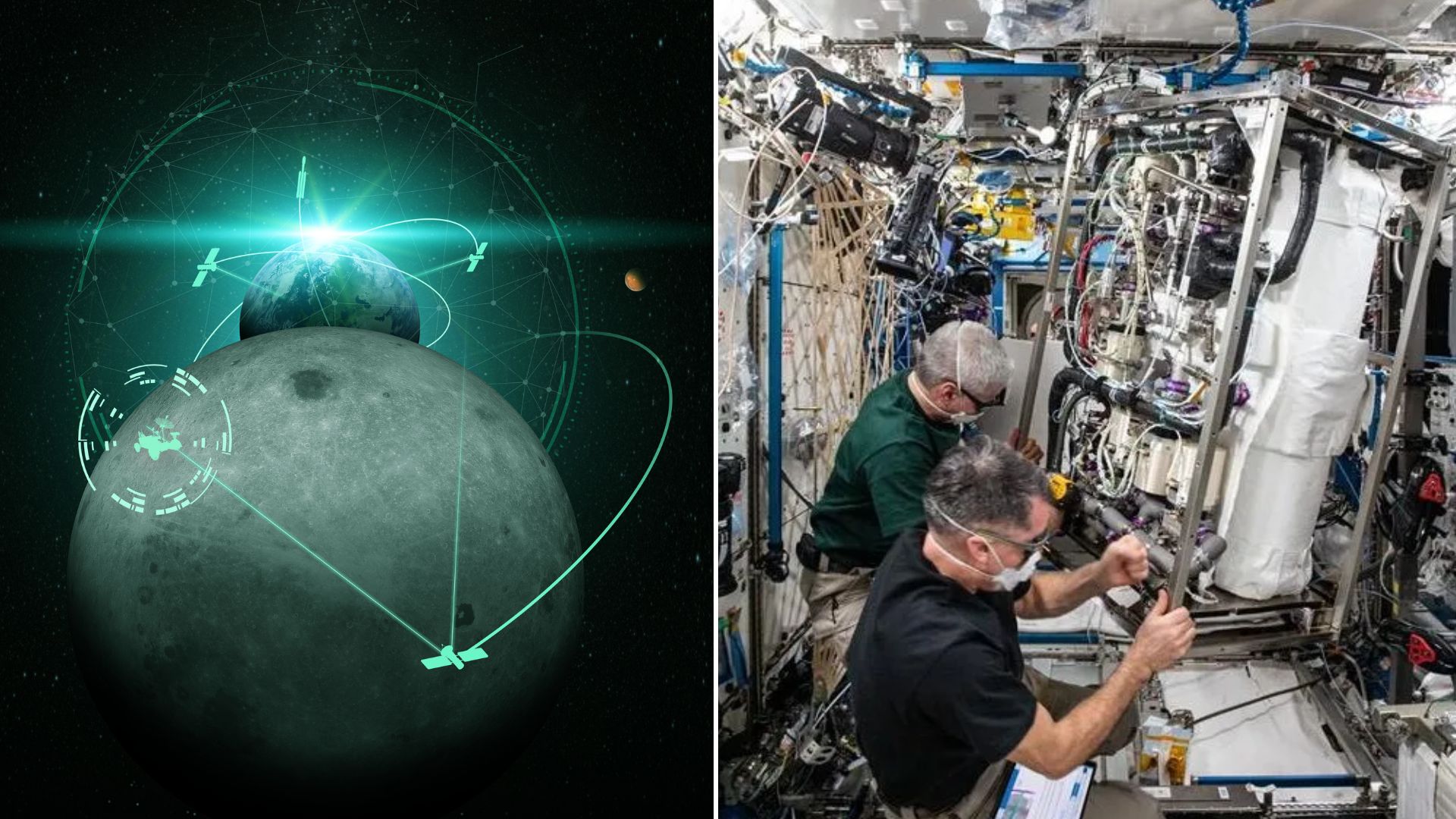
Returning astronauts to the Moon is one challenge. Keeping them there for months or years is another. A permanent lunar base will need much more than a landing vehicle and a pressurized habitat. It will require reliable power, locally sourced resources, radiation protection, autonomous construction systems, and infrastructure that can survive one of the harshest environments in the solar system. NASA’s plans for a sustained lunar presence near the South Pole highlight how much work remains. The agency is developing technologies for surface power, resource extraction, construction, communications, and dust mitigation, but many still need to be demonstrated and integrated under actual lunar conditions. Here are seven technologies that will be essential to turning the Moon from a destination for short missions into a place where humans can live and work for the long term. 1. Continuous power systems that survive the lunar night Solar panels are an obvious source of electricity on the Moon, but they cannot provide uninterrupted power everywhere. A lunar day and night each last approximately 14 Earth days, and locations in permanent shadow receive little or no direct sunlight. A base will need energy storage systems capable of supplying electricity and heat through extended darkness, alongside power generation that does not depend on sunlight. NASA is developing vertical solar arrays designed to collect sunlight near the lunar poles, as well as radioisotope power systems and small fission reactors. Nuclear fission could provide a particularly important source of continuous electricity, operating independently of solar conditions. NASA has announced plans for Lunar Reactor-1 to land on the surface in 2030. However, the reactor and the wider power distribution infrastructure still need to be developed and demonstrated for sustained operations. 2. Systems that extract water, oxygen, and fuel from lunar resources Transporting every kilogram (every pound) of water, oxygen, and propellant from Earth would make a permanent settlement extremely expensive. Instead, lunar infrastructure will need to use resources already present on the surface, a process known as in-situ resource utilization (ISRU). The lunar South Pole is particularly interesting because permanently shadowed craters may contain water ice. If engineers can locate, excavate, and process it at useful scales, the water could support drinking, hygiene, and life-support systems. It could also be separated into hydrogen and oxygen, potentially providing ingredients for rocket propellant. Oxygen may also be extracted from lunar soil, or regolith, which contains oxygen chemically bound in minerals. NASA researchers demonstrated an integrated solar-carbothermal prototype in 2026 that extracted oxygen from simulated lunar regolith. Scaling such systems for practical surface production remains a major challenge. 3. More autonomous life-support systems Astronauts cannot rely on a continuous supply of fresh air and water from Earth. A permanent base will need systems that recycle wastewater, remove carbon dioxide, control humidity, and maintain a breathable atmosphere with minimal human intervention. The International Space Station already uses an Environmental Control and Life Support System (ECLSS) that recovers approximately 90 percent of its water. It also removes carbon dioxide from cabin air and generates oxygen through water electrolysis. However, a lunar settlement will need more robust, maintainable systems that can operate for much longer periods with limited resupply. Equipment will need to handle failures, contamination, and changing crew requirements while allowing astronauts to repair or replace components. Recycling will also need to extend beyond water and air to include waste processing and, eventually, the recovery of useful materials. 4. Technology to keep lunar dust out of everything Lunar regolith is not ordinary terrestrial dust. Its particles are sharp, abrasive, and electrostatically charged, allowing them to cling to spacesuits, equipment, seals, solar panels, and optical surfaces. During Apollo, dust created problems for astronauts and hardware. At a permanent base, repeated exposure could damage mechanical joints, degrade equipment, contaminate habitats, and create health risks if particles enter the cabin. NASA has already demonstrated one promising approach. Its Electrodynamic Dust Shield uses electrical fields to move dust away from protected surfaces. The technology successfully removed lunar regolith from surfaces during Firefly Aerospace’s Blue Ghost Mission 1 in March 2025. However, a settlement will need a much broader dust-control system. This could include specialized spacesuit interfaces, airlocks, filters, dust-resistant seals, and cleaning equipment that can operate repeatedly without consuming large quantities of supplies. 5. Radiation shelters built into lunar habitats Earth’s magnetic field and atmosphere protect people from much of the radiation arriving from space. The Moon has neither a substantial atmosphere nor a global magnetic field, leaving astronauts exposed to galactic cosmic rays and potentially dangerous solar particle events. A permanent habitat will therefore need more than a conventional pressurized structure. One solution is to cover living areas with thick layers of lunar regolith, creating shielding from radiation and micrometeorite impacts. NASA is investigating regolith-based protective structures and materials that could be manufactured using local resources. A base may also need a dedicated storm shelter where astronauts can spend periods of intense solar activity. The challenge is balancing protection with construction weight, available materials, and the need to maintain a safe, functional living environment. 6. Autonomous robots that can build the base Sending astronauts to construct roads, landing pads, berms, and habitat foundations would consume valuable mission time and expose crews to environmental hazards. Robotic construction systems could prepare much of the site before humans arrive. NASA is developing autonomous excavators such as its Infrastructure Pilot Excavator, designed to dig, collect, and transport lunar regolith for site preparation. Other research is exploring additive manufacturing, in which local material is processed into structural components or protective enclosures. These systems will need to work in reduced gravity, extreme temperatures, and abrasive dust while operating with limited supervision from Earth. Their ability to coordinate excavation, material handling, and construction will determine how quickly a lunar outpost can expand. 7. A lunar communications and navigation network A permanent Moon base will need reliable communications not only with Earth but also between astronauts, rovers, landers, orbiters, and other infrastructure. This is particularly important near the South Pole, where terrain can block direct radio links to Earth. NASA’s LunaNet framework aims to establish an internet-like communications and navigation architecture around the Moon. Lunar relay satellites could provide continuous connectivity in areas without a direct line of sight to Earth, while navigation services would help spacecraft and surface vehicles determine their positions without relying entirely on Earth-based tracking. In September 2026, NASA also awarded a contract to develop a lunar 5G communications system with integrated Wi-Fi 6. The planned demonstrations are intended to help establish a scalable surface network for future Moon Base operations. Building more than a place to land None of these technologies will be sufficient on its own. A permanent lunar settlement depends on power systems supporting life support, robots building infrastructure, local resources reducing dependence on Earth, and communications connecting it all. NASA’s phased Moon Base plan reflects this challenge. Initial missions are expected to test technologies and prepare the surface, followed by deployments of foundational infrastructure and eventually interconnected habitats. The goal is not simply to send people back to the Moon. It is to create an environment where they can remain, work, maintain their equipment, and expand their operations without depending on Earth for every essential resource. Achieving that will require a new generation of technologies designed to work together in an environment humans have only briefly explored. Get the latest in engineering, tech, space & science - delivered daily to your inbox.Kaif Shaikh is a journalist and writer passionate about turning complex information into clear, impactful stories. His writing covers technology, sustainability, geopolitics, and occasionally fiction. A graduate in Journalism and Mass Communication, his work has appeared in the Times of India and beyond. After a near-fatal experience, Kaif began seeing both stories and silences differently. Outside work, he juggles far too many projects and passions, but always makes time to read, reflect, and hold onto the thread of wonder.
Seven major engineering challenges stand between humans and a permanent Moon base
Full Article
Original Source
Read the full article at Interestingengineering →KhanList aggregates and links to publicly available news content. We do not host full articles from third-party sources. Always verify important information with original sources.