
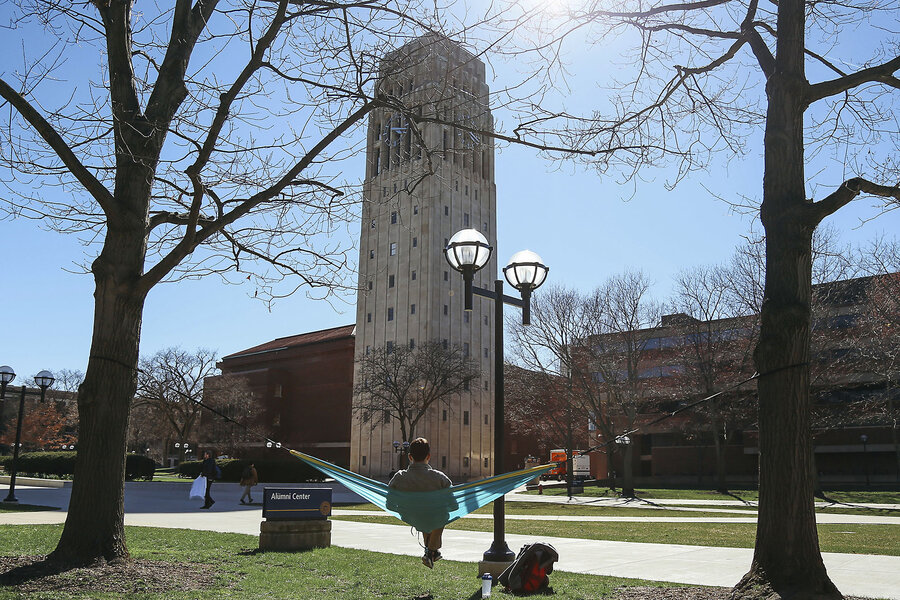
Jibreel Rehman took a chance on a new subject in college when he first got to the University of Michigan as a freshman two years ago: discrete mathematics, a computer science course that he didn’t have to take as a new student.“I’ve never taken a class like it before,” says the junior, a biochemistry major with his eyes set on medical school. “I think now, understanding how a college course works, if I took it now it wouldn’t have been as difficult for me.”But at that time, it was. So much so that he would return home from class and frantically text his parents that he wasn’t doing well. He ended up getting a C, which will go on his transcript when applying to medical school. Why We Wrote This Some experts see dropping first-semester letter grades as a sign of eroding rigor alongside grade inflation and thinner reading assignments. The University of Michigan says its change will help more students acclimate to the demands of college. Michigan, one of the top public universities in the country, recently announced it will start a pilot program in fall 2027 using a pass/no-credit system for all first-year students in the College of Literature, Science, and the Arts (LSA) for the first semester of school. Students will privately receive letter grades and feedback from instructors for all courses, but on their transcripts, those grades will be “covered” and will only show as a P for pass or NC for no credit.Some education experts see the move as another step in diminishing the rigor that gives higher education its value. But the school and its supporters say the point is to help new students transition successfully into the more rigorous environment of college.“Helping all students establish early momentum has been recognized as the most important element in U-M’s campus-wide Student Success Initiative,” the school said in a statement. “We believe that covering grades will help students start strong and curb the mental health crisis unfolding among college-aged individuals.”Michigan says the goal is to help new students acclimate to college workloads and expectations and allow them to pursue genuine interests. The school wants them to feel free to take unfamiliar or difficult courses, at first, without worrying about a letter grade.“If I had known that this policy was available at the time for my graduating class, if I had been aware of the difficulties of the class, I would have been more comfortable taking [discrete math]” says Mr. Rehman, who is president of the student council for LSA, where the new policy will start.Some students view the change as unnecessary or inappropriate.“There is a sense of unfairness there,” says Hayden Rometty, a senior political science and economics major who transferred to Michigan after his freshman year at George Washington University.He says that if transfer students have to perform well starting off college with letter grades to get into Michigan, high school students transitioning should also have to. He also prefers having eight semesters to get the best GPA instead of seven.Michigan is following other schools, including the Massachusetts Institute of Technology, Wellesley, and Swarthmore College, that have already adopted a similar approach. Many education experts support it.Students at these selective schools are “going to work really hard, but it is an adjustment for them coming in. They’re coming from high school, where they have classes every day, to a college or university, which is on a semester system, where their classes meet two or three times a week,” says Tom Guskey, professor emeritus in the College of Education at the University of Kentucky, who has studied pass-fail outcomes.He says college requires students to become much more independent because they are not getting the same amount of guidance from teachers in high school. They come in without having many friends and are away from home and parental support, all of which are major adjustments, he adds.At the same time, Dr. Guskey says research shows that students who take pass-fail courses often will do just enough to pass, while students who take courses with letter grades will put in more effort.“The idea is that they’re going to do whatever you set the pass level to be – and the key then is to set your pass level pretty high,” Dr. Guskey says. That’s because, while a D could technically be passing, students won’t be able to make it through college with Ds.Critics say what Michigan is doing will create even more entitled students while devaluing the degree itself.“Unfortunately, higher ed has retreated so far from rigor or expectations – between grade inflation, electives, reduced reading loads, and the rest – that it has gutted student work and compromised the integrity of a college education,” says Frederick Hess, senior fellow at the American Enterprise Institute, a conservative think tank, via email.“The hallmark of a strong undergraduate education is that students work hard, tackle challenging content, deal with adversity,” and they emerge as stronger thinkers and citizens, Dr. Hess says. “This certainly cuts against that.”“If Michigan were simultaneously bolstering reading loads, combating grade inflation, mandating attendance, and restricting devices, I could potentially imagine a case for something like this. But in isolation, it seems like an unhelpful step.”Richard Wicentowski is provost of Swarthmore, where he has also taught computer science since 2002. The college, which started a similar policy for first-year students in the early 1970s, has seen students thrive under this practice.He says first-year students are still motivated to learn and do well, because they know letter grades will be the norm in subsequent semesters. They also know they might have the same professors again, and they might need those professors to write recommendations for graduate school or internships.Above all, exploration of unknown subjects is good for students, he adds.“I think the primary reason at Swarthmore that it was put in place was because we value students exploring the curriculum,” Dr. Wicentowski says. “We want someone to say, ‘Hey, you know what? I heard computer science might be cool, and I’m going to go try it out. I don’t know much about it, but if I go and try it out, and I don’t do super well, it’s not going to harm me.’”
Setting students up to succeed? Why Michigan is ditching first-semester grades.
Full Article
Original Source
Read the full article at Csmonitor →KhanList aggregates and links to publicly available news content. We do not host full articles from third-party sources. Always verify important information with original sources.