
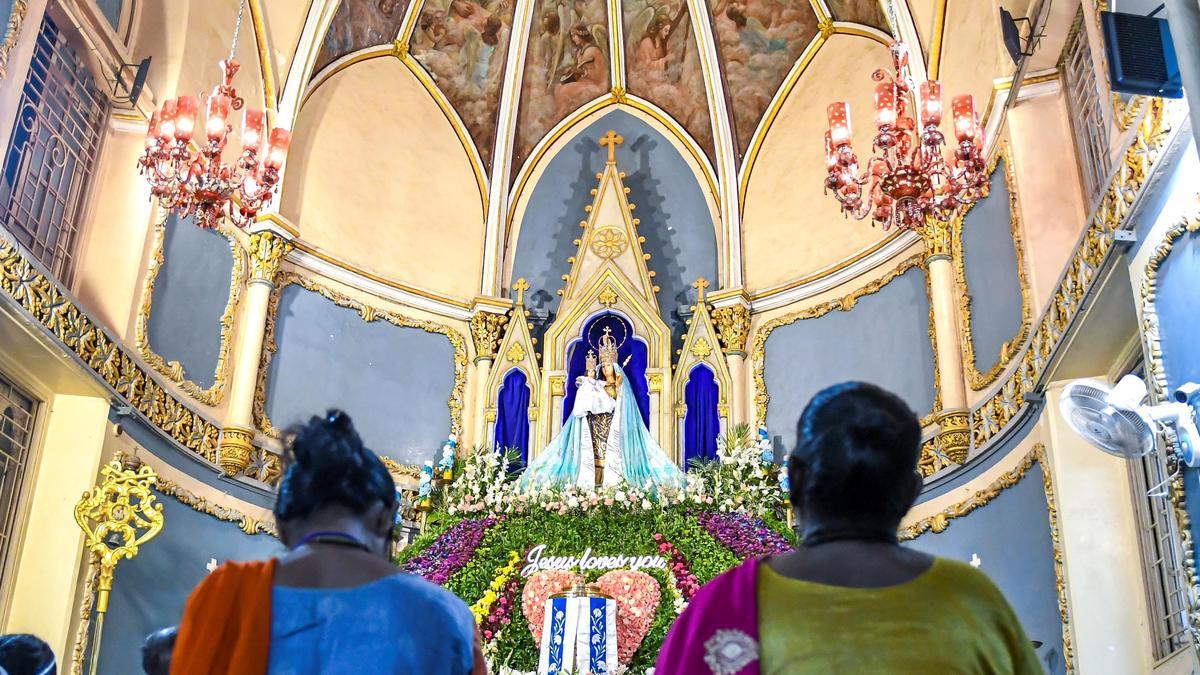
The story so far: The Maharashtra Freedom of Religion Act, 2026, comes into force on August 28, requiring anyone who intends to convert to give the district magistrate sixty days’ notice, and sets prison terms of up to seven years for a first violation and up to ten years for a repeat one.In the Mumbai Metropolitan Region, church leaders have begun circulating a consent form among worshippers weeks ahead of the deadline. Pune police have already used the law once, before it was even notified, and later called it a mistake. Christian, Muslim and Buddhist groups have each raised the same core concern: where does the law’s target end and everyday practice begin? What does the law do?The Act received President Droupadi Murmu’s assent earlier this month and took the form of a State law after its official notification. It targets conversion carried out through coercion, fraud, inducement or marriage, and lays out a procedure for a person who wishes to change religion by choice. A person planning to convert must notify the district magistrate sixty days in advance.The law also sets out steps to be followed after a conversion. A person found to have converted someone through a prohibited means faces a prison term of up to seven years, and a repeat offence draws up to ten years. According to a press note issued by the Archdiocese of Bombay, Maharashtra is the thirteenth State to pass a law of this kind, after similar statutes in States including Uttar Pradesh, Madhya Pradesh, Gujarat and Karnataka.The debate that arose is not new to India. States that already have anti-conversion legislation have faced the same question Maharashtra now confronts: how to draw a line between a conversion obtained through pressure and a change of faith that a person chooses on their own?What was the case filed in Pune?The law has already entered police files in Pune, ahead of its own start date. Officers registered cases alleging attempts to induce individuals to convert, including one against a United Kingdom-based Overseas Citizen of India cardholder accused of delivering religious speeches without the permission the law requires. Reports from the city say police invoked the law before its notification took effect, and senior officers later acknowledged the application had come too soon.The episode raises questions on how the law will be applied at the level of a police station, and over the safeguards that are supposed to precede a case under it.What do the church consent forms state?Ahead of August 28, prayer halls across Vasai, Virar, Mira-Bhayandar and other parts of the region have begun asking worshippers for a signature they were never asked for before. A self-declaration form has been in circulation for close to a month across congregations in Mumbai, Mira-Bhayandar, Vasai-Virar, Palghar and Thane.The form states that the worshipper is attending the prayer meeting by choice and faces no pressure, inducement, temptation, lure or threat of any kind. It states that the decision to attend is personal and independent, and asks for a passport-size photograph along with an Aadhaar or PAN number. Fr. Nigel Barrett, spokesperson for the Archdiocese of Bombay, described the form as a step taken out of caution.“Taking a consent form is a wise precaution. It establishes that people are attending voluntarily and that no one is forcing them to come. Given the current law and the manner in which certain groups, such as the Bajrang Dal, enter these spaces, people are taking precautions to safeguard themselves,” said Fr. Nigel Barrett, Archdiocese of Bombay.What is the objection?The Archdiocese of Bombay set out where its concern lies. It said prayer meetings and other church work could come under scrutiny and stated that it has always opposed conversion by force, fraud, coercion or inducement, while asking for safeguards so that lawful practice is not treated as an offence.Pointing to records in other States, the press note argued that anti-conversion laws in practice targeted religious minorities more often than they have addressed the conduct they were framed to stop. It invoked Article 25 of the Constitution, which protects the freedom to profess, practise and propagate a faith.A different faith, a different questionThe question of where the law’s reach stops is not confined to churches. At the Amrapali Buddha Vihar in Thane, Bhante Vishal, a Buddhist monk, pointed to a separate concern. He said conversion to Buddhism on any scale mostly happens around October 14, the date associated with B.R. Ambedkar’s own conversion, and that the choice to follow Buddhism is a personal one. He noted that meditation and other rituals are practised daily by Buddhists and asked how the government proposes to act against that. In his words, faith and religion are not the same thing.What did the Court’s observe about Article 25?A recent Bombay High Court order, unconnected to the conversion law, sets out how the court reads the constitutional right at the centre of this debate.A Division Bench of Justice Anil S. Kilor and Justice Rajnish R. Vyas was hearing a petition against an August 1 order of the Deputy Commissioner of Police, who had refused permission for a Kavad Yatra along a route the petitioner had sought. The procession of about 3.5 km was meant to carry consecrated water from Mahadeo Ghat for a Jalabhishek. The petitioner argued that permission had been denied without a hearing, and that a place of worship belonging to another group could not be grounds to deny his group passage.The Bench held that the right guaranteed under Article 25 to practise one’s religion is subject to the larger interest of law and public order, and the needs of other sections of the population, where the exercise of that right in a particular manner affects them. It drew a distinction between the right to profess a faith and the right to practise it in a particular mannerThe court found that permission for the procession itself had not been refused, only the specific route sought; the police had proposed an alternate route, citing earlier incidents connected to law and order on that stretch. The Bench also noted that the temple linked to the yatra is private property whose owner had complained to police, and that authorities could not compel a private party to allow use of the temple for the event. It held there is no right inherent in a person to take out a procession along one particular route and dismissed the petition, after finding no fault in the police decision.The order does not deal with religious conversion. But it is one of the clearest recent statements from the Bombay High Court on how far Article 25 extends when it meets a claim of public order, and it lands at the same time as a law that turns on the same constitutional provision.What happens from here?With the Act now coming into force, its early test will play out around prayer meetings, religious instruction, interfaith relationships and complaints of inducement — the areas its own text is aimed at.The State government’s stated case for the law is the need to curb conversion obtained through force or fraud. Sections of the Christian and Muslim communities have set out the opposite concern: that a wide reading of terms such as inducement could reach conduct that has nothing to do with coercion, from a personal relationship to attendance at a weekly service.Two threads from the past month will likely shape how that plays out. One is the Pune case, where police acted before the law’s own start date and then walked it back, a sequence that has already raised questions about the checks meant to precede a case under the Act.The other is the spread of the self-declaration form, which began before the deadline and is likely to become standard practice at more congregations as a form of documentation against future complaints. Sections of the Buddhist community, going by Bhante Vishal’s comments, face a related but separate question, over how a law aimed at conversion sits against daily religious practice that involves no change of faith at all.Litigation of the kind that produced the Bombay High Court’s Kavad Yatra order suggests that the courts are likely to settle on questions in the absence of clarity from the State.
Consent forms, notices, prison terms: Maharashtra anti-conversion law | Explained
Full Article
Original Source
Read the full article at Thehindu →KhanList aggregates and links to publicly available news content. We do not host full articles from third-party sources. Always verify important information with original sources.