
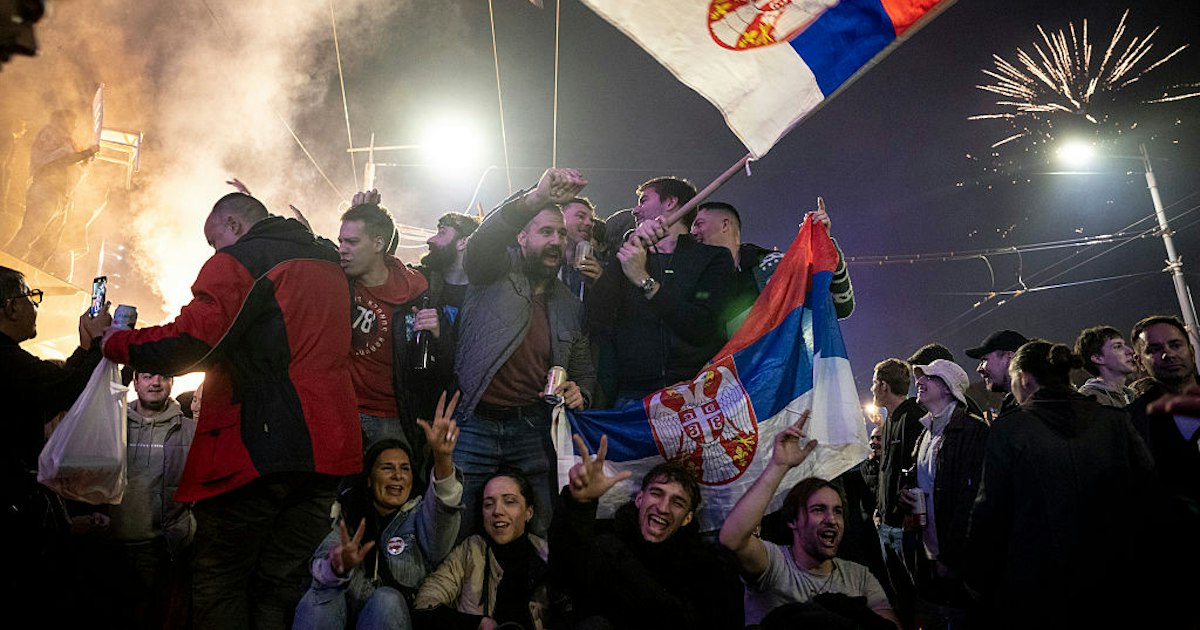
Foreign Affairs Belgrade will continue to balance Western and non-Western partnerships. Photo by Andrej Ivanov/Getty Images Serbia’s recent high-stakes parliamentary elections produced nothing short of a political earthquake. The student-led opposition—the Student List—achieved a monumental victory on October 25, securing roughly 53 percent of the vote to defeat Aleksandar Vučić and his Serbian Progressive Party (SNS). This election will go down in history as a case of successful public mobilization, which suddenly ended SNS’s 14 years of political dominance. Following nearly two years of student-led protests in response to the collapsed railway station canopy in Serbia’s second largest city, Novi Sad, the issues driving the opposition pertained mostly to domestic politics: state capture, democratic erosion, corruption, institutional failures, and cronyism. The foreign policy implications are not straightforward, but sudden and drastic shifts are unlikely. Serbia’s new government almost certainly will instead prioritize internal challenges, such as political consolidation and institutional reconstruction, above all else. Serbia’s “multivector” foreign policy has kept Belgrade reasonably close to Beijing, Moscow, Brussels, and Washington. This “four pillars” strategy of balancing these partnerships—which dates back to Boris Tadić’s presidency (2004–12)—will continue to shape Serbia’s geopolitical orientation, experts told The American Conservative. “The new leadership will not see any benefit to be made from full alignment with either of the major powers,” Vuk Vuksanović, a lecturer at King’s College London, said, stressing that any full transformation is not in the cards. The Student List, which lacks an established leader, will need to take on a political establishment which has captured the police, judiciary, prosecution services, and many other institutions important to any democracy. Facing this challenge, the post-Vučić government will lack the bandwidth to embark on drastic foreign policy changes. As Vuksanović put it, “The new government will be so preoccupied with domestic challenges and repairing a broken society that it will not be keen to engage in a major foreign policy experiment, nor will it have the political strength to do so.” One area where there is potential for true change in Serbian foreign policy relates to the EU. As a formal candidate to the bloc since 2012, Serbia’s pathway to full-fledged membership has stagnated due to democratic backsliding and illiberalism. Reforms advanced by the post-Vučić government could reset Serbia’s relationship with Brussels. Under Vučić, Serbia–EU relations had centered around bargaining over short-term political issues such as its stance on Kosovo—which Belgrade considers part of the Republic of Serbia—as well as Serbia’s lithium resources, its orientation toward the Russia–Ukraine War, a French aviation deal, and Belgrade’s role in the Western Balkans. But Miloš Petrović, a Belgrade-based researcher who specializes in European studies, now expects democratization in Serbia to open a pathway to EU membership, shifting attention back to fighting organized crime, curbing corruption, protecting human rights, and restoring judicial independence. Although, as he pointed out, the “elephant in the room” remains the sensitive Kosovo file. While relations with the EU may improve, expecting rapid progress in Serbia’s journey toward membership would be naïve. Nikola Miković, a Serbian geopolitical analyst, expressed skepticism, maintaining that the EU will probably not fundamentally alter its approach to Belgrade irrespective of which government is in power. “Brussels does not see Serbia becoming an EU member anytime soon, if at all,” Miković said. “There will always be new conditions and demands that no Serbian government can realistically be expected to fulfil. Why the EU continues to pursue this approach is a question that should be directed at Brussels itself.” Vuksanović stressed that much blame for the stagnation of the EU’s enlargement belongs on Brussels’ doorstep, considering the extent to which the bloc has placed Serbia and other Western Balkan candidates on the back burner while prioritizing short-term geopolitical factors above credible accession. As he observed, the EU’s ability to enlarge is “dubious” and Serbia’s new government harbors no illusions about that. How the post-Vučić government approaches the protracted Kosovo dispute will matter much to the trajectory of Serbia–EU relations. For any Serbian government, the bloc’s linkage of progress in Serbia’s accession process to its normalization of relations with an autonomous Kosovo will present a dilemma. Petrović believes the EU should avoid reducing its relationship with Belgrade to the Kosovo issue and put more energy into supporting democratization in Serbia with the new government in power. “The U.S. and the EU need to find a way to accept that there are limits to what Serbia could accept regarding Kosovo’s unilateral secession,” Petrović said. “After all, two decades into its so-called independence, it has been only half-recognized, less than the State of Palestine. Even the EU countries are divided on the issue, with Spain, Greece, Romania, Slovakia, and Cyprus refusing to recognize it and impose such conditions on Serbia.” Slobodan Janković, a senior research associate at the Belgrade-based Institute of International Politics and Economics, holds an even more critical position, maintaining that Brussels’ policy of making Serbia–Kosovo normalization a necessary precondition for Serbia’s accession to the EU has done much to decrease support among the Serbian public for membership in the bloc. As he explained to TAC, the EU has been “encouraging Serbia to abandon part of its citizens, territory, and legal authority” and this will not sit well with Belgrade even under the new government. Comments by Petar Milutinović, a research associate at the Belgrade-based Institute of European Studies, support that reading. “Kosovo is the decisive test. The new [Serbian] leadership says it is open to dialogue with Pristina [the capital of Kosovo], but it rejects Kosovo’s independence. Without a credible normalization strategy, EU progress will remain constrained,” Milutinović said. Ultimately, it remains to be seen whether a democratic transition in Serbia invigorates the normalization dialogue with Pristina, a process that achieved limited progress under Vučić. Also unclear is whether the Student List will have both the will and ability to advance that process. Within the movement are nationalist elements which firmly hold the “Kosovo is Serbia” stance. Therefore, the new Serbian leadership will have to navigate competing pressures on this crucial issue. In any event, it is safe to assume that Kosovo will remain the main constraint on Serbia’s pathway to EU membership in the post-Vučić era. A fundamental deterioration in Serbia’s relationship with Russia is an unlikely result of Vučić’s defeat. Nevertheless, the outcome of last month’s election could affect bilateral ties. When Vučić was leading Serbia, Russia was able to benefit from strong influence in Serbia’s media sphere, cooperation with different political and security structures within the Serbian state, and close contacts with policymakers in Belgrade. Under the new government, it is conceivable that some of these channels will weaken, delivering a blow to Moscow’s clout in the Western Balkans. Particularly important to track will be the Serbian government-aligned tabloids which uncritically parroted Russian talking points during Vučić’s presidency, as well as Serbia’s intelligence networks. Nevertheless, the Student List opposes sanctions on Russia, and vows to maintain Belgrade’s official neutrality, which reflects domestic political considerations and Serbian national interests that transcend which government holds power in Belgrade. Ultimately, when it comes to energy, Serbia remains heavily dependent on Russia. Regarding the Kosovo issue, Belgrade will continue to regard Russia as a valuable partner—especially given Moscow’s status as a permanent member of the UN Security Council, with veto power—sharing Belgrade’s opposition to Kosovo’s independence. Additionally, deep historical, cultural, and religious ties between Serbia and Russia will continue ensuring friendly bilateral relations at the societal level. An important question relates to ammunition deliveries to Ukraine. Under Vučić, Serbian ammunition indirectly reached Ukraine, but Serbia never implemented Western sanctions on Moscow. The new government has vowed to halt arms deliveries, which the student movement largely interpreted as Vučić’s efforts to secure Western tolerance for his government’s policies. Nonetheless, Serbia will probably maintain its position that Crimea and the Donbas region belong to Ukraine, rejecting Moscow’s annexation of these territories. A consequence of last month’s parliamentary election could be Serbian–Russian relations becoming less politically intimate even as Moscow continues to retain significant leverage over Belgrade’s foreign policy decision-making. “Moscow can take satisfaction from the fact that Belgrade will not join EU sanctions against Russia and that it will abort ammunition deliveries to Ukraine,” Vuksanović said. “Russian influence took a blow, but not a fatal one, as its pillars of influence remain: gas supply, the Kosovo dispute, and soft power.” Beijing, in all likelihood, will probably maintain a largely pragmatic and economic-oriented relationship with Belgrade in the post-Vučić era. As Serbia’s most important non-Western economic partner, China has a vast presence in the country through a host of infrastructure projects, industrial investments, and economic cooperation more broadly. Under Vučić, Chinese investment was a pillar of the Serbian government’s economic and political strategies, enabling the leadership in Belgrade to present itself as successful in luring international capital without depending on EU members. Looking ahead, the new government is unlikely to take any steps to undermine Belgrade’s relationship with Beijing or encourage Chinese firms to leave Serbia. Yet bilateral cooperation could change in nature with the incoming leadership placing a greater emphasis on the need for transparency in Chinese investments and enforcement of regulations to protect the environment, public health, and the rights of workers. “I don’t expect significant changes in relations with China, save for closer scrutiny over secret contracts that previous government signed with its companies, and requesting from them to follow labor laws and ecological standards more closely,” Vladimir Trapara, a Belgrade-based political analyst, told TAC. Milutinović offered a similar view. “China remains a major investor and infrastructure partner in Serbia, and the new government’s priority is economic stabilization and development, not geopolitical realignment,” he said. “Any change would be incremental and driven less by ideology than by EU accession requirements and domestic accountability concerns.” Such a shift in Serbia’s approach to Chinese investors would mark a departure from the Vučić government’s practices. It would also be in line with the student-led movement’s general emphasis on the need to address corruption and improve transparency. But it would not mark a fundamental transformation of relations with Beijing. Looking further ahead, Serbia may have to navigate intensifying competition between China and Western countries. As Miković said, the future of its relationship with China will significantly depend on how the EU–China relationship evolves, especially if Brussels attempts to reduce Europe’s economic dependence on the Asian giant. Nonetheless, for now, Belgrade can be expected to maintain its cooperation with China while simultaneously seeking to preserve flexibility in its partnerships with Western powers. Serbia’s partnership with the U.S. is expected to remain broadly stable, yet Vučić’s departure will remove a personal dimension from Belgrade’s relationship with the administration of President Donald Trump. While working to build close ties with Trump, Vučić was determined to secure greater support from Washington and strengthen his legitimacy at home in Serbia. With the new government in power in Belgrade, it is safe to assume that the Serbian leadership will be less incentivized to pursue this form of personalized diplomacy. Most likely, the new authorities in Belgrade will conduct foreign policy vis-à-vis Washington via traditional and established diplomatic channels. Vuksanović believes that post-Vučić Serbia will pursue the best possible working relationship with the U.S. and seek to minimize disagreements on sensitive issues that have long been sources of tension in bilateral affairs, chiefly Kosovo. It is safe to assume that the Strategic Dialogue, inaugurated in July 2026, will continue. As Trapara told TAC, this dialogue will continue but its “content and results will be more public” under Serbia’s new government. Subscribe Today Get daily emails in your inbox Due to the fact that Trump’s waivers on Russia sanctions benefit Serbia’s energy supply and other factors, Milutinović agrees that the new leadership in Belgrade will seek a working relationship with the current U.S. administration. However, he stressed that Serbia is “unlikely to move quickly toward NATO membership or adopt a strongly pro-American security posture, given its commitment to neutrality and its refusal to sanction Russia.” Similarly, Mikovic does not foresee major changes in Belgrade–Washington relations, and he expects Serbia to continue efforts to establish deeper ties with the United States, although with Belgrade investing more energy in its relations with Brussels. That said, with Serbia surrounded by four EU members, Mikovic believes “Belgrade will have less room to play the Trump card,” especially with Hungary’s Viktor Orbán no longer in power. “That is why I believe the new leadership will likely prioritize relations with the EU over those with Washington.” In sum, the post-Vučić government will probably not fundamentally reorient Belgrade’s geopolitical position, despite the major transformations expected in Serbia’s domestic political framework. Although gradual foreign policy adjustments may occur, sudden realignments should not be expected. Ultimately, Belgrade’s “four pillars” foreign-policy strategy is set to outlive the Vučić era. The central question is how a more democratic Serbian government can conduct its “multivector” foreign policy with greater transparency and in ways accountable to the Serbian people.
Serbia’s Political Tsunami Won’t Bring Geopolitical Transformation
Full Article
Original Source
Read the full article at Theamericanconservative →KhanList aggregates and links to publicly available news content. We do not host full articles from third-party sources. Always verify important information with original sources.