
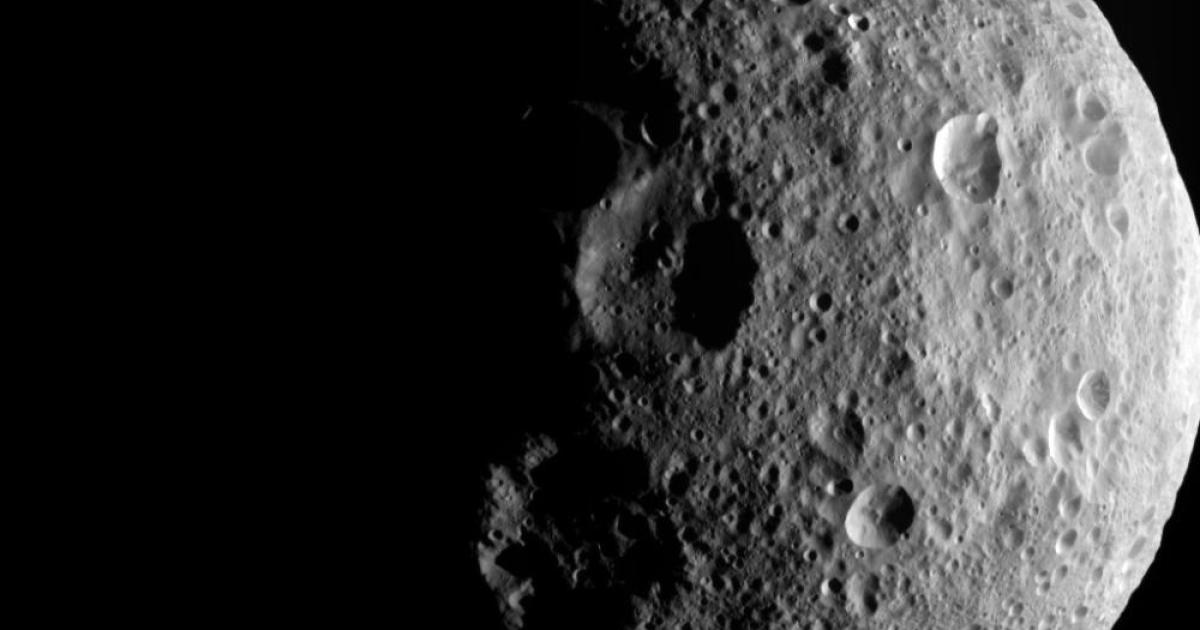
Today in the history of astronomy, the third asteroid is discovered – although astronomers aren’t calling it that yet. | Published: September 1, 2026 When Heinrich Olbers discovered 4 Vesta in 1807, he thought it -- along with Juno, Ceres, and Pallas, and all the other asteroids in the asteroid belt -- was a remnant of a destroyed planet. Credit: NASA/JPL-Caltech/UCLA/MPS/DLR/IDA On Sept. 1, 1804, German astronomer Karl Ludwig Harding peered through a 5-centimeter refracting telescope at a private observatory near Bremen, and discovered a celestial body he named Juno. Harding was part of the so-called Celestial Police. This group of astronomers had dedicated themselves to the search for the “missing planet” that the Titius-Bode law – a mathematical formula for predicting the distances from the Sun that each planet should be – indicated should be between Mars and Jupiter. Juno, now known to be approximately 145 miles (233 kilometers) in diameter, was the third asteroid ever discovered, following on even-larger Ceres (1801) and Pallas (1802). At the time of their discovery, all three were actually classified as planets; they were later reclassified in the 1850s, after William Herschel introduced the term asteroids to describe these too-small-to-be-planets bodies. Their existence, along with all the other asteroids between Mars and Jupiter, led another Celestial Police member, Heinrich Olbers, to suggest that the asteroid belt was formed when a larger planet – that “missing planet” – was destroyed. By the mid-20th century, that theory had been disproved. It’s now thought instead that the asteroids are pieces of what could have been a planet but never formed, due to disruption from Jupiter’s gravity. Elisa Neckar is senior production editor of Astronomy magazine, and the editor of the Today in the History of Astronomy feature on Astronomy.com.
Sept. 1, 1804: Karl Harding spots 3 Juno
Full Article
Original Source
Read the full article at Astronomy →KhanList aggregates and links to publicly available news content. We do not host full articles from third-party sources. Always verify important information with original sources.