
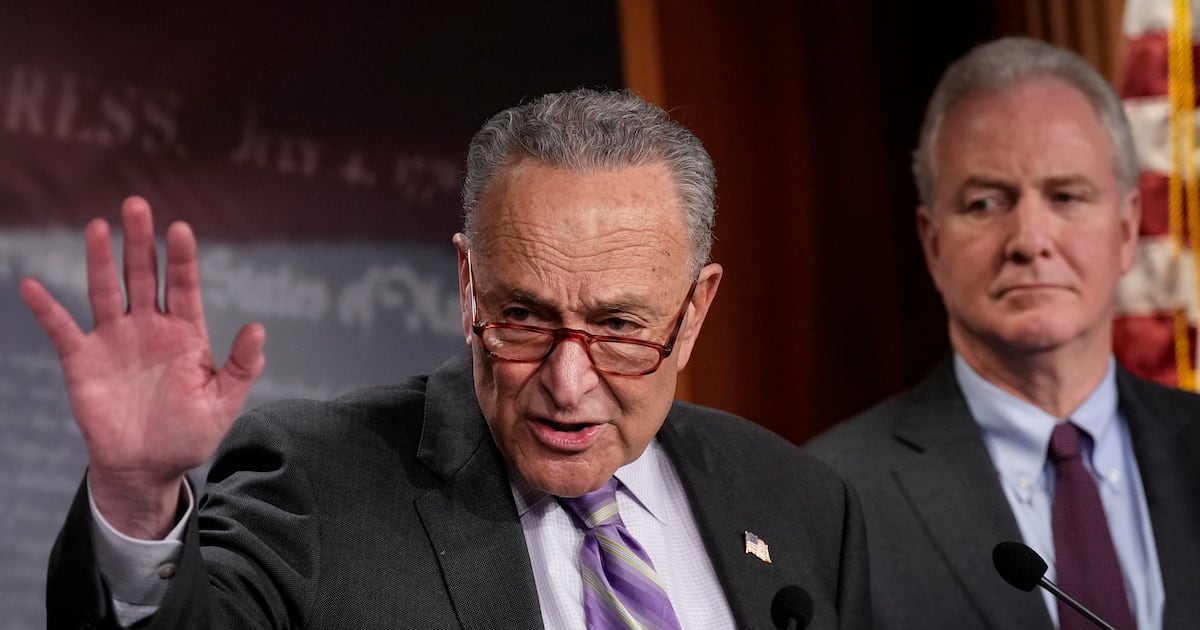
As the euphoria of the midterm election success begins to fade for the Democratic Party, so comes the first true test of their resolve, direction and identity. Chris Van Hollen, the Maryland senator whose mild disposition belies an outspoken progressive streak, is adamant that he can muster the votes to topple Chuck Schumer as the incumbent US Senate majority leader. ‘Repudiation’ became the overnight commentariat buzzword of the midterms. Van Hollen’s argument is that the Senate blindly persisting with the status quo – in the familiar face of Schumer – would be akin to a repudiation of the wishes of the American voters.“I think this is a wide-open race, and I think the American people spoke loudly and clearly on election day,” he said this week.READ MORE“First of all, they rejected Trump’s policies – his wars, corruption, the high costs. But they haven’t fully hired the Democrats. We have a chance, but we need to earn people’s trust. So, this isn’t about any one individual. It is about what the American people had to say.”Van Hollen’s challenge has sharpened the contrast between the progressive and establishment wings of the party. A host of new senators – including the high-profile Abdul El-Sayed of Michigan, Adam Hamilton of Kansas and Troy Jackson, who ended Susan Collins’s 30-year run in Maine – have all stated their intention not to vote for Schumer. Others, such as Angus King, the Maine Independent who caucuses with the Democrats, are arguing that Schumer is the architect of the historic sweep that has led to the party winning some 55 Senate seats – a figure predicted by precisely nobody. “Why would you fire the manager who just won the World Series?” he pointed out.Schumer himself has been publicly relaxed about Van Hollen’s challenge, stating last week he is confident he has the votes (in a straight majority election count) and that he welcomes debate. The 75-year-old New Yorker has been a fixture in the Senate since 1999, adopting a smiling and avuncular political manner as he assumed godfather status within the party. Irish lobbyists will recall him as a staunch supporter of the immigration Bill, originally co-authored by Patrick Leahy, the influential Vermont senator, and Dick Durbin of Illinois, that would have granted some 10,000 undocumented Irish a path to attain legal status under the proposed E-3 non-immigrant visa. The Bill was introduced by Schumer in 2012 but did not pass. Schumer has remained a trenchant defender of US support for Israel, even if one of his more outspoken moments lay in his criticism of Binyamin Netanyahu, whom, he told the chamber in March of 2024, had “totally lost his way” in his leadership of a government that “no longer fits the needs of Israel”. The words were stronger than anything offered by president Joe Biden as the onslaught against Gaza worsened. But Schumer has a long-standing relationship with AIPAC, the biggest pro-Israel lobbying group, while Van Hollen has referred to Netanyahu as a “chronic liar” and a “wanted war criminal” and has actively worked to halt arms shipments and military aid to Israel.Senator Chris Van Hollen: 'This was not a Washington-orchestrated election around the country. This was the American people wising up against a lawless president and demanding change.' Photograph: Daniele Volpe/The New York Times To the new generation, that sharp contrast leaves Schumer out of step: a member of the Biden-era vanguard and not representative of the fervent wish for economic and social reform as expressed in election results that upended historical precedent in states such as Iowa and Texas. Van Hollen has also suggested that behind the scenes, Schumer is lobbying to bring forward the election debate from December 1st before his challenge can fully catch fire.“I think there is an overwhelming sentiment that we should have a fair and open process,” he told Politico on Monday in one of a series of interviews he has given in recent days.“After all, we called for a fair and open process in the national elections, and it would be kind of strange if the Democratic Party cut short debate and used that to influence the outcome of the election. I would just ask why that would be – that folks would want to cut debate short ... is it that the longer this discussion goes on, the more momentum grows?”Contained within that rhetorical question is a haunting muscle-memory for the Democratic movement. The July 2024 decision by Biden to abandon his re-election bid was quickly alchemised into an August coronation, at the convention in Chicago, of then vice-president Kamala Harris. There were extenuating circumstances – not least that the election was three months out – and the Democrats enjoyed a late summer jolt of optimism about a presidential campaign that had flatlined following Biden’s catastrophic debate performance in Atlanta.But the lack of process – and even a cursory debate about holding a primary so other candidates could make their case – plagued the party after Donald Trump returned to the White House. Trump could goad the Democrats about their decision to essentially replace Biden, who had been chosen by the public in the Democratic primaries – and goad them he did.The stunning New York mayoral campaign by Democratic socialist candidate Zohran Mamdani last year presaged the wave of midterm campaigns. Last September, Van Hollen criticised Schumer and House minority leader Hakeem Jeffries for their reluctance to endorse their fellow New Yorker.“That kind of spineless politics is what people are sick of,” he said in a speech in Des Moines.“They need to get behind him and get behind him now.”During the first six rampaging months of Trump II, the idea of the Democratic Party concocting the biggest midterm sweep in half a century would have seemed delusional. In all polls, the party was mired in dismal approval ratings and appeared clueless as to how to get out of that rut.Against those odds, and through a combination of general disillusionment with the Iran war and other Trump policies, they have done so. Schumer supporters are adamant that he set the campaign manifesto of talking about cost, corruption and chaos – and chose key candidates such as Roy Cooper (North Carolina) and Sherrod Brown (Ohio). Chuck Schumer has run into resistance from progressives who don’t want to see him become majority leader. Photograph: Alex Kent/The New York Times “Let’s be real,” Van Hollen argued this week.“This was not a Washington-orchestrated election around the country. This was the American people wising up against a lawless president and demanding change. We won not just Senate seats and House seats, we won governor’s races, we won legislative races and if you look at some of the races we won say in Mississippi – Scott Colom wasn’t recruited by anybody in Washington. [Nor was] Annie Andrews in South Carolina.”Not only that, but Schumer had actively supported Haley Stevens, the Michigan establishment pick narrowly defeated by El-Sayed in their primary election. Stevens’s tense relationship with El-Sayed broke down on the eve of the midterms, causing her to publicly endorse Republican candidate Mike Rogers, a stunning reversal that Schumer denounced as a “despicable betrayal”.Among the sitting senators firmly in Schumer’s camp is John Fetterman, the Pennsylvania Democrat senator who has remained a staunchly pro-Israel advocate and has become increasingly estranged from the party mandate. Fetterman has said the prospect of Van Hollen leading the caucus could be a “red-flag” issue for him: there is a strong possibility that if Van Hollen does succeed in toppling the veteran, it could result in an immediate defection.Many Democratic voters will see this leadership tussle as a referendum on the party’s internal ideological arm-wrestle. Its senators, returning and new, are going to have to make their decision by December 1st – if not before. It will represent their first real test after the November dream and there is no easy answer.As Yogi Berra, the legendary New Yorker who knew a thing or two about winning and losing World Series said: “When you come to a fork in the road, take it.”
Senate leadership challenge presents fork in the road for Democrats
Full Article
Original Source
Read the full article at Irishtimes →KhanList aggregates and links to publicly available news content. We do not host full articles from third-party sources. Always verify important information with original sources.