
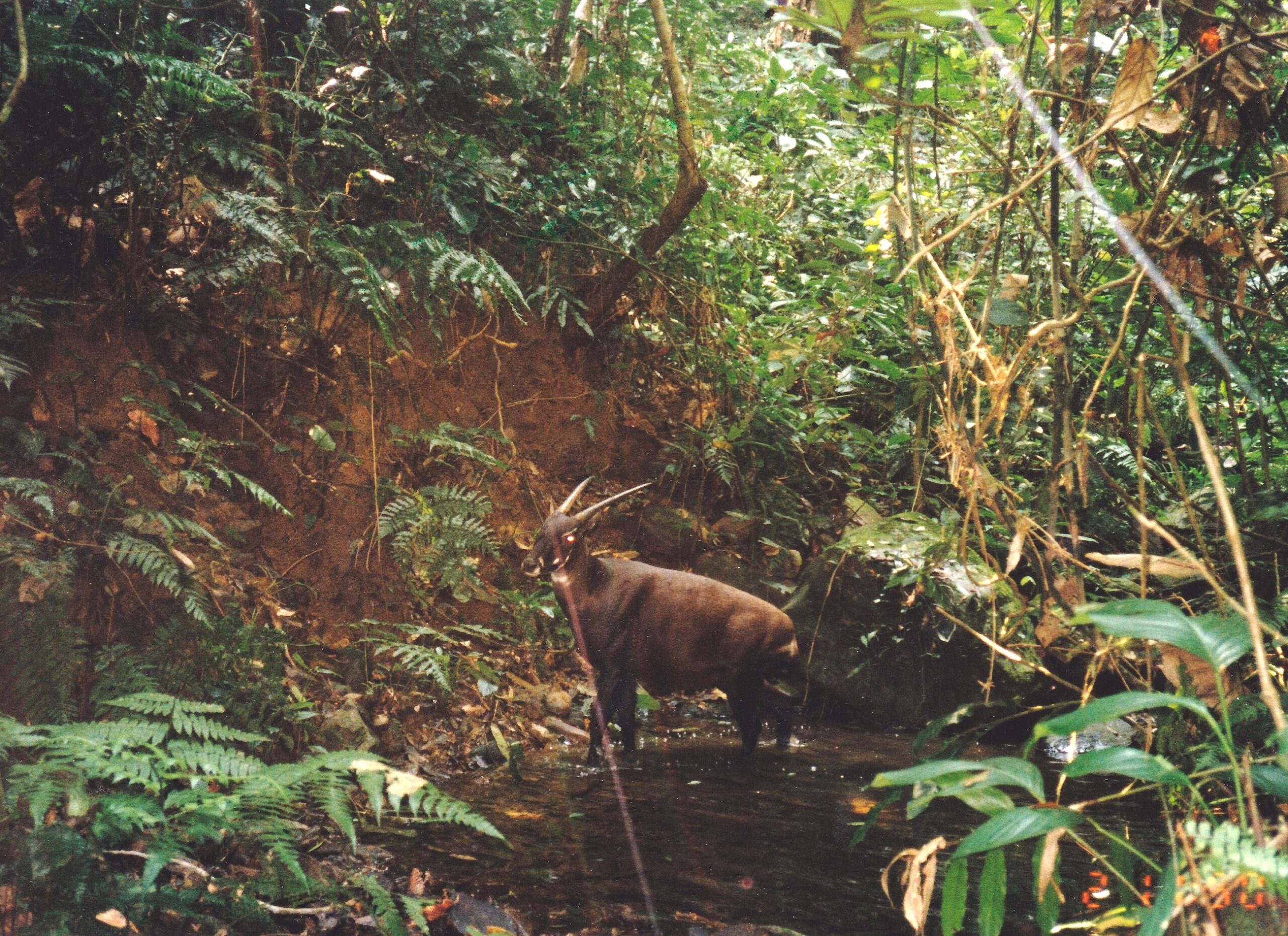
The saola, a tropical bovid that superficially resembles an antelope, was only discovered by scientists in 1992, and has not been recorded since 2013.A search for the saola in the Annamite Mountains in Laos risks coming to a halt due to a loss of funding.In addition to searching for the saola, the research team is documenting the wildlife of a particularly remote corner of the Annamites, a global biodiversity hotspot. The search for the enigmatic creature often called the Asian unicorn is stumbling forward on a month-to-month basis, according to the Saola Foundation, which organizes the search. The group says it’s now frantically raising funds to keep the search for the saola in Laos going. “The team comes out of the forest each July for the wet season. This year a sharp contraction in our funding meant we could not confirm they would go back in October,” said Lorraine Scotson, CEO of the Saola Foundation for the Conservation of the Annamite Mountains. Funding for October has only just come through, largely thanks to donations from a number of zoos, but fundraising continues for future months. The saola (Pseudoryx nghetinhensis) may well be the world’s most endangered large animal. The only member of its genus, the species is a tropical bovid that superficially resembles an antelope with its long, curved horns, thin face, and elegant facial markings. It’s believed to have remained this way largely unchanged for 15 million years. Found in the biodiverse Annamite Mountains, which straddle the border region of Laos, Vietnam, and a small portion of Cambodia, the saola was only discovered by scientists in 1992. Captive saola in Laos, 1996. Image by W. Robichaud/WCS. “Fewer than 50 are thought to remain, none are held in captivity, and the last confirmed record anywhere was a camera-trap photograph in 2013. Very few people have ever seen one alive,” Scotson said. Given this, the Saola Foundation launched a search in Laos for the Asian unicorn in 2025. The search includes expert trackers from local communities, sniffer dogs trained by Working Dogs for Conservation, and DNA-testing equipment at base camp. Scotson said the DNA tests can tell “within a couple of hours whether a dung sample is from a saola or a serow.” The western serow (Capricornis sumatraensis) is another odd large mammal, also a bovid, found in the Annamite Mountains. The team has been targeting 300 square kilometers (116 square miles) of rich forest in Laos’s Bolikhamxay province, on the border with Vietnam. Scotson said they chose the area because it had “relatively low hunting levels” and high densities of serow and muntjac, a small deer native to Asia. A field technician from the Annamite Mountains Research and Conservation Team photographs a dung sample found in the forest during the search for Saola. Souksamlan Laladeth / Saola Foundation. The biggest threat to the saola isn’t habitat loss, but hunting. The animals are especially imperiled by the global snaring crisis. Metal or wire nares kill indiscriminately and en masse. For such a rare animal, a few deaths in snares could prove existential. For some conservationists, that’s prompted the question of whether the saola is even out there still? Scientists haven’t detected it in 13 years, raising fears it may have gone extinct. Barney Long, senior director for conservation strategies at conservation NGO Re:wild, said the species’ odds of survival are slim. Re:wild was one of several partners that recently looked for the saola in Vietnam. The effort, led by WWF-Vietnam, ran from 2022-2024, and, according to Long, “found nothing.” “Unfortunately, I personally think we have lost the saola,” Long said. “It has not been seen for 13 years, and even if one or two remain hidden away in some pocket of remote rainforest, the likelihood that they are able to maintain a viable population is close to zero.” Scotson disagreed. “We see no sound scientific reason to conclude the saola is extinct. Years without a record do not mean the species is gone,” she said. “Saola signs look much like those of other hoofed mammals, and at very low densities any animal becomes extremely hard to detect.” Scotson said saola density is likely to be as low as one animal per 300 km2. But she added the Saola Foundation’s team is “more skilled and versatile than any seen before in the region.” She said that “with world-class tools and technology, they are positioned to be a leading technical resource for the Annamite Mountains for years to come.” This 1999 camera trap photo of a saola in Laos is one of the few images of a wild saola. Image by Ban Vangban Village/W. Robichaud/WCS. In addition to the saola, the Annamite Mountains are home to dozens of species found nowhere else, such as the giant muntjac (Muntiacus vuquangensis), the Annamite striped rabbit (Nesolagus timminsi), two species of gibbon, three species of douc langurs, and the Laotian rock rat, or kha-nyou (Laonastes aenigmamus). Scotson said the mountain range covers “less than 0.2% of the Earth’s land surface … yet it holds more than 3% of the world’s land-based vertebrate species.” Long also called the Annamite Mountains “one of the most important landscapes for the conservation of biological diversity in the world.” In addition to searching for the saola, the Laos team is helping to document that rich biodiversity. If the search for the saola stops, so does this vital documentation, Scotson said. “All around the world, organizations like ours are struggling in such an uncertain funding climate, with many jobs lost and projects ended as a result,” she said. “Our experience is one shared by many.” The search for the saola may be the last chance to prove its existence while there’s still time to take action to ensure its survival. Such action could include capturing saola for a captive-breeding program, conservationists have proposed. But first, they say, they have to find them. “If we aren’t searching,” Scotson said, “no one is searching for the saola.” To track a unicorn: Laos team goes all out to find the last saolas FEEDBACK: Use this form to send a message to the editor responsible for this story. If you want to post a public comment, you can do that at the bottom of the page. Credits Topics
Search for the ‘Asian unicorn’ faces an uncertain future amid funding losses
Full Article
Original Source
Read the full article at News →KhanList aggregates and links to publicly available news content. We do not host full articles from third-party sources. Always verify important information with original sources.