
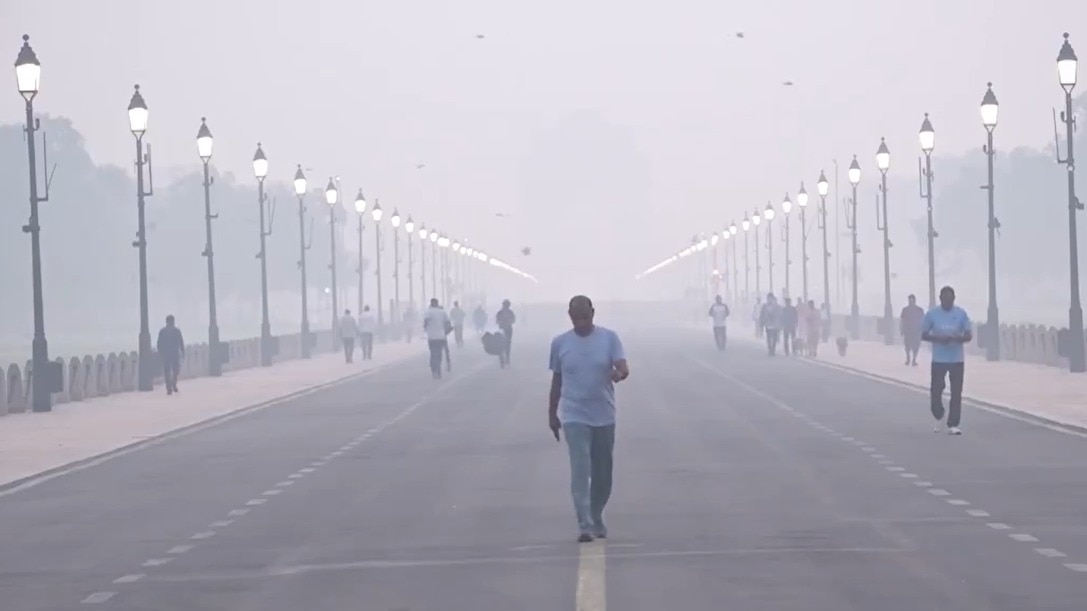
A familiar haze is beginning to settle over Delhi as the city moves deeper into the season of deteriorating air quality.On Wednesday morning, smog returned to the national capital, with visibility and air quality concerns adding to the unease as temperatures fell.The change comes a day after Dussehra celebrations, while stubble burning in neighbouring states and weather conditions that can trap pollutants remain key concerns as Delhi heads towards the winter pollution season.According to the Air Quality Early Warning System (AQEWS), Delhi’s air quality was expected to slip into the ‘poor’ category from Wednesday and remain there until Friday, October 23. The forecast followed an Air Quality Index (AQI) reading of 179 on Tuesday, when the city’s air quality was classified as ‘moderate’.Station-level readings showed that several parts of the capital had already entered the ‘poor’ category by early Wednesday. VIDEO | Delhi: A layer of haze covers parts of the capital city. Morning visuals from India Gate, Kartavya Path areas. #DelhiWeather #WeatherUpdate (Full video available on PTI Videos - https://t.co/d8jp61yd2p) https://t.co/1tXkV7y0MI— Press Trust of India (@PTI_News) October 21, 2026At midnight, the AQI stood at 273 in Bawana, 262 in Dwarka Sector 8, 248 at Delhi Technological University and 230 at the Dr Karni Singh Shooting Range.The ‘poor’ category covers AQI readings between 201 and 300.Thick fog was also reported at the Biodiversity Park near the Commonwealth Games (CWG) Apartments in the Akshardham area on Wednesday morning, adding to concerns over the hazy conditions across parts of the capital. (Credits: IndiaToday) (Credits: IndiaToday) DUSSEHRA CELEBRATIONS ADD TO POLLUTION CONCERNSDelhi celebrated Dussehra on Tuesday, with Ramleela events, the burning of Ravana, Kumbhakarna and Meghnad effigies, and fireworks at several venues.The celebrations coincided with the seasonal deterioration in air quality that typically affects Delhi and the National Capital Region as temperatures fall and atmospheric conditions become less favourable for pollutant dispersion.Fireworks can release particulate matter and other pollutants into the air, while emissions from vehicles, construction dust, industries and waste burning remain significant sources of pollution across the capital.It is yet to be established how much Dussehra activities contributed to Wednesday’s smog.Stubble burning in neighbouring states is another concern as the paddy harvesting season progresses. Earlier this month, the ICAR-Indian Agricultural Research Institute detected 19 farm-fire incidents across six monitored states: seven each in Punjab and Uttar Pradesh, four in Madhya Pradesh and one in Haryana.Farmers burn crop residue to clear fields for the next crop, releasing pollutants that can affect air quality across the region.The contribution of these fires to Delhi’s current pollution levels depends on factors including the number and location of fires, wind direction and atmospheric conditions.FALLING TEMPERATURES, WEATHER CONDITIONS AFFECT AIR QUALITYThe deterioration comes alongside a drop in temperatures across Delhi. On Tuesday, Safdarjung, the capital’s primary weather station, recorded a maximum temperature of 31.8 degrees Celsius and a minimum of 17.7 degrees Celsius, both slightly below normal.Palam recorded a maximum of 29.3 degrees Celsius and a minimum of 17.3 degrees Celsius, while Lodhi Road registered a maximum of 31.4 degrees Celsius and a minimum of 17 degrees Celsius, according to PTI.As winter approaches, atmospheric conditions can make it harder for pollutants to disperse, allowing emissions from multiple sources to accumulate closer to the ground.The AQEWS forecast indicated that air quality was likely to remain in the ‘poor’ category through October 23, with the outlook for the following six days also pointing to poor conditions.DELHI ANNOUNCES WINTER POLLUTION CONTROL MEASURESThe worsening air quality comes as the Delhi government prepares to implement its Winter Action Plan from November 1. The measures are aimed at curbing vehicular emissions, construction dust, industrial pollution and other sources that contribute to the capital’s seasonal pollution problem.The plan includes a No PUC, No Fuel policy, under which vehicles without valid Pollution Under Control certificate will be denied fuel.From November 1, non-BS-VI-compliant vehicles registered outside Delhi will also face entry restrictions, subject to exemptions.The government has announced plans for 50% work from home, restrictions on construction activities, stricter monitoring of dust pollution and increased use of mechanised road sweeping.The Commission for Air Quality Management’s revised Graded Response Action Plan (GRAP) also provides for progressively stricter measures depending on the severity of pollution. These include steps targeting road dust, construction activity, polluting vehicles and other emissions sources.With the forecast pointing to several days of poor air quality, the immediate challenge for authorities will be to enforce existing pollution-control measures while preparing for the more difficult winter months.- Ends
Smog returns to Delhi: Is the capital bracing for another polluted winter?
Full Article
Original Source
Read the full article at Indiatoday →KhanList aggregates and links to publicly available news content. We do not host full articles from third-party sources. Always verify important information with original sources.