
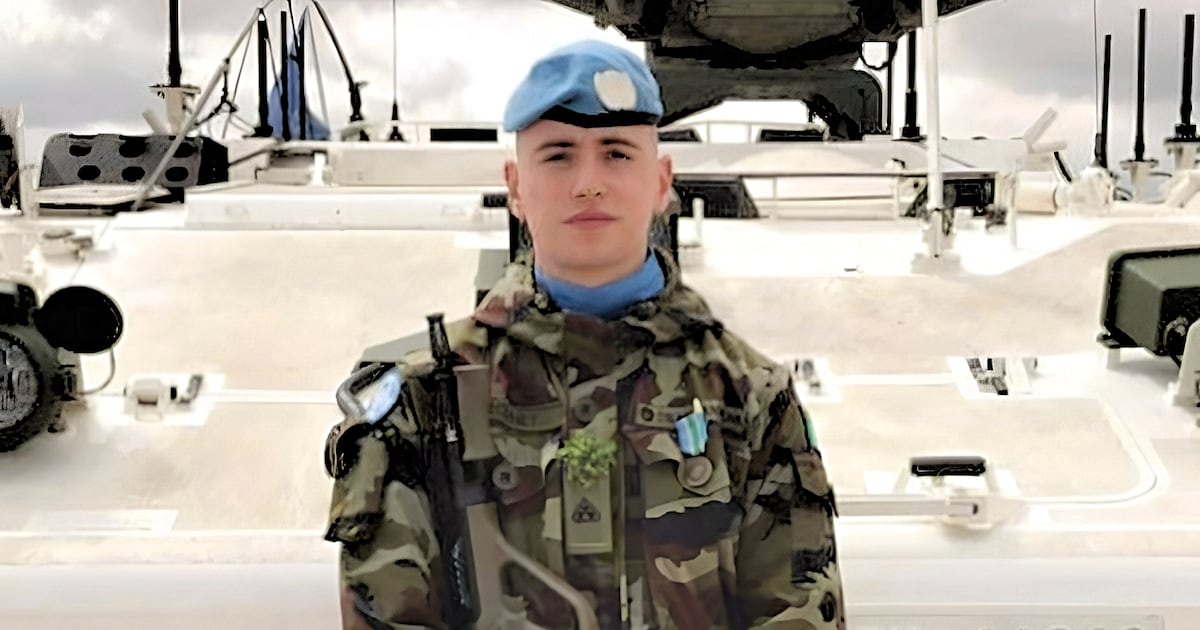
A soldier has said he was “not trying to deceive” the inquest into the death of Pte Seán Rooney, the UN peacekeeper killed in Lebanon almost four years ago, after discrepancies were pointed out in statements he had given related to the incident. Much of the evidence heard at the Dublin District Coroner’s Court on Thursday centred on what happened when the two vehicles in a convoy became separated on the night of December 14th, 2022.The convoy was travelling from Camp Shamrock, where Irish peacekeepers serving with the United Nations Interim Force in Lebanon (Unifil) were based, to Beirut Airport so two soldiers could go home for separate family funerals.The inquest heard how the two vehicles became separated after a planned stop at a designated point on the route – known as EP28 – to remove UN flags from the vehicles, as they were leaving the Unifil area. The second vehicle temporarily would not start, causing a delay in it leaving this area.READ MOREThe lead vehicle continued on the planned route, believing the second vehicle was behind them, the inquest heard. The soldiers travelling in the second vehicle, driven by Rooney, drove straight ahead, not realising they had missed a turn.On Wednesday, soldiers who were in Rooney’s vehicle told the inquest how they ended up in a nearby village and their 4x4 vehicle was quickly surrounded by people, some armed, and vehicles.Barrister Seán Guerin, representing the Rooney family, on Thursday asked Cpl Richard Shanahan why one of his statements said the lead vehicle, after making the turn, had only travelled about 100m up the main supply road on the route, while another statement said the vehicle had gone several hundred metres up the road.Guerin suggested the vehicle had actually gone about 1km up the road in question.Shanahan, who was a signalman at the time of the incident, said he could not recall exactly how far the vehicle travelled up the road. He said it was “quite a stressful time” and his memory might be “a little patchy”.Guerin said there “seems to have been a common affliction of the memory of those in the lead vehicle”.Shanahan acknowledged there were inconsistencies in his statements but said he was “not trying to deceive” anyone. This prompted Guerin to ask Shanahan “if it looks like an attempt to deceive now”. Shanahan said he “100 per cent” denied this.Guerin pointed out that, in a statement given shortly after the incident in 2022, Shanahan said the lead vehicle was at one point about 15km away from the second vehicle, while he told the inquest he thought they were about 6 to 7km away. Guerin also said it was unclear from Shanahan’s statements if the lead vehicle went back to EP28. Shanahan initially told Guerin he could not recall if the lead vehicle made it back to EP28 when trying to get help for the second vehicle, before later saying he was sure it had. Shanahan noted that Capt David Kelly, the first-in-command, swapped seats with the driver of the lead vehicle, Michael O’Sullivan, at a certain point. Guerin suggested this was because Kelly was a more experienced driver and better equipped to drive the wrong way down a motorway at night.Guerin also questioned why there was no record of the soldiers in each vehicle communicating via a VHF (very high frequency) radio, which is typically used when vehicles are closer together. He said there was a record of the soldiers speaking via WhatsApp calls, a hand-held Motorola radio, and a HF (high frequency) radio, which is typically used when vehicles are further apart. Guerin said the VHF radio has a “more powerful connection” than a Motorola radio. He suggested it wasn’t used because there was no VHF radio in the second vehicle. Earlier on Thursday, the inquest heard that no VHF radio was found when equipment was recovered from the second vehicle after the incident in which Rooney was killed. Guerin said the VHF radio may have been taken by someone during the incident or it may not have been in the vehicle when it left Camp Shamrock.The inquest heard that the members of the lead vehicle had to abandon their vehicle for a period after shots were fired at them, before the Lebanese Armed Forces came to their assistance.Earlier on Thursday, the inquest heard that Cpl Josh Phelan, the second-in-command of the convoy, became frustrated with Kelly on the night in question.Phelan was the front-seat passenger in the second vehicle. He told the inquest it was his first time in Lebanon and he was not familiar with the route from Camp Shamrock to Beirut Airport. Guerin asked Phelan if it was fair to say the second-in-command of a convoy would “expect a detailed briefing of the route” and to be provided with physical maps. Phelan agreed, but said this did not happen on this occasion.In Phelan’s deposition read out to the court on Wednesday, he said he had received a short briefing of about 10 minutes before leaving Camp Shamrock.[ Situation became ‘very hostile very quickly’ on night Seán Rooney was killed, inquest hearsOpens in new window ]On Thursday, Guerin asked Phelan if this briefing was possibly “only two or three minutes”. Phelan agreed “it could have been less than 10 minutes”.Guerin said there had been an issue with certain equipment in one of the vehicles, so “a change in vehicles” was required, and this delayed the convoy leaving Camp Shamrock. He asked Phelan if this delay had caused “time pressure” to get to the airport. Phelan agreed. Guerin asked Phelan if he knew that the vehicle being driven by Seán Rooney was supposed to turn on to a different road about 3.6km after they left the location where they had removed the flags. Phelan said no.Guerin asked Phelan if he had been given any instructions about what to do if the vehicles became separated. Phelan said he had not. “The orders you had were effectively just to follow the lead vehicle,” Guerin said. Phelan agreed.Phelan said Seán Rooney was trying to catch up to the first vehicle in the convoy and drove straight for a few minutes. He said they “knew something had gone wrong” when they didn’t see the first vehicle. Their vehicle entered a village and things quickly became hostile, the court heard. Phelan said he made contact with Kelly to tell him what was happening. Phelan said he thought he called Kelly first, rather than the other way around. Guerin noted that in statements Phelan gave to Lebanese authorities and the UN in the aftermath of the incident, he said Kelly called him first. Guerin said Kelly might have forgotten this detail with the passage of time.The jury was then shown a screenshot of Kelly’s call log from that night. It indicated he phoned Phelan at 10.50pm in a call that lasted 49 seconds. Kelly called Phelan again at 10.54pm in a call that lasted for one minute and 19 seconds. Phelan said he could not recall exactly what was said during these calls, but he remembered being “angry” and “frustrated”. When Guerin asked him why, Phelan said he was frustrated that Kelly “was gone, essentially”.Phelan said Kelly initially told them to turn around and return to a certain junction where the first vehicle would meet them.Seán Rooney was initially able to turn the vehicle around but the crowd blocking it quickly grew in size and became more aggressive, the inquest heard. [ ‘His death has absolutely destroyed our lives’: Seán Rooney inquest begins in DublinOpens in new window ]The court saw screenshots of maps sent by Phelan to Kelly to show him where the second vehicle was. These images were sent at 10.54pm and 11.09pm, the inquest heard. At some point, Phelan said he told Kelly not to come to where the second vehicle was as it was too unsafe for a single, unaccompanied vehicle. He said he asked for Kelly to request backup from Camp Shamrock, though this was about an hour’s drive away. Phelan called Kelly at 11.06pm for one minute and 24 seconds, according to the call logs. He called Kelly again at 11.10pm, for one minute and 35 seconds. Kelly called Phelan at 11.16pm in a call that lasted almost four minutes. Phelan said this call was on speaker phone so the men in both vehicles could talk to each other.In evidence heard on Wednesday, Cpl Nathan Bryan said the soldiers said goodbye to each other in the last phone call. Kelly is due to give evidence next week.The inquest continues before coroner Dr Myra Cullinane and a jury of six women and four men.
Seán Rooney inquest: Soldier denies ‘trying to deceive’ as discrepancies pointed out
Full Article
Original Source
Read the full article at Irishtimes →KhanList aggregates and links to publicly available news content. We do not host full articles from third-party sources. Always verify important information with original sources.