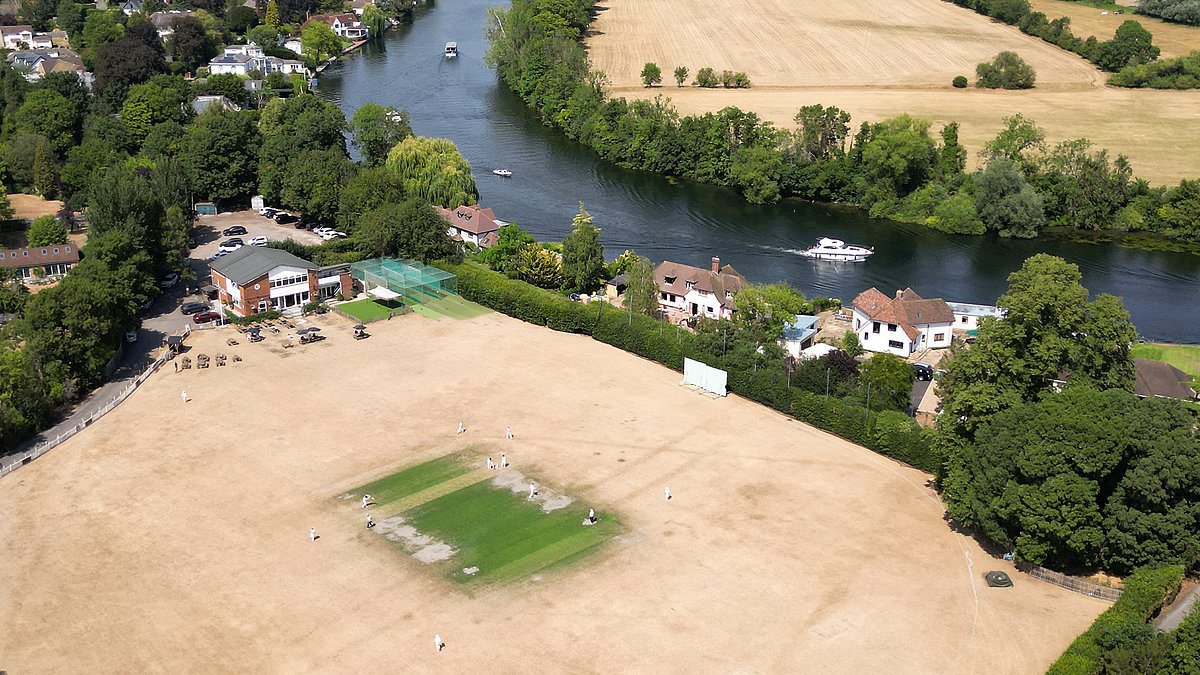
Yellow fields and cracked earth can be seen across the UK today, as the fourth heatwave of the year is set to hit while wildfires are already tearing through parts of the country. Wildfires in Cairngorms National Park have been raging for ten days and were declared a major incident by Scotland yesterday. Now, there are fears the wildfires could spread across southern England too, with many areas of the country suffering droughts and temperatures expected to climb to 30C in some parts once more next week. Perhaps the most visible sign of the oncoming heatwave was the scorched playing fields - formerly green - that had turned yellow and dry from above. Maidenhead and Bray's Cricket Club played a game on an extremely parched field on Saturday, with aerial images taken from above highlighting the extent of the scorched earth. A cricket pitch in Southam, Warwickshire, showed the same yellow, dry fields from above after the region saw consecutive days without rainfall amid rising temperatures. Wildfires are already burning across the Rhinogydd mountains, North Wales, and Blaenavon, South Wales, with the latter affecting 220 hectares. The past few days have also seen blazes on heathland on the Isle of Wight, woodland in the New Forest and fields in Tadley, Hampshire. An aerial shot of the cricket grounds in Maidenhead on Saturday showed extremely scorched grass, as the fourth heatwave is set to hit the UK next week A cricket pitch in Southam, Warwickshire, had a similar appearance on Tuesday amid the relentless high temperatures and unusually low rainfall this month More than 500 firefighters have been tackling a wildfire in Cairngorms National Park for the past ten days, which has forced the evacuation of homes in the remote region A helicopter is seen flying above the Cairngorms National Park as part of firefighting efforts todayToday, First Minister John Swinney asked Prime Minister Andy Burnham for help to battle the major blaze in Cairngorms, calling on military aid from the UK Government amid anger from residents in the highland village of Nethy Bridge, who were forced to evacuate. Smoke was visible 59 miles away in Aberdeen. More than 500 firefighters have been tackling the blaze, which has forced the evacuation of homes in the remote region. There were warnings the day could see matters worsen thanks to the wind changing direction, meaning smoke is now blowing towards Aberdeenshire and the North Sea. Emergency services previously said significantly changed weather conditions, including stronger winds, have contributed to the unpredictable behaviour of the blaze. It has so far ravaged around 600 hectares of land. In an update on Saturday morning, Police Scotland said residents in a small area of properties north-west of Dorback Lodge (Lain Thatchan) had been evacuated as a precaution.The Scottish Government said a fire break around the village of Nethy Bridge was established overnight, and new breaks are being constructed as Scottish Fire and Rescue Service (SFRS) deploys additional resources.A smoke advisory is also in place for Tomintoul, where residents have been advised to keep windows and doors closed due to smoke from the wildfire. Elsewhere, Nottinghamshire Fire and Rescue Service (NFRS) were called to a large fire haystack fire in a field near Saxondale Island on Friday evening Scorched grassland on Tintwistle Moor, in the Peak District, from a wildfire that has been burning for more than a month The Met Office forecast for London shows the heatwave criteria of temperatures at least 28C for three consecutive days could be met between Tuesday and Thursday next weekResidents in the village of nearby Nethy Bridge are 'upset, angry and frustrated' amid fire evacuation orders and 'apocalyptic' palls of smoke from the blaze. Sandy McCook, chairman of the Nethy Bridge and Vicinity Community Council, said residents of the Cairngorms village could see large plumes of smoke from the wildfire on Friday before they were evacuated.Speaking on Saturday, Mr McCook said: 'Apocalyptic is the word for the pall of smoke that was on the go yesterday.'On the ground, Mr McCook said there was a major increase in firefighting units from the SFRS in and around the village, plus multiple wildfire response units.'I think a lot of people are running on adrenaline,' he said.First Minister John Swinney said the blaze remained a 'major and serious' incident but that they were seeing an 'improved picture' on Saturday afternoon.He said: 'A request has been made today to the UK Government for military assistance in aerial support that can be used to supplement existing resources that are being deployed to tackle the Cairngorms wildfire and we await a response.'The military is not currently conducting any aerial firefighting operations in the area. Smoke visible from Aberdeen, some 59 miles away, with flames seen from the outskirts of Nethy Bridge from where hundreds of residents have had to flee amid the Cairngorms wildfire More than 500 firefighters have tackled the blaze over the last 10 days, alongside specialist wildfire appliances, all-terrain vehicles, helicopter water-bombing operations and partner agenciesNo rain has fallen in July in Bedfordshire, Buckinghamshire, Hertfordshire and West Sussex, and 16 counties have recorded 0.1mm, which 'might just be a bit of dew on the grass', said the Met Office's senior operational meteorologist Marco Petagna. The UK has had 20 per cent of its average July rainfall, which takes into account the wetter areas. Mr Petagna added that it is 'very, very unusual' for a hot and dry spell to last this long. The dry conditions follow last year's drought summer, as the UK faces more extreme weather fuelled by human-caused climate change, mostly from burning fossil fuels. Heat alerts are in place across parts of England this weekend, with officials warning that temperatures are likely to impact on health and wellbeing. Yellow alerts for the East Midlands, East of England, London, South East, South West and West Midlands are in place until 9am on Sunday morning. Cooler and fresher weather is expected widely on Sunday, ending the longest running heatwaves with highs of 25C and 26C possible in the South East and high teens and low 20s more widely elsewhere. But the heat will climb again at the start of next week, with Monday's high forecast at 27C in the South East, just below the area's heatwave threshold of 28C. Heatwave thresholds will start to be topped the following day, with highs of more than 30C expected until Thursday in the South East. Next week's heatwave may also not be the last of the summer, the Met Office's long range forecast suggests. '(The weather) is a bit more changeable in the short term, but as we head more into August there are hints that conditions will settle down and become drier again', Mr Petagna said. Massive forest fires have forced the evacuation of 200,000 people in south-western France and central Spain as flames raged out of control. Firefighters in Spain admitted the fires were so fast and violent that they could not be tackled head on.
Scorched grass seen across UK as Scotland asks Burnham government for help over Cairngorms 'major incident' and there are warnings wildfires could spread through southern England
Full Article
Original Source
Read the full article at Dailymail →KhanList aggregates and links to publicly available news content. We do not host full articles from third-party sources. Always verify important information with original sources.