
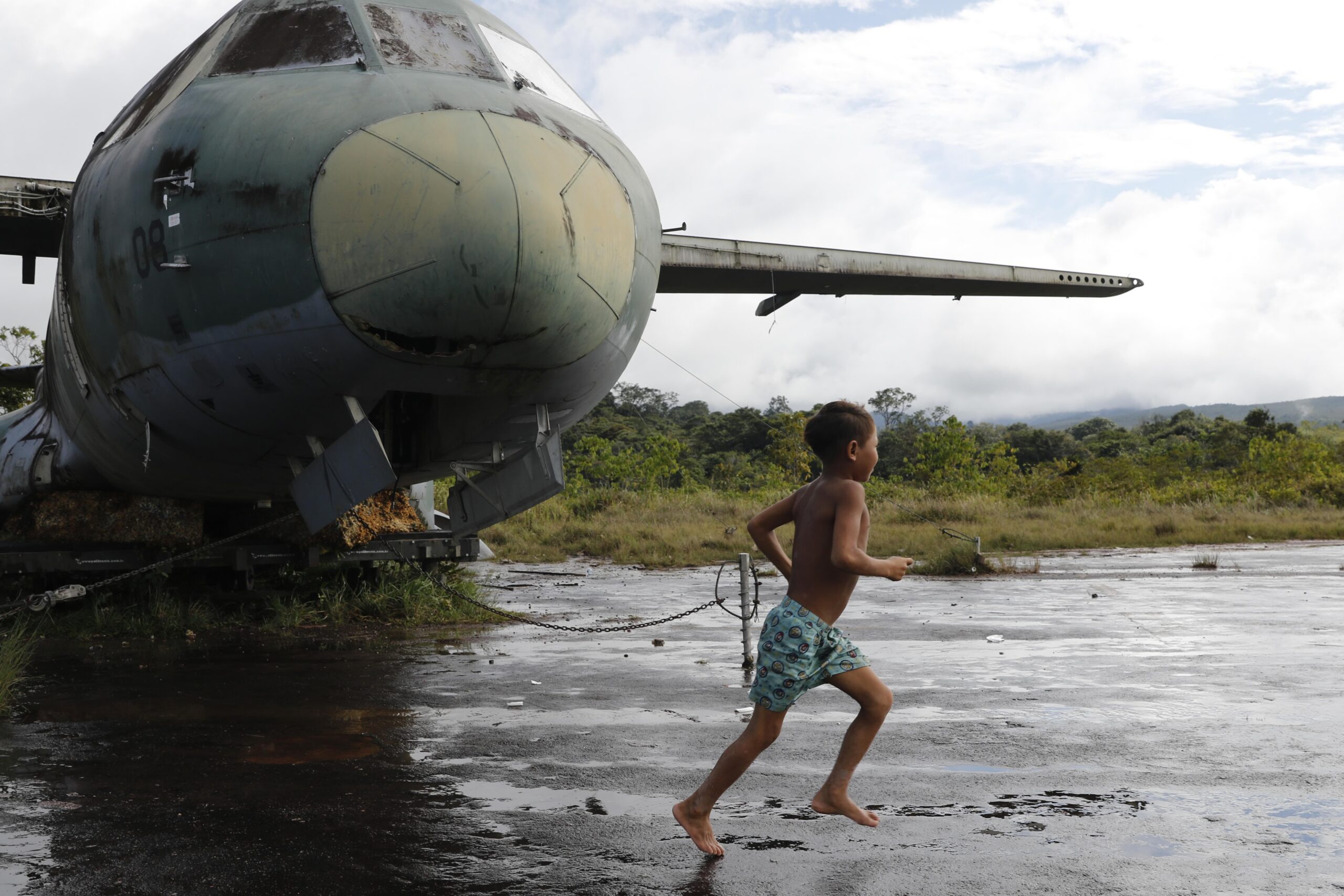
Researchers have found a direct link between illegal mining, miners’ routes, and malaria cases in the Yanomami Indigenous Territory in Brazil.Now, they’re working on an alert system that will rely on mining data to warn local health agents about the risk of a malaria outbreak.The number of malaria cases dropped sharply after authorities expelled illegal miners from the Yanomami land, but Indigenous people worry the potential return of a right-wing government after October’s election could revive the humanitarian crisis. A study detailing the links between illegal gold mining and malaria cases in the Yanomami Indigenous Territory in the Brazilian Amazon won second place in the MapBiomas Award, announced in July. The research collective produces data on land use in Brazil and recognizes initiatives that use this information to promote conservation. The study examined the explosion in malaria cases under the government of Jair Bolsonaro, Brazil’s president from January 2019 to 2022, whose far-right policies encouraged illegal miners to invade Brazil’s largest Indigenous land, home to 31,567 Yanomami. Known locally as garimpeiros, the illegal miners spread disease, contaminated water sources with mercury, and scared away wildlife, prompting a humanitarian crisis in the territory straddling the states of Roraima and Amazonas. Using satellite imagery and data from the Ministry of Health, researchers led by Márcia Castro, from the Harvard T.H. Chan School of Public Health in the U.S., found that a 1% increase in the mined area in the Yanomami territory was associated with a 24% increase in monthly malaria cases. The study, published in November 2025 in the journal PLOS Neglected Tropical Diseases, shows that malaria also increased in areas without mining activity but still used as routes by the miners. “The garimpeiros move around a lot because they have to bring in supplies and machinery,” Castro told Mongabay. “When you pass through these areas, you’re a carrier of the parasite as you walk, and you can get bitten by a mosquito along the way. And just like that, [the disease] spreads.” The number of malaria cases dropped in the Yanomami territory after the federal government sent a task force to expel the illegal miners in 2023. Image courtesy of Fernando Frazão/Agência Brasil. The finding explained why malaria cases “also increased at health centers in areas without gold mining,” MapBiomas noted in its award announcement. Now, Castro and her colleagues are working on a strategy to help eliminate malaria in Brazil. Their plan is to use data on mining, deforestation, and climate to create an alert system that warns local health authorities at the first sign of a malaria outbreak. “We’ll be able to reach out to the coordinator of the [malaria] control program in that area and say, ‘Look, these are the places where there might be an increase’,” Castro said. “If that person takes action where we’re pointing out, we’ll be wrong every week, because he’ll have acted before the problem erupts.” The alert system will rely on a new tool under development by MapBiomas, which will show new mining sites being opened every week. Currently, these data are published annually. The weekly mining alert may be ready by the beginning of the next year. Malaria is an infectious disease transmitted by mosquitoes of the genus Anopheles. It causes symptoms such as fever and headache and can even lead to death in severe cases and without proper treatment. The same person can be reinfected repeatedly, making it a very hard-to-contain disease. “Malaria is cruel,” said Waihiri Yanomami, the president of the URIHI Yanomami association, who contracted the disease 13 times. “It causes hot flashes, chills, fever, and weakness. You can’t walk or do any kind of exercise, and you can’t even work.” Illegal gold mines create the perfect environment for the proliferation of the mosquitoes that transmit malaria. Image courtesy of Fernando Frazão/Agência Brasil. Malaria cases plunged after task force Beyond potentially spreading the parasite, garimpeiros may also be creating the perfect habitat for mosquitoes, by destroying the forest and opening pools where stagnant water accumulates — ideal breeding grounds for the insect. The fragmentation of the forest, whether for mining, moving gear, or building campsites, has a strong impact on the rise in malaria cases, as shown in a study published in January 2026 in the journal Biology Letters. “The mosquito that transmits malaria is concentrated in forest edge areas,” lead researcher Daniela de Angeli Dutra, a professor at Bangor University in the U.K., told Mongabay. “So, when the forest is fragmented, there is an increase in habitats conducive to the spread of the mosquito.” During the Bolsonaro administration, the number of malaria cases skyrocketed in the Yanomami territory, with more than 25,000 cases annually. When Luiz Inácio Lula da Silva took over as president in January 2023, images emerged from the territory of sick children, shocking the world and prompting the authorities into action. The Lula administration declared a public health emergency and sent a task force to the area composed of health and security agents. The latter were tasked with expelling the garimpeiros. Deaths from malaria and malnutrition soared in Bolsonaro’s administration, affecting mostly the children. Image courtesy of Fernando Frazão/Agência Brasil. As a result, the extent of the areas being mined shrank from about 1,800 hectares in 2022 to just 29 hectares in 2024 (from about 4,450 to 320 acres). The latest report from the Ministry of Health recorded 7,600 cases of malaria in the Yanomami Indigenous Territory from January to July 2026, a 55% decrease compared to the 17,000 cases recorded in the same period last year. Around 1,15o Yanomami also received a new single-dose medication called tafenoquine, which not only treats the disease but also reduces the risk of reinfection. According to the Ministry of Health, the number of reinfections fell by 61.9% from March to June 2026. “This innovation simplifies treatment, increases adherence, and helps reduce relapses, especially in hard-to-reach communities, such as indigenous communities,” the ministry said on its website. In an email to Mongabay, the Ministry of Health added that no deaths from malaria were registered in the first half of 2026. It said it had tripled the number of health agents and reopened seven health care facilities in the Yanomami territory since 2023. Some garimpeiros, however, remained in the territory, going deeper into the forest and moving to the border with Venezuela. “The miners are still there — that’s the plain truth — and cases of malaria continue to occur,” Castro said. Some communities still struggle to access malaria diagnosis and treatment, and have to walk up to seven hours to reach health assistance, according to Waihiri, the Indigenous leader. He said his biggest fear, however, is that a new anti-Indigenous government — led by one of Bolsonaro’s sons, Flávio — wins the next presidential election, to be held in October. “I’m very afraid that the situation will go back to the way it was during the Bolsonaro administration,” he said. “It’s still very fresh in my memory, because I witnessed many cases of the Yanomami people suffering from malaria and malnutrition.” Banner image: A Yanomami Indigenous child plays among the wreckage of a Brazilian Air Force aircraft at the Surucucu airport. Image courtesy of Fernando Frazão/Agência Brasil. Crackdown lets rainforest reclaim illegal road in rare win for the Amazon Citations: Castro, M. C., Arisco, N. J., Diniz, C. G., Ponmattam, J., Peterka, C., Basta, P. C., & Ferreira, M. U. (2025). Mining and malaria in the Brazilian Amazon and in the Yanomami indigenous land. PLOS Neglected Tropical Diseases, 19(11), e0013677. doi:10.1371/journal.pntd.0013677 De Angeli Dutra, D., Fontes, J., Braga, É. M., & Mordecai, E. (2026). Investigating the Yanomami malaria outbreak: Gold mining and malaria. Biology Letters, 22(1), 20250659. doi:10.1098/rsbl.2025.0659 FEEDBACK: Use this form to send a message to the author of this post. If you want to post a public comment, you can do that at the bottom of the page. Cite this articleFernanda Wenzel (2026). Scientists use mining data to build malaria alert system in the Amazon. Mongabay Conservation news. DOI: https://doi.org/10.66709/news-328177 Credits Topics
Scientists use mining data to build malaria alert system in the Amazon
Full Article
Original Source
Read the full article at News →KhanList aggregates and links to publicly available news content. We do not host full articles from third-party sources. Always verify important information with original sources.