
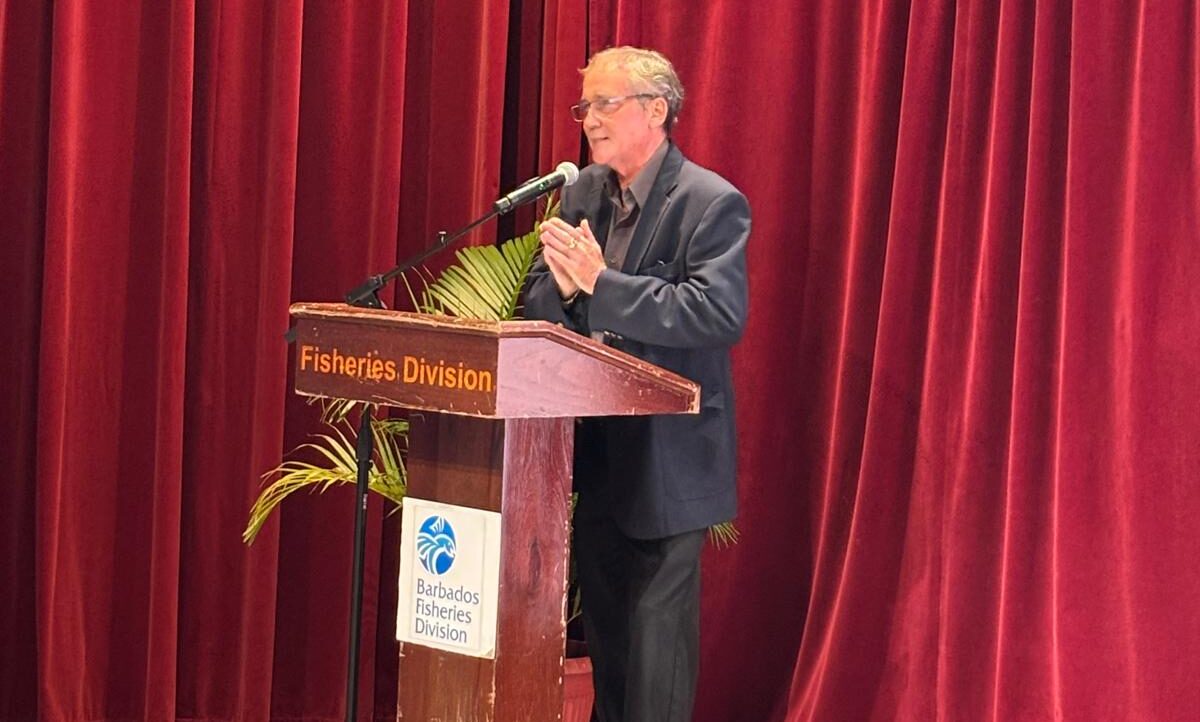
Acting Chief Fisheries Officer Dr Christopher Parker addressing attendees. (Photo Credit: Coretta Joe) Fisheries authorities are preparing to require every horizontal longline vessel operating in Barbadian waters to replace traditional J-hooks with circle hooks, following trials which found that a C16 hook configuration caught more yellowfin tuna while improving the chances of survival for non-target species released at sea. The move, which supports the Sustainable Fisheries Development and Management Act, was outlined as the Fisheries Division launched a public awareness campaign on Friday under the theme, Transformative Change: Fish Smart, Hook Right. The campaign aims to sensitise fisherfolk, vendors, and the general public to the transition from J-hooks to circle hooks, or C-hooks, as Barbados seeks to modernise its fishing industry while protecting marine ecosystems. Circle hooks have points turned perpendicularly back towards the shank, creating their distinct circular shape. Research shows they are more likely to hook fish in the mouth rather than the gut, significantly improving survival rates among non-target species. The centrepiece of the regulations is the mandatory transition from J-hooks to circle hooks for all horizontal longline vessels operating in Barbadian waters. Acting Chief Fisheries Officer Dr Christopher Parker said the provisions of the Sustainable Fisheries Development and Management Act were designed to protect the fish stocks on which fishing livelihoods depend. You Might Be Interested In “It is a shift from using J-hooks to circle hooks on every horizontal longline vessel operating in Barbadian waters,” Dr Parker explained. “I want us to understand the significance of what Barbados is doing at the regional stage since 2022. Every contracting party to the International Commission for the Conservation of Atlantic Tunas (ICCAT), Barbados included, has been obligated to use circle hooks or finfish bait to reduce the bycatch of sea turtles.” Dr Parker said Barbados’ approach went beyond simply meeting its international obligations. “No other CARICOM or Caribbean Regional Fisheries [Mechanism] member state has paired a locally generated, evidence-based trial with a cost, structured financial scheme and formal domestic legislation all at once. If we get this right, Barbados will not simply be complying with an international obligation, but setting the model for the wider Caribbean to follow.” The United States already had similar requirements, but Barbados had distinguished itself through what he described as a comprehensive, evidence-based approach. Dr Parker stressed that the policy was not a compromise between conservation and productivity, but a strategy for “better catch, better survival, and a better future”. The transition follows research conducted by the Fisheries Division with the REBYC-III CLME+ project. Field trials on local longline vessels found that C-hooks supported sustainable catches. Nia Browne, project coordinator with the REBYC-III CLME+ Barbados team, said the study tested C16 and C18 hooks across two trials. Both models outperformed J-hooks, leading to the recommendation of the C16 as the principal tool for the industry’s transition. Nia Browne, project coordinator with the REBYC-III CLME+ Barbados Team, speaking on gear trial results. (Photo Credit: Coretta Joe) “The catch per unit that they were fishing at—they were getting the same amount of time in the same waters at the same time, but they were finding that the circle hooks were catching significantly more fish. So then we dove into that a bit deeper and found that actually it was the C16 that was catching a significant amount more of the target species, the yellowfin tuna.” Browne said the study also examined safety and hooking locations. It found that C-hooks generally caught fish in the corner of the mouth rather than the gut, a key consideration for endangered, threatened or protected (ETP) species that must be released. The Fisheries Division has also announced measures to address concerns about the cost of adopting the new gear. Dr Parker said a box of circle hooks cost about US$200 (BDS$400), compared with US$120 (BDS$240) for J-hooks. The division has partnered with the REBYC-III CLME+ project to facilitate a gear-exchange scheme that lets fisherfolk trade in their existing gear. It is also working with suppliers to secure discounted rates. Parker said: “I am asking you to be part of this change not because the government demands it, but because the evidence of the gear trials shows it is good for your catch, good for the ocean, and good for the next generation of Barbadians.” Makayla Williams, legal consultant for the Fisheries Division, provided insight into the legislative framework supporting the changes. Nikola Simpson of Sustainable Caribbean also contributed to the proceedings, presenting on the wider implications for ocean conservation and delivering the vote of thanks. The event concluded with the release of the campaign jingle, sung by Reniece Bonnett; the showing of the campaign skit; and a tribute to the late Chief Fisheries Officer Dr Shelly-Ann Cox, performed by saxophonist Darren Watson. Reniece Bonnett, singer of campaign jingle. (Photo Credit: Coretta Joe) Saxophonist Darren Watson. (Photo Credit: Coretta Joe) (CJ)
Moves to make circle hooks mandatory for longline fishing fleet
Full Article
Original Source
Read the full article at Barbadostoday →KhanList aggregates and links to publicly available news content. We do not host full articles from third-party sources. Always verify important information with original sources.