
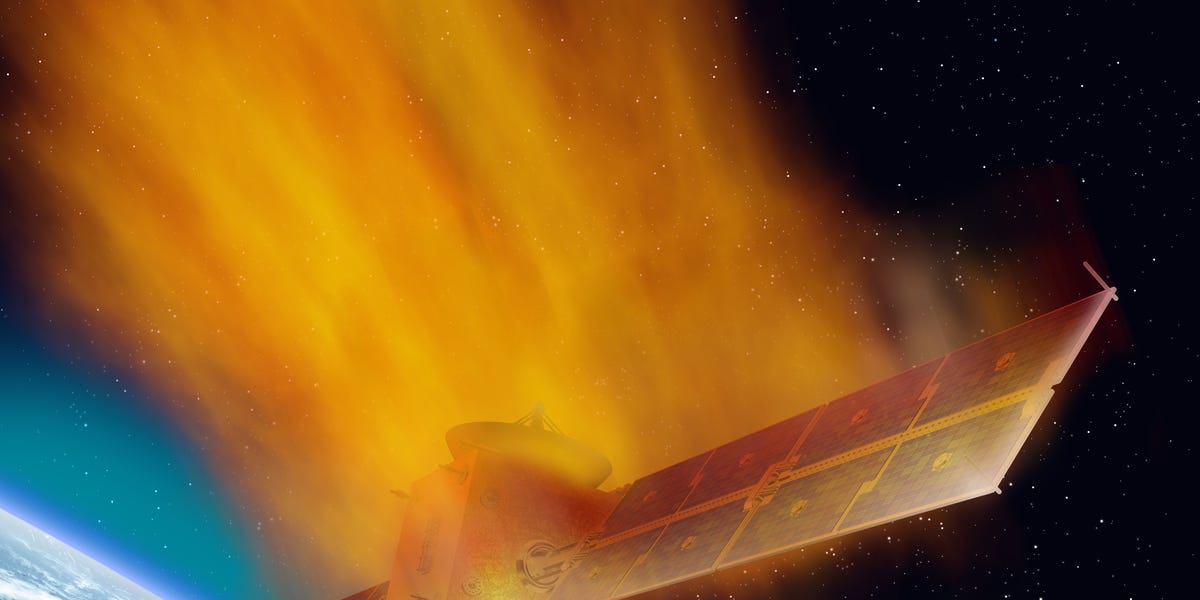
3 min readIf hypothetical aliens ever search for technosignatures, thousands upon thousands of satellites orbiting Earth should be an obvious sign that intelligent life exists on this planet. The problem is that an alien spacecraft might be better off keeping its distance. As the spiral into dystopia here on Earth continues, there has been growing concern that someone could take out many of those satellites (and the infrastructure they support) with a nuclear weapon. What would happen in the wake of such an attack is a question keeping scientists from sleeping at night.When a team of researchers from Princeton and the University of Wisconsin-Madison gauged the theoretical destruction of a nuclear strike in low-Earth orbit, or LEO, the results were grim. There have been over 13,000 satellites at altitudes under 1,242 miles (2,000 km) since early 2026. Many of these fly close together in a region of about 193-232 square miles (500-600 km2), and the use of LEO has only been expanding as the U.S. Department of Defense continues deploying hundreds more for detecting missiles and carrying out military communications, but they have only become more of a target for hostile forces. In an unnerving thought experiment, the researchers worked out the aftermath of detonating a one-megaton nuclear weapon 311 miles (500 kilometers) above the South Atlantic—they found it would easily wipe out about 98% of satellites.“Radiation-disabled spacecraft remain in orbit but are assumed to lose maneuverability,” they said in a study recently posted to the preprint server arXiv. “We follow collisions and breakup fragments in altitude bands, retaining mass and allowing fragments to move above and below their birth altitude after a velocity kick. Both intact objects and debris descend under atmospheric drag.”This is not the first time a “what if” like has been batted around, in theory or otherwise. Nuclear paranoia decades ago led to an actual experiment that revealed the potential horrors of detonating something in LEO. On July 9, 1962, the the Starfish Prime test saw a 1.4-megaton bomb detonated in the Pacific, around 400 km above Johnston Atoll. An artificial radiation belt was created by clouds of electrons released from radioactive debris scattered by nuclear fission. It caused severe damage to satellites that were either in outfit at the time or launched soon afterward. Radiation continues to be dangerous long after the initial explosion, because spacecraft continue to pass through it as they orbit, experiencing degrading effects that make them more difficult to maneuver. They then end up at increased risk of collision.The researchers found that the worst effects from a detonation over the South Atlantic would be from exposure to radiation damage, which would disable 25% of the fleet in not even a day. That would rocket to 78% after three days and 98% after a week. Damaged satellites prone to crashing would collide with each other—or scraps of space junk—and gradually shut down services that rely on them. There would be three collisions within 15 days and double that by 30. Smashing spacecraft would also clog LEO with fragments that would put even more satellites at risk, and at least 19 collisions would occur a year after the detonation. Atmospheric drag would reduce the hazard by removing disabled spacecraft orbiting lower, but those at higher altitudes would remain at the highest risk. Disabled satellites would continue to die off.Starfish Prime was so disastrous that the Partial Nuclear Test Ban Treaty was signed by the U.S. and the Soviet Union a year later. This enforced an outright ban on testing nuclear weapons anywhere but underground, whether it was on the surface, in the atmosphere, or deep in space. Satellites in LEO have multiplied since the 1960s. How long radioactive ions can keep letting electrons loose above the atmosphere is still uncertain, but satellite breakdowns would be staggering. It would take decades to restore the damaged spacecraft and infrastructure.“Restoring orbital services would require more than replacing the lost spacecraft,” the researchers said. “New satellites would need to survive the remaining radiation and debris. The prospect of rapid infrastructure loss followed by years of disruption reinforces the need to prevent the deployment and use of nuclear weapons in space.”Elizabeth Rayne is a creature who writes. Her work has appeared in Popular Mechanics, Ars Technica, SYFY WIRE, Space.com, Live Science, Den of Geek, Forbidden Futures and Collective Tales. She lurks right outside New York City with her parrot, Lestat. When not writing, she can be found drawing, playing the piano or shapeshifting.
Scientists Simulated What May Happen If a Nuclear Bomb Goes Off in Space. The Fallout Is Terrifying.
Full Article
Original Source
Read the full article at Popularmechanics →KhanList aggregates and links to publicly available news content. We do not host full articles from third-party sources. Always verify important information with original sources.