
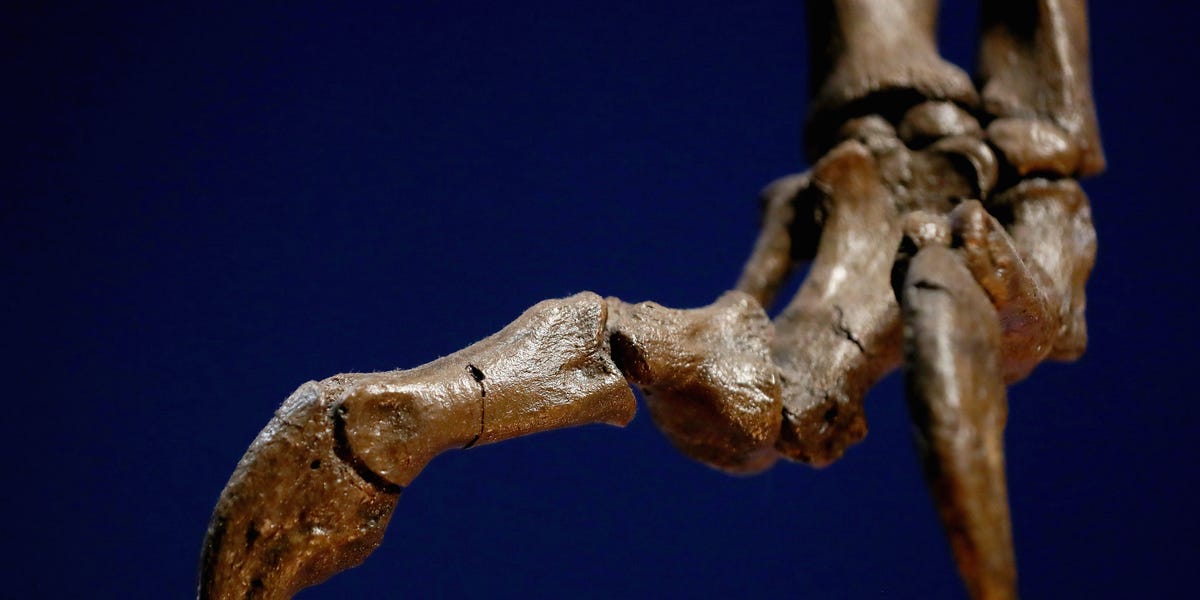
4 min readHere’s what you’ll learn when you read this story:While adult T. rex footprints are rare on their own, paleontologists have discovered the first trackway, consisting of more than one print, thought to be made by an adult T. rex. The dinosaur had apparently been walking through soft sediment that eventually hardened into mudstone and sandstone, and it was moving at about 5 to 6.5 feet per second.Although the tracks were badly eroded, digital reconstructions showed how huge this animal was, and how fast and far it moved. Tyrannosaurus rex left behind the skeleton of its hulking frame, its bone-crushing skull, and its dagger-like teeth—but its footprints have remained elusive. The star of Jurassic Park and myriad other dinosaur horror movies has no print for the Hollywood Walk of Fame. Footprints from smaller, swifter juveniles have turned up before, but hardly any remain from the behemoths those juveniles grew into. Only a few rare adult T. rex prints escaped being washed or eroded away by time—or blasted to dust by the asteroid that doomed them all.That scarcity is unfortunate, because tracks can reveal a lot of valuable information. Trackways are ichnofossils—traces left by an animal rather than pieces of the animal itself—and they capture a living creature in motion. They can reveal how fast the trackmaker was moving, how much it weighed, when it passed through the area, and even the shape of its feet. So when paleontologist Tyler Larson and his team were excavating in the badlands of North Dakota and came upon a set of enormous three-toed prints with T. rex bones lying nearby, they had a rare opportunity. Found in the Hell Creek formation, the prints were preserved as natural casts. After the T. rex pressed its feet into the mud, sand filled the depressions, and calcium carbonate cemented that sand into hard lumps of rock called concretions. Because those casts are tougher than the rock around them, they outlasted it. Despite cracks in the prints that preserve only vague anatomical detail, they’re a stunning find.“The task of assigning trackmakers to tracks is only made more difficult by the fact that ‘footprints are not feet,’ and apparent track morphology may differ substantially from foot morphology either due to foot movement and sediment response or due to preservation,” Larson said in a study recently published in Journal of Vertebrate Paleontology. “[It] can be frustrating given the potential wealth of information recorded in fossil tracks about locomotor capabilities and behaviors.”Despite these issues, it’s still possible to identify what species made the tracks. The prints were discovered in the same location and formation as bones from the same species—and possibly the very individual—that made them. The three toes and enormous size of the prints also point to T. rex: no other theropod that large lived in North America during the Late Cretaceous.Nothing like this trackway has been found before. A single footprint in New Mexico had previously been attributed to T. rex, and another three-toed print preserved in siderite had turned up in the Hell Creek Formation, but that one couldn’t be confirmed because the impression of its largest toe was missing.It’s now thought that the four tracks Larson and his team found in the Upper Cretaceous Hell Creek Formation came from an individual that lived around 66.5 million years ago—only 500,000 years before the Chicxulub asteroid obliterated terrestrial dinosaurs forever. Scans of the tracks allowed the researchers to create digital models that showed their length, width, and pace, plus the angle of that pace, more clearly. The entire trackway was nearly 23 feet (7 meters) long.Each three-toed footprint is around three feet long and 23 to 31 inches wide. Severe erosion in the formation made the outlines hard to read, though one track is slightly longer than the rest and yielded the clearest digital model. That print may well be bigger than the foot that made it: the dinosaur sank into soft sediment, which tends to spread under a heavy load.Even in sandy mud, the animal was covering about 13 feet (4 meters) per stride, at roughly 5 to 6.5 feet per second (1.5 to 2 meters per second). Edmontosaurus, a hadrosaur, lived in the same place at the same time and also walked on three toes—but it almost certainly didn’t leave these prints, which are among the largest ever found in the region.“Future excavations may be able to expose more of the trackway and may be able to uncover more features that elucidate foot anatomy and motion or may present trackway parameters that indicate notable locomotor behavior,” the researchers said. “However, the considerable overburden means that further excavations may be unlikely.”Elizabeth Rayne is a creature who writes. Her work has appeared in Popular Mechanics, Ars Technica, SYFY WIRE, Space.com, Live Science, Den of Geek, Forbidden Futures and Collective Tales. She lurks right outside New York City with her parrot, Lestat. When not writing, she can be found drawing, playing the piano or shapeshifting.
Scientists Just Found a Dino Artifact We’ve Never Seen Before—and It’s Answering a Major Riddle
Full Article
Original Source
Read the full article at Popularmechanics →KhanList aggregates and links to publicly available news content. We do not host full articles from third-party sources. Always verify important information with original sources.