
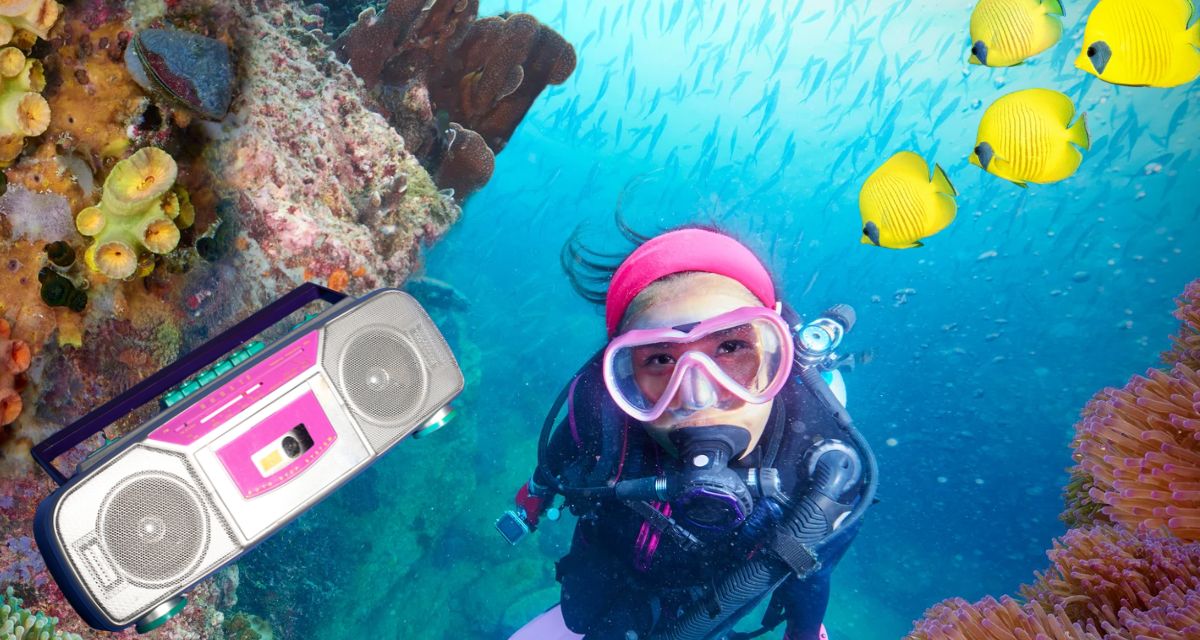
Underwater, a thriving reef is anything but silent. Several years ago, scientists discovered that this bustling soundtrack could be the key to bringing damaged reefs back to life. In 2019, an international team of scientists set out to entice young fish back to a severely damaged section of Australia’s Great Barrier Reef using what they called “acoustic enrichment.” The team included researchers from the U.K.’s University of Exeter and University of Bristol, along with Australia’s James Cook University and the Australian Institute of Marine Science. More sounds = more fish = more life As lead author Tim Gordon of the University of Exeter explained, “Boosting fish populations in this way could help to kick-start natural recovery processes, counteracting the damage we’re seeing on many coral reefs around the world.” Senior author Professor Steve Simpson, also of the University of Exeter, added that “Healthy coral reefs are remarkably noisy places–the crackle of snapping shrimp and the whoops and grunts of fish combine to form a dazzling biological soundscape. Juvenile fish home in on these sounds when they’re looking for a place to settle.” The results were pleasantly surprising Over six weeks, the team placed underwater loudspeakers in patches of dead coral that played recordings of healthy reefs. They found that twice as many fish arrived and stayed in these patches as in equivalent patches where no sound was played. Biodiversity also increased by 50%. A graph showing the effect of acoustic enrichment on fish population in damaged areas of the Great Barrier Reef from Nature.com The latter part was particularly encouraging, as each fish species plays a different role on the reef. Algae grazers keep excess algae off coral, while predators help keep fish populations balanced. With so many creatures playing their part, it’s no wonder a healthy reef is such a cacophonous symphony. Bringing a greater variety of fish back to a damaged reef could therefore help restore some of the ecological processes that allow the reef to function as it should. The experiment’s success led scientists to believe that acoustic enhancement, along with habitat restoration and other conservation measures, could restore the habitat much faster. Now Jamaica is trying it too In 2026, scientists in Jamaica are testing this idea as well. PBS NewsHour documented a project off the country’s northern coast that similarly uses “underwater boomboxes” to broadcast recordings of healthy reefs. Only this time, the project combines art and science. The researchers collaborated with Italian artist Marco Barotti, who created coral-like sculptures based on 3D scans that the solar-powered speakers could be mounted on. Lab-grown coral fragments were also eventually attached to these fixtures. Obviously, this approach is still in its early days. And, again, sound alone can’t undo the damage caused by warming oceans, pollution, and other human-made threats. But by recreating the soundscape of a lively reef, we might be able to invite life to return. That’s certainly one step toward progress. Even small interventions like this one can help make restoration efforts more successful.
Scientists hoped to revive dead reefs by putting speakers underwater. Then the fish showed up.
Full Article
Original Source
Read the full article at Upworthy →KhanList aggregates and links to publicly available news content. We do not host full articles from third-party sources. Always verify important information with original sources.