
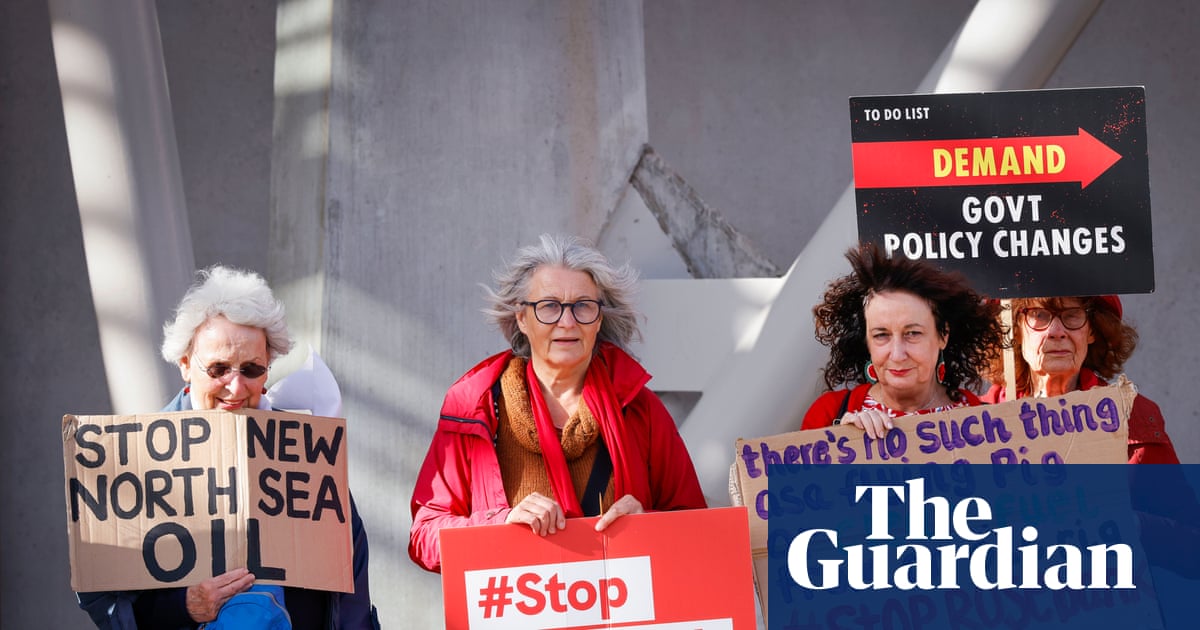
The giant Rosebank oilfield can be approved without breaching the UK’s emission targets, according to government insiders, in a boost to those in the cabinet who are pushing for it to be given the go-ahead.The Guardian revealed last week that Miatta Fahnbulleh, the energy secretary, was leaning towards rejecting the project, but her position has put her at loggerheads with cabinet colleagues, including the chancellor, John Healey, who are lobbying for an approval.Government insiders have told the Guardian the project can be approved on a strict reading of Britain’s climate obligations, in part because once the oil is exported, the emissions from burning it no longer count against domestic targets. “Miatta has more latitude than you might think,” said one.Map of North Sea oil and gasfieldsA decision to approve the oilfield would be met with dismay from climate campaigners and some Labour backbenchers who view it as a harmful step away from prioritising net zero – and may see the shift of emissions from one country to another as a trivial distinction.On Tuesday, Greenpeace and Friends of the Earth wrote to the prime minister urging him to consider the cumulative impacts of big decisions on North Sea drilling, Heathrow expansion and grants for heat pumps – rather than viewing each in isolation.But sources say the Treasury has already accounted for billions of pounds’ worth of tax revenue from Rosebank and so would be faced with a shortfall should it be rejected.“The climate case against was never the direct emissions,” one source said. “Instead it was the leadership position … the power of a G7 producer seeking to put that into action is the climate point, not the direct emissions.”Greg Muttitt, a climate researcher at University College, London, said the government was wrong to approve the Jackdaw gasfield last week and would be wrong to approve Rosebank, which would generate around seven times the emissions.But he added: “It is true that the UK government is not going to find itself in any international court if it approves Rosebank. Approving it is not inconsistent with what the UK has committed to firmly, because most of the oil will be exported and so will count towards other countries’ emissions.”Fahnbulleh has been forced to make a decision over Rosebank because of a legal judgment that the previous environmental consent was incorrectly given by the Conservative government at the time.A judge ruled in 2024 that ministers should have accounted for emissions not just from drilling for oil at Rosebank, but also from those which will be generated by burning it.Given most of that oil will be burned abroad, however, the resulting emissions will not count against the UK’s carbon budgets. Experts estimate that Rosebank could emit 1m additional tonnes of carbon dioxide by 2042, against an overall limit of 90m tonnes.Fahnbulleh is under an obligation to take into account Britain’s commitment under the Paris agreement to take action to prevent global temperatures rising more than 1.5C.In her decision to approve the Jackdaw scheme last week, however, she noted Jackdaw would account for about 0.01% of global greenhouse gas emissions created by the oil and gas industry in 2035.Some experts believe Rosebank could be approved without meaningfully adding to global temperature changes. But others insist that any new oil and gasfields are harmful to the goal of staying within safe carbon budgets.Downing Street insiders insist the decision rests with Fahnbulleh, rather than with Andy Burnham. However supportive ministers have interpreted the prime minister’s promise to take a “pragmatic” approach to oil and gas as a signal he would support giving the green light to Rosebank.He has also talked of “reindustrialisation” in a speech in Motherwell, North Lanarkshire, this month, language often associated in Scotland with the North Sea. Scottish Labour MPs are believed to be overwhelmingly in favour of approving the oilfield.Fahnbulleh, the energy secretary, and Healey, the chancellor, are understood to be in disagreement over the North Sea oilfield. Photograph: Lauren Hurley/No 10 Downing StreetFahnbulleh told the Guardian last week that while she had approved the Jackdaw gasfield on the grounds of national energy security, the same concerns did not necessarily apply to Rosebank.Her allies say she is leaning away from approving it because the climate damage it would create, while arguably not enough to violate legal limits, would not be overriden by the potential benefits, which those who support its approval argue includes tax take, jobs and investment.In recent days, however, people close to the chancellor have said he wants Fahnbulleh to approve the project.The Guardian has learned that part of the reason for this is the Treasury has already accounted for the tax benefits, which Adura, the company operating the field, estimate would be £500m a year by the end of this parliament.A spokesperson for the Department for Energy Security and Net Zero said: “Any decision will be made through the quasi-judicial process, taking into account all relevant evidence, including environmental assessments and public representations received as part of the regulatory process.”
Rosebank oilfield would not breach UK emission targets, say government insiders
Full Article
Original Source
Read the full article at Theguardian →KhanList aggregates and links to publicly available news content. We do not host full articles from third-party sources. Always verify important information with original sources.