
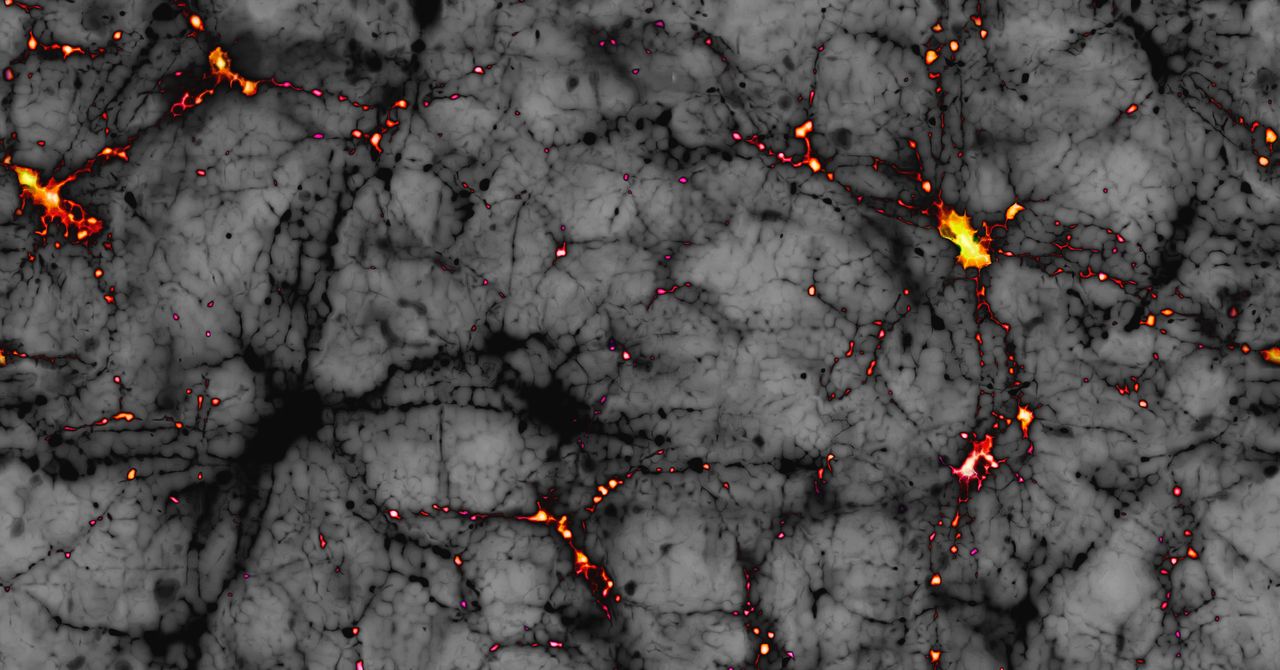
More than a kilometer underground, in what used to be a gold mine, inside a tank filled with tons of liquid xenon, “something” struck the nucleus of an atom. The tiny collision left an unusual energy signature that researchers are still unable to explain, but the scientists behind the experiment believe this could be the most convincing physical evidence of dark matter to date.Dark matter is one of the most important and elusive substances in astrophysics. Though it makes up about 85 percent of the matter in the universe, we can’t observe it directly because it doesn’t interact with light or much else. Most of the evidence for its existence comes from its gravitational effects, the mass of dark matter having tugged on the atoms of the early universe to form stars, galaxies, and the vast web of intergalactic structures visible today.But the enigma of dark matter is complex. Scientists don’t even know what it is made of, whether it’s a single type of particle or an entire set of particles that interact with one another in ways we do not yet understand. The most fantastical explanations even suggest that it consists of black holes. One of the most widely studied theories on dark matter has dubbed its components WIMPs, short for Weakly Interacting Massive Particles, meaning the particles have a mass and thus a gravitational pull but otherwise interact weakly with conventional matter.If WIMPs exist and are part of the dark matter of our galaxy, enormous quantities of them could be passing through the Earth continuously without leaving a trace. However, it is possible that, very occasionally, one might interact with an atomic nucleus and transfer some of its energy to it, which is why an inexplicable collision is exciting in the world of particle physics.In the strange disturbance recorded at the Sanford Underground Research Facility (SURF) in South Dakota, the detector monitoring the tank recorded that a xenon nucleus received energy and recoiled. Though researchers have not yet been able to satisfactorily explain the cause, some models suggest a WIMP could produce such a reaction.The scientists stated that this single event is statistically too small to be considered the discovery of a new particle. In 220 days of observations conducted between 2023 and 2024, only one such anomaly occurred. “With only one event, we don’t want to get ahead of ourselves. We are not claiming to have seen dark matter. But we have seen something interesting that we want to share with the scientific community for their input,” Rick Gaitskell, a professor at Brown University and a member of the team leading the project, said in a press release.The team behind the experiment has published their study as a preprint, meaning it has not yet been peer reviewed. They have, however, presented the results to the scientific community at the 2026 TeV Particle Astrophysics Conference in Japan.Discoveries made around dark matter tend to elicit this kind of restrained excitement. When in November 2025 a team of Japanese astronomers announced that they had seen signs of dark matter in the Milky Way, they too advised the research community not to count their chickens.But even if cautious, there are reasons for enthusiasm. If the impact was caused by dark matter, there is enough evidence for researchers to begin characterizing the responsible particle. For example, the team has already calculated that, under the WIMP models they analyzed, the particle is about 200 times more massive than a proton. The impact could help us understand how this type of matter interacts with conventional matter.The team has also been examining other possible explanations. Paradoxically, in experiments as sensitive as this one, atypical events are not all that uncommon. That’s why SURF has various methods of filtering out background noise and detecting interference caused by known particles or radiation. This event withstood that scrutiny. So far, the researchers have not found an explanation among these known sources that fits what they observed.“We understand our detector and the backgrounds so well that even a single outstanding event, like the one we found, is important,” said Sam Eriksen, a senior researcher at the University of Bristol and the study’s lead author. “We expect dark matter events to be extremely rare, so only a handful could mark the first detection of WIMP dark matter.”This story originally appeared on WIRED en Español and has been translated from Spanish.
Scientists Have Found the Most Convincing Evidence Yet of a Dark Matter Particle
Full Article
Original Source
Read the full article at Wired →KhanList aggregates and links to publicly available news content. We do not host full articles from third-party sources. Always verify important information with original sources.