
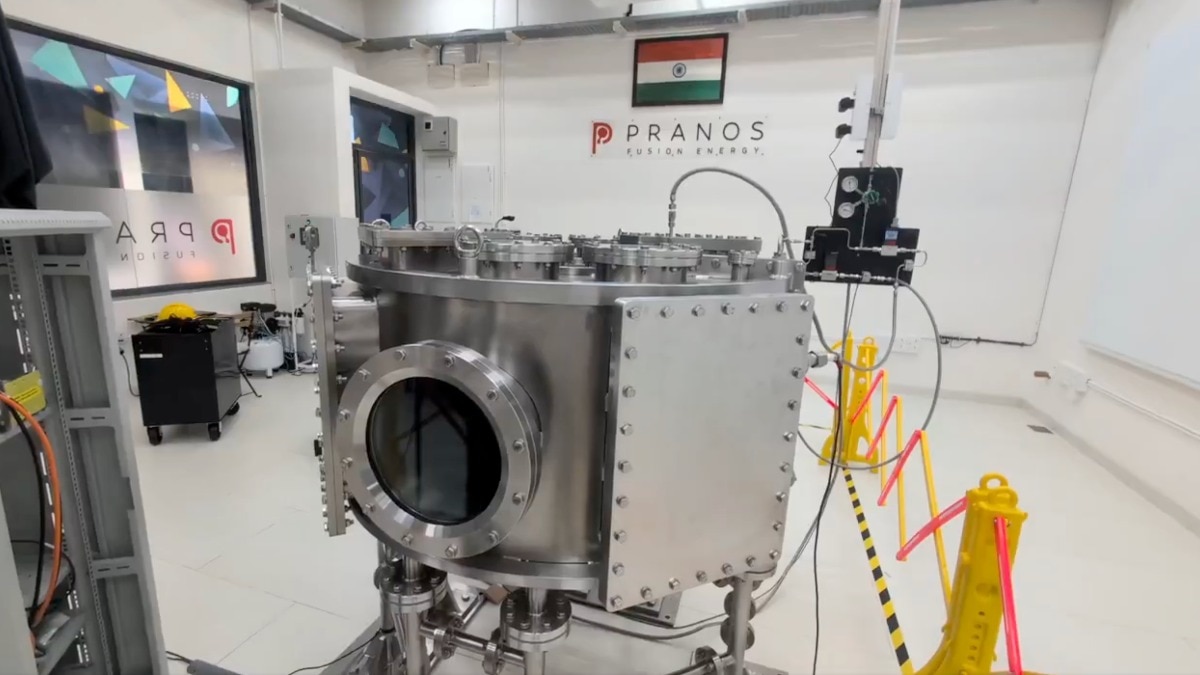
Pranos Fusion has unveiled Pragya, which is describes as India's first privately developed compact tokamak. The machine will test fusion technologies while helping build domestic capability in plasma science.Pragya is not yet designed to generate commercial fusion power. (Photo: Pranos)Bengaluru-based deep-tech startup Pranos Fusion has unveiled Pragya, which it describes as India’s first privately developed compact tokamak, marking a significant step in the country’s emerging private nuclear fusion ecosystem.The machine is designed as a compact, low-aspect-ratio tokamak that will serve as an experimental platform for studying and controlling plasma, the superheated state of matter essential for achieving nuclear fusion.Pragya is not yet designed to generate commercial fusion power, but will act as a critical testbed for the technologies needed to build future fusion reactors.According to Pranos, the reactor took around eight months to build. The company plans to operate Pragya for nearly two decades, targeting between 10 and 12 experimental shots a day, or roughly 3,000 shots annually. The high-frequency experiments are expected to generate a large volume of data on plasma behaviour, tokamak design and control systems. Pranos plans to use the facility to test plasma control technologies, high-temperature superconducting magnets, diagnostics and other critical systems that could eventually be integrated into larger fusion machines.A tokamak uses powerful magnetic fields to confine extremely hot plasma inside a doughnut-shaped chamber. The ultimate goal is to create conditions in which light atomic nuclei can fuse together, releasing vast amounts of energy—the same fundamental process that powers the Sun.Pragya represents the first step in Pranos' longer-term roadmap towards commercial fusion energy.The company has previously outlined an integrated technology programme involving Pragya, its plasma and machine-design platform called JENGA, and MAGGA, a programme focused on fusion-grade high-temperature superconducting magnets.Pranos aims to have its high-temperature superconducting magnet technology operational by 2027. By 2030, it hopes to build a net-gain fusion reactor called PraniQ, a far more ambitious machine designed to demonstrate a major milestone in fusion development.Beyond hardware, the Bengaluru startup also wants Pragya to become a training ground for India's next generation of plasma physicists and fusion engineers. The company believes building a domestic talent pipeline will be as important as building the machines themselves.India has traditionally pursued fusion research through government-backed institutions and its participation in international projects such as ITER. Pragya's emergence adds a new private-sector dimension to that effort, as startups begin attempting to translate decades of fusion science into working engineering systems.For Pranos, the journey has only just begun, but Pragya could become an important laboratory in India's race to harness the power of the stars.- EndsPublished By: Sibu Kumar TripathiPublished On: Sep 3, 2026 16:51 IST
Pranos unveils India's first private compact nuclear fusion reactor Pragya
Full Article
Original Source
Read the full article at Indiatoday →KhanList aggregates and links to publicly available news content. We do not host full articles from third-party sources. Always verify important information with original sources.