
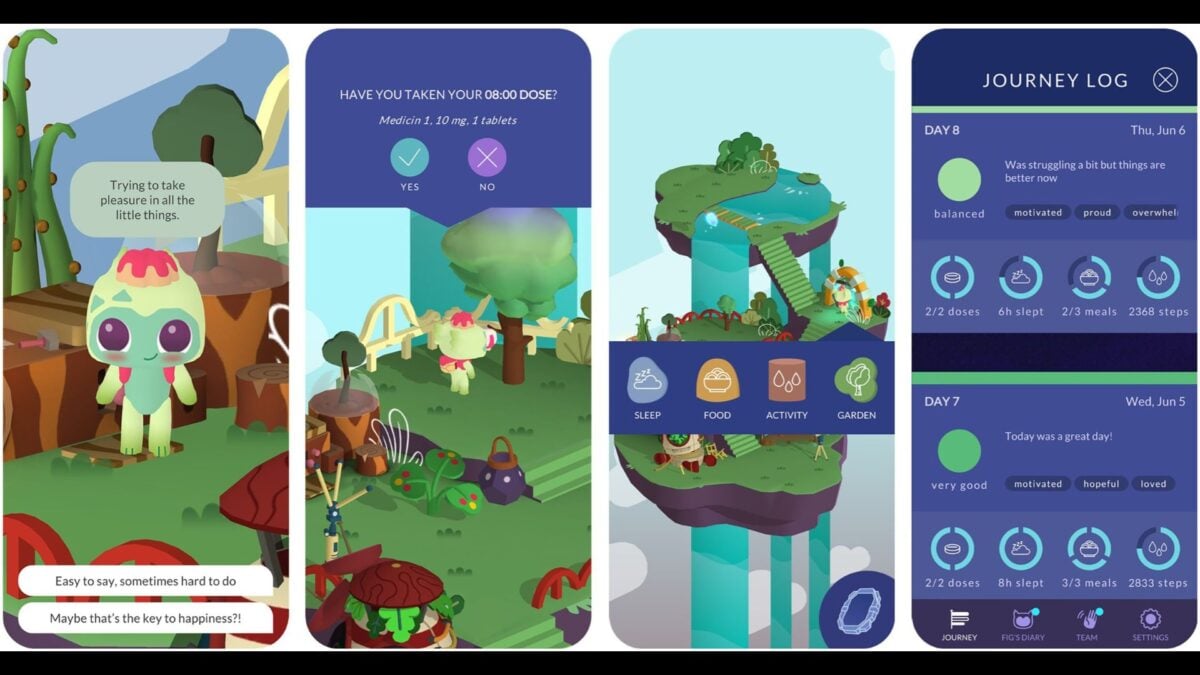
For people struggling with depression, a simple game you can play on your smartphone just might offer some real help, recent research suggests. Scientists in Sweden tested an app, named Fig: The Game for Depression, designed to complement people’s existing depression treatment. Compared to people given standard care alone, people recruited to play Fig experienced a greater reduction in symptoms and were more likely to report taking their prescribed medication, they found. The findings provide early evidence that Fig can be a valuable method of support for people with depression, the researchers said, though more studies will be needed to know for sure. Fig: The Game for Depression Fig was developed by the Sweden-based company Mindforce Game Lab. It’s the company’s first attempt at creating “meaningful gaming experiences that engage the mind and promote well-being” and was made with the input of psychiatrists. The game is intended to help people stick with their healthy habits through the titular character. It offers virtual rewards when people report getting enough sleep, eating enough meals, and adhering to their antidepressant medication. It also comes equipped with 25 optional modules based on cognitive-behavioral therapy techniques and provides messaging access to a therapist on demand. The game is intended to be played in short bits of time twice a day. The researchers recruited 148 people who were already taking antidepressants for this trial. Roughly half were randomized to play Fig for nine weeks, while the other half were placed on a waitlist, acting as a control group (afterward, they could play the game, too). By the study’s end, people in the Fig group seemed noticeably better off, the researchers found. About 51% of the game participants saw at least a 30% reduction in depressive symptoms, compared with 19% of the control group. The Fig players also reported better medication adherence and a greater reduction in co-existing anxiety symptoms. “The results indicate that access to the intervention can reduce depressive symptoms and comorbid anxiety symptoms as well as increase medication adherence among adults receiving antidepressant medication with residual depressive symptoms,” the authors wrote in their paper, published this September in the Journal of Affective Disorders. Only preliminary evidence for now The researchers caution that there were several limitations to the study. For one, this was an open-label trial, meaning everyone knew which group they belonged to. Secondly, though about 80% of people in the treatment group did at least download Fig, only about 60% finished the entire study and provided responses on how they felt afterward, compared to 82% of the control group. The results were also based on people’s self-reported assessments and only looked at short-term effects. All of these factors mean the current findings should merely be considered “preliminary evidence” of the potential benefits of Fig—findings that will “require confirmation in trials with active comparators before conclusions about the specific contribution of the game can be drawn,” the researchers wrote. Another consideration for some people might be cost. Though the app, which is now available via the Google Play Store and Apple’s App Store, comes with a 14-day free trial period, it is ultimately priced at $7.99 (USD) a month. Still, while more data will be needed, it’s certainly possible that some people with depression could benefit from a cute video game sidekick.
Scientists Gave Depressed Patients an Adorable Video Game Sidekick. It Seems to Be Working
Full Article
Original Source
Read the full article at Gizmodo →KhanList aggregates and links to publicly available news content. We do not host full articles from third-party sources. Always verify important information with original sources.