
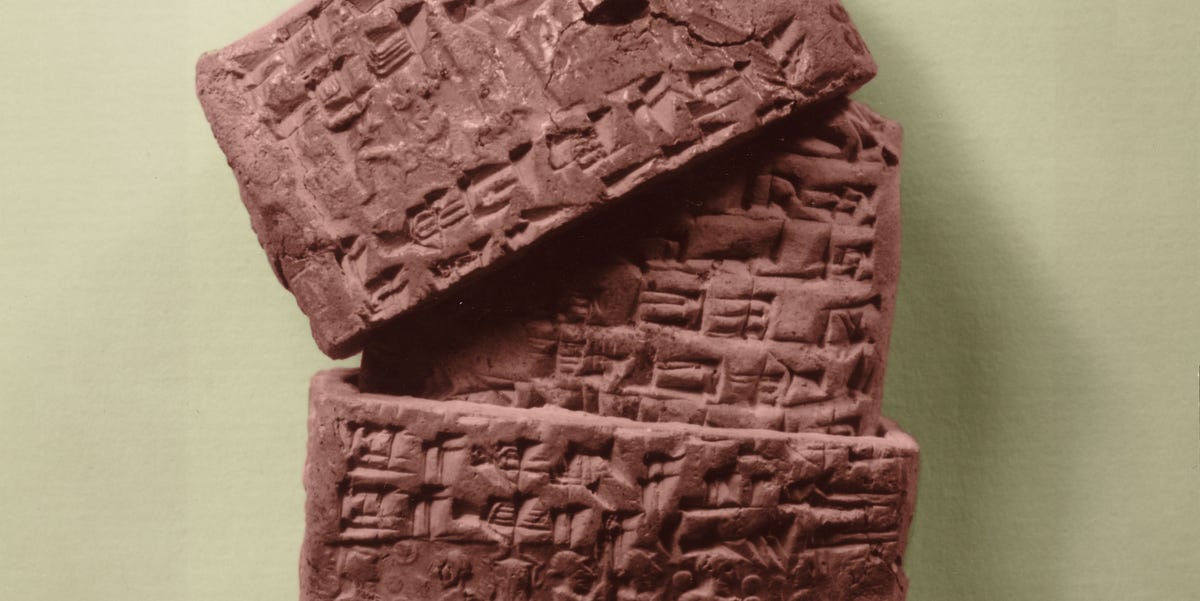
5 min readResearchers developed ENCI, a portable x-ray device that digitally opened sealed clay envelopes from ancient Assyria and Babylon without damaging 4,000-year-old artifacts inside.A letter from wife Anna-anna to merchant husband Ennum-Aššur revealed women’s roles in ancient business affairs and household management during long-distance trade operations.The technology successfully extracted cuneiform texts and organic materials like barley seeds from unopened envelopes, offering unprecedented insights into ancient daily life and commerce.Where does an artifact begin and end? It’s a trickier question than you might think.If you found a sealed, unsent letter in the drawer of your childhood bedroom, you of course would swiftly rip open the envelope to see what forlorn love note your 7th-grade self wrote to some long-forgotten crush. The historical object in this case is simply the letter (unless you’re particularly partial to the colorful sticker used to seal the envelope flap).But the further back an unsent letter dates, the more the entirety of the object has historical significance. If historians opened a drawer in, say, Theodore Roosevelt’s historic Sagamore Hill home and found an unsent letter, they’d likely take far more care to unseal the envelope and see what’s inside; the envelope is now part of the artifact.Accessing sealed letters is even more challenging for missives created before the widespread adoption of the modern envelope was spurred by the publication of Rowland Hill’s 1837 Post Office Reform. Prior to that, complex and varied practices of “letterlocking,” the act of creasing, folding, or sealing a letter onto itself, made unopened letters of the past puzzles for modern day historians. Only within the last decade have researchers been able to “open” unsent letters from 300 years ago without damaging them.But wrestling with “letterlocking” is just the warm-up for those looking to peer into unopened correspondence from the past. The “final boss” of affixed missives of history comes courtesy of the ancient Assyrians and Babylonians 4,000 years ago—and a new study has just cracked how to do it without cracking the artifacts.“Between half a million and a million cuneiform artefacts have been uncovered in South-Western Asia, especially in Iraq, Syria, Iran, and Türkiye,” the study, published in npj Heritage Science, explains. “Among the many different types of texts found, those written for utilitarian purposes from the second half of the third millennium onwards were sometimes enclosed in a clay envelope bearing only a few lines of text and several seal impressions on the outside.” For legal and administrative messages, these clay envelopes would be marked with a summary of the enclosed text (or sometimes the whole of the text itself) to convey the stakes of the enclosed agreement. “Once the contract was completed, the envelope was broken, and the text no longer had any legal value.” Personal letters carried less information on their envelopes. Often, “only the names of the sender and addressee were written.”The letters, contracts, and administrative documents contained within these clay envelopes are of great value to researchers and scholars, offering insight into everything from daily life to governmental goings-on 4,000 years ago. But until now, there was no way to access what was in those clay envelopes without damaging the envelopes themselves, which also risks irreparably damaging what was contained within them.Recently, a multi-disciplinary team from Deutsches Elektronen-Synchrotron and the University of Hamburg brought together x-ray physicists, computer scientists, and Assyriologists to create ENCI, whose acronym stands for “Extracting non-destructively cuneiform inscriptions.” ENCI is a portable device designed to be dismantled and reassembled at museums around the world, which can “read” the messages within these clay envelopes for the first time in millennia. Equipped with high energy x-rays, the machine scans the clay envelope (utilizing a 2mm copper filter to compensate for the beam-hardening distortions the hardened clay can cause) and then uses reconstruction software to enable “virtual unwrapping and detailed exploration.”ENCI’s first two deployments were to the Louvre Museum in Paris, France, and the Museum of Anatolian Civilizations in Ankara, Türkiye. In the latter institution, ENCI digitally opened a letter never read, a missive from wife to husband that offered insight into both spousal communication and monetary lending some 4,000 years ago.The letter was addressed to the merchant Ennum-Aššur by his wife, Anna-anna. Sometime prior to the letter’s composition, the husband had loaned some silver to a man named Laqēpum. Going away on business, Ennum-Aššur evidently tasked his wife with collecting the repayment. After attempting to collect the debt, she wrote the following words to her husband:“Say to Ennum-Aššur: thus (says) Anna-anna. According to the instructions you sent me, regarding Laqēpum, I have been repeatedly going to him, and he (always answered) as follows: ‘I paid the silver to Kudātum.’ I checked and went to him (saying) as follows: ‘I will certainly get witnesses (to testify) against you in case you did not pay (it) to Kudātum.’ He (answered) as follows: ‘I will not give the silver to you. When Ennum-Aššur arrives, it will be to him that I will pay (it)!’ You are my master. Why do you keep turning your head towards the lapis lazuli? Here, your instructions concerning silver, 10 or 20 minas that are either in Burušhattum, or in Wahšušana, or here, you left your instructions and you keep turning your head towards it. If within 10 days you have not arrived, as for your departure, stand up and come. I hear bad words all the time!”Far from a mere peek into a B.C.-era spat, the study notes that this letter offers insight into “the status of women in this society of merchants involved in long-distance trade.”“Often alone and at the head of their households,” this unopened letter demonstrates that “these women also intervened in their husbands’ business affairs.”Other envelopes that were x-ray unwrapped by ENCI offered further revelations about the economic practices of the time. One particularly noteworthy envelope first found during a 1993 expedition, “in the house of Ali-ahum and his son Aššur-taklāku,” was revealed to be a loan contract, which provided instructions for how to signify that a debt had been repaid. “When the debt is repaid, the creditor gives the document to the debtor, who cancels it by breaking the envelope.” This particular object, however, had more to offer than just the text instructions. The X-ray tomography also discovered a piece of organic material within the envelope: a 4,000 year old barley seed.Beyond what we can learn from these specific envelopes, the ENCI tech offers an opportunity to more easily access information sealed away in various artifacts around the world. Perhaps, one day, we might even get to find out if Ennum-Aššur ever got his silver back.Watch Our Science VideosMichale Natale is a News Editor for the Hearst Enthusiast Group. As a writer and researcher, he has produced written and audio-visual content for more than fifteen years, spanning historical periods from the dawn of early man to the Golden Age of Hollywood. His stories for the Enthusiast Group have involved coordinating with organizations like the National Parks Service and the Secret Service, and travelling to notable historical sites and archaeological digs, from excavations of America’ earliest colonies to the former homes of Edgar Allan Poe.
Scientists Finally Read a Mysterious 4,000-Year-Old Letter—Without Ever Opening It
Full Article
Original Source
Read the full article at Popularmechanics →KhanList aggregates and links to publicly available news content. We do not host full articles from third-party sources. Always verify important information with original sources.