
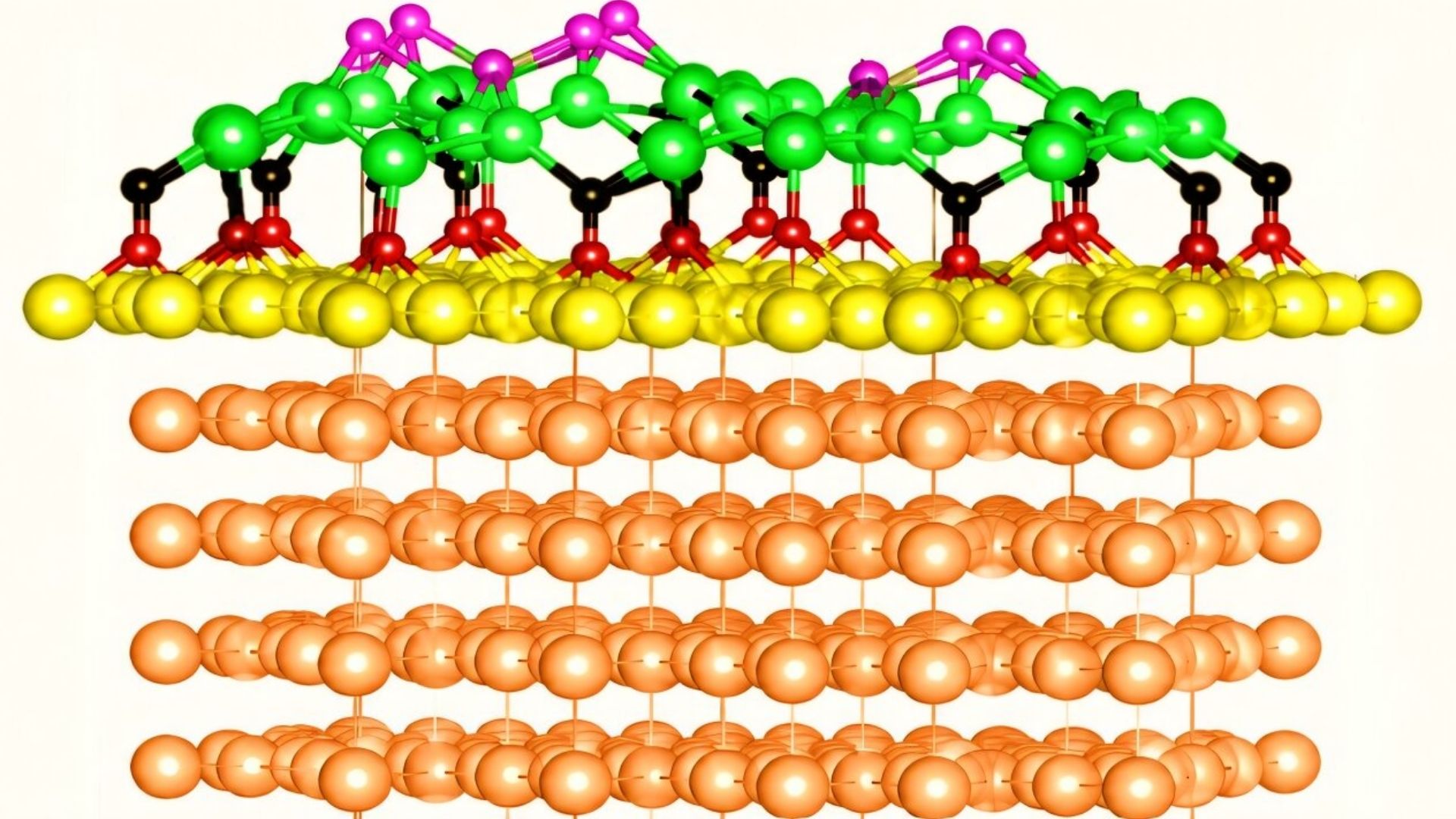
Scientists have discovered that an oxygen-rich layer forming on copper surfaces during the earliest stages of oxidation behaves much more like metallic copper than previously expected. The finding could help researchers better understand how copper corrodes and potentially improve the design of catalysts and copper containers intended for the long-term storage of spent nuclear fuel. Copper gradually develops an oxide layer when exposed to oxygen, eventually producing the familiar green patina seen on old copper roofs. But before conventional copper oxides such as Cu₂O form, the surface can develop more complicated structures made from copper and oxygen atoms. One of these structures, known as the ’29’ surface oxide, has presented scientists with a puzzle. Researchers knew that it contained a high concentration of oxygen, but conventional spectroscopy techniques struggled to determine exactly how strongly the copper atoms themselves were oxidized. A team led by Professor Alexander Föhlisch has now measured those chemical states directly using Auger photoelectron coincidence spectroscopy (APECS) at BESSY II. The researchers found that the copper atoms in the ’29’ surface oxide have an oxidation state of only around 0.3. That is dramatically closer to metallic copper than to conventional copper oxides, despite the large amount of oxygen present on the surface. “This is surprising and truly remarkable, because the oxygen concentration on the surface is very high,” said Swarnshikha Sinha, who performed the measurements. The team also identified how different oxygen species are distributed across the protective surface layer, providing a more detailed picture of the earliest stages of copper oxidation. The results were published in the Journal of the American Chemical Society. Why the finding matters for catalysts Copper is widely studied as a catalyst for chemical reactions including carbon dioxide reduction, methanol synthesis, and oxidation. In many catalytic processes, the most important active sites may not consist entirely of pure copper or fully oxidized compounds such as CuO and Cu₂O. Instead, partially oxidized surfaces can have distinct electronic properties that influence how molecules interact with them. The new measurements suggest that some oxygen-rich copper surfaces can remain electronically close to metallic copper. Understanding this intermediate state could therefore help researchers design catalysts with more precisely controlled activity and selectivity. Rather than treating copper surfaces as simply “metallic” or “oxidized,” scientists may be able to account for more subtle intermediate structures when designing catalytic materials. A clue for nuclear-waste storage The finding could also improve understanding of copper corrosion over much longer timescales. Copper is being considered for containers used to isolate spent nuclear fuel in some proposed geological disposal systems because of its corrosion resistance. The protective oxide layers that form on copper are therefore important to understanding how such containers behave over time. The study provides a more detailed picture of a fundamental chemical process that could help evaluate such materials. Knowing exactly what happens during the earliest stages of oxidation could help researchers build more accurate models of copper’s surface chemistry and corrosion. The researchers say their results demonstrate that the amount of oxygen present on a surface does not necessarily indicate how strongly the underlying copper atoms have been oxidized. That distinction could prove useful wherever controlling the chemistry of copper surfaces matters, from developing more selective catalysts to predicting how copper behaves in demanding long-term environments.Get the latest in engineering, tech, space & science - delivered daily to your inbox.Kaif Shaikh is a journalist and writer passionate about turning complex information into clear, impactful stories. His writing covers technology, sustainability, geopolitics, and occasionally fiction. A graduate in Journalism and Mass Communication, his work has appeared in the Times of India and beyond. After a near-fatal experience, Kaif began seeing both stories and silences differently. Outside work, he juggles far too many projects and passions, but always makes time to read, reflect, and hold onto the thread of wonder.
Scientists discover oxygen-rich copper surface behaves almost like pure metal
Full Article
Original Source
Read the full article at Interestingengineering →KhanList aggregates and links to publicly available news content. We do not host full articles from third-party sources. Always verify important information with original sources.