
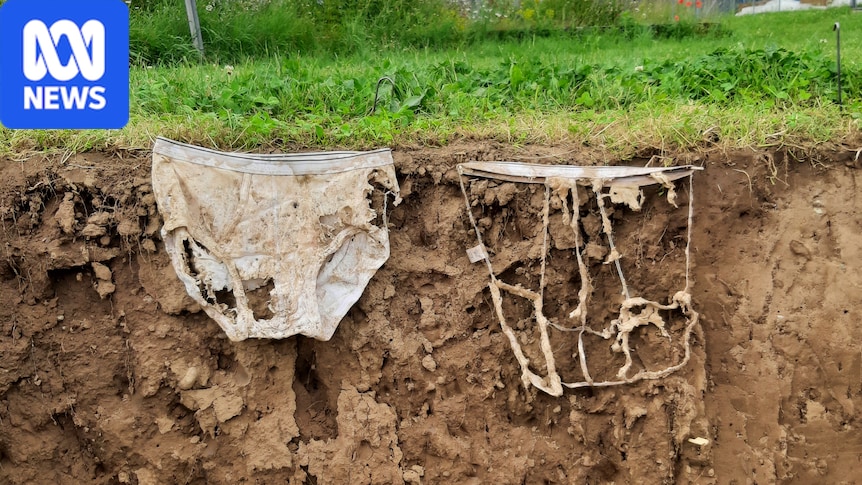
What do burying undies, stealing from babies and vicious friends all have in common?It's all part of research celebrated today with an opera about mushrooms and paper planes thrown at winning researchers as part of the Ig Nobel Prizes.The annual awards, which play on the coveted Nobel Prizes, are given for research that "first makes people laugh, and then make them think".In the past, very important research such as Dr Karl's citizen science investigation into belly button lint has won awards.This year, 10 prizes were awarded at a ceremony in Zurich, the first time in 36 years the Ig Nobels have been hosted outside of the US.Despite the silly nature of the prizes, the winners, including Australia/US dual citizen Keelan Williams, are typically delighted to win."I couldn't believe it when I got the phone call," Dr Williams said. "That was a very exciting moment."We prefer our friends vicious Dr Williams, an evolutionary psychologist at Hamilton College, and her colleagues, won the Ig Nobel Peace Prize for their paper on the surprising trait we want in our friends: viciousness. "We want our friends to be kind and helpful and generous and just overall lovely people," she said."But at the same time, we also have friends who would happily stab our ex in the eye if they had the chance. How can we reconcile these two things?"Researchers found that while we all want kind friends, we also want people who are fiercely loyal. (Unsplash: Jeremy Bishop)The paper found that while we'd like our friends to be kind and helpful, that's not the whole story. "What we really mean is that we want friends who are all of those things to us, not necessarily towards other people, especially people we don't like," Dr Williams said.A precise definition of kissing … in animalsThe Ig Nobel Biomechanics Prize went to a team in the US and UK who went above and beyond in the realm of kissing. While we think of kissing as "very human thing," we're definitely not alone in the animal kingdom, Matilda Brindle, an evolutionary biologist at the University of Oxford, said.Polar bears tongue, prairie dogs gently smooch and insects suck face.Polar bears are one of many animals that seem to "kiss", using the researchers' definition. (Getty Images: Darrell Gulin)"We had to have this really broad definition, but it also had to be narrow enough that it would exclude behaviours that look like kissing, but aren't," Dr Brindle said.And so a not-very-sexy definition of kissing was born: "non-agonistic interactions involving directed, intraspecific, oral-oral contact with some movement of the lips/mouthparts and no food transfer".Delightful. But Dr Brindle said it was important to understand these oft-forgotten parts of animal relationships. "We dismiss these behaviours as evolutionary quirks and we think that research into them maybe is a little bit frivolous," she said. "But actually, it has really fundamental consequences for how we understand not only the evolution of reproductive strategies, but our own sexuality."Testing soil by burying undiesThe Ig Nobel Soil Science Prize went to European researchers for some extremely soiled undies. The team got 1,000 citizen scientists to plant cotton underwear across more than 25 countries to test soil health in their local areas.The researchers found that the type of land use, garden, meadow, field or lawn, is a key factor in the decomposition of underwear. (Supplied: Gabriela Brändle/Agroscope)Marcel van der Heijden, an agroecologist at the University of Zurich, said the goal was to make people aware of the importance of soil. "We explore soil biodiversity and the importance of soil life for plant growth and ecosystem functioning," Professor van der Heijden said. "We wanted to bring our work closer to the general public and hence we started this action of burying underpants to visualise soil processes."The team found the buried cotton undies decomposed faster in soil with higher fertility and more nutrients.They have now proposed an "underwear index" using a decomposition percentage to measure the health of soil in an easy-to-understand way.Upper-class people steal more candy from babies The Ig Nobel Economics Prize went to North American researchers who undertook a large study in 2012 that compared the ethical behaviour of upper-class versus lower-class people. Upper-class people didn't come out well. They were more likely to break the law while driving, lie in a negotiation, cheat to win a prize and take lollies meant for children.Study participants were offered a jar of lollies, which they were told was intended for children. (Getty Images: by vesi_127)The researchers weren't sure why this was the case, but they put forward a few hypotheses.They suggested the increased privacy of upper-class jobs, extra money to deal with the consequences if they were caught and even a feeling of entitlement could have contributed."Together, these factors may give rise to a set of culturally shared norms among upper-class individuals that facilitates unethical behaviour," the researchers concluded. "As our findings suggest, the pursuit of self-interest is a more fundamental motive among society's elite, and the increased want associated with greater wealth and status can promote wrongdoing."
'Soiled' undies and vicious friends research honoured at Ig Nobels
Full Article
Original Source
Read the full article at Abc →KhanList aggregates and links to publicly available news content. We do not host full articles from third-party sources. Always verify important information with original sources.