
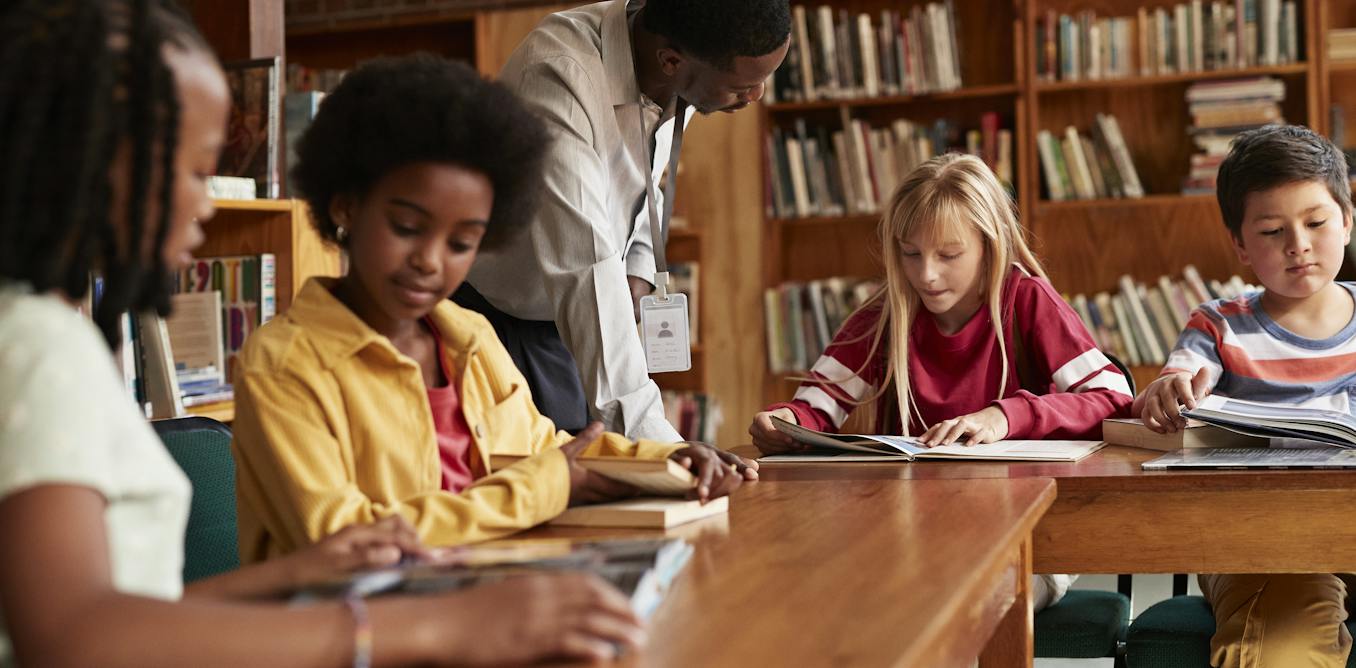
Fewer than 10% of Michigan public schools report having a school library staffed with a trained school librarian. Although Michigan strongly recommends that schools employ certified librarians, the state does not require them. In the 2023–24 school year, the state ranked 46th in the student-to-librarian ratio, with one school librarian for every 2,760 students. The lack of school librarians impacts students across Michigan, but particularly in low-income communities like Detroit and Flint and more isolated ones like Alcona County in the northern Lower Peninsula and Ontonagon in the Upper Peninsula, exacerbating disparities in resources for young people. We are scholars in library and information sciences from Wayne State University, studying information access and ethics and equity in education and school libraries. Currently, we are conducting a statewide campaign to contact every school in Michigan and learn about their libraries, staffing, book collections, technology resources and more. Michigan’s 2025–26 School Aid budget funded our statewide survey to measure the school librarian shortage and guide efforts to address it. Our work, and the work of many others, reveals how school librarians help students become strong readers and informed citizens. Fewer than 10% of Michigan public schools have a trained librarian. Harkim Wright Sr./AP Catalysts for student achievement A missing librarian is harder to see than an empty bookshelf. A room full of books can look like a school library. But if students cannot borrow those books, teachers have no librarian to plan lessons with, and no one leads author visits or digital citizenship lessons, the space offers only a fraction of what a school library can provide. School librarians bring those services to life. Also called school library media specialists, they hold a teaching certificate and complete advanced education. They connect students with books they want to read and work with teachers to build richer lessons, using library resources to extend learning beyond the textbook. Their impact stretches far beyond standardized test scores, though studies link strong library programs with higher student achievement and improved student literacy, especially for struggling readers. They can instill a love of reading and teach technological skills, which is critical in the age of artificial intelligence. At our Michigan School Census symposium held in 2026, Michigan school librarians and a principal described what that work looks like. Brian Peck, a teacher librarian at Detroit’s UPrep Academy, helped students research and build a library where none had existed. He reported that 334 students voluntarily visited and checked out books during the previous school year. At West Ottawa, librarian Julia Reynolds described replacing crowded shelves with displays that let children see book covers. Circulation quadrupled, she reported. A principal on the panel explained how district support helped schools make library visits a priority from the first week of school. Students’ information worlds Access to information is only a start. Students also need help making sense of what reaches them through searches, social media and AI. AI can create convincing fake videos of students doing or saying things they never did, harming their reputations and undermining trust in what people see online. Less visible forces shape students’ information worlds, too. Algorithms and online platforms often dictate which search results and suggested videos appear first. Students need to understand that the first result is not necessarily the most credible or trustworthy source. AI is becoming so prominent that even elementary school students are learning about it. Building information literacy Information literacy means knowing how to find, judge and use information. School librarians turn those skills into practice. For a history assignment, a librarian might help students compare a newspaper account with a firsthand record. Who produced each source? What might explain their different accounts? The same habits apply to AI. Students can trace a claim to its source, check whether the source exists and compare what it says with the generated answer. A confident response still needs evidence. Guided by certified school librarians, students can build upon these foundations and learn to effectively find, evaluate and use information, including news articles about a historic event for a social studies assignment or to analyze current social media trends. Students can also judge the accuracy, recency and relevance of information. They learn to apply information in decision-making, writing and other forms of communication. Becoming savvy digital citizens Knowing whether information is trustworthy is an important skill. Deciding what to do with it is another. Digital citizenship includes deciding whether to post someone’s photo, seeking their permission before doing so, and choosing not to share a fake video. Recent research emphasizes that digital citizenship prepares students to be empowered online and act ethically, safely and legally in digital environments. Our work also starts with the knowledge young people bring to school. Project Restoring Urban School Libraries helped classroom teachers earn the additional endorsement needed to become school librarians. The program combined mentoring with coursework that drew on students’ cultures, including using hip-hop to explore how young people find, create and share information. Students start by examining the media they already use. A lesson might ask them to trace a sample, credit its creator and discuss what changes when someone else’s work reaches a new audience. Fighting for recognition Principal preparation programs can help school leaders understand what school librarians contribute beyond book checkout. But principals and school librarians often train in separate academic units: colleges of education and schools of library and information science. Without shared coursework or joint projects, principals may complete their training without learning how to work with a school librarian. In our “Closing the Literacy Gap” symposium, we brought school librarians and administrators together on a panel to show what their partnerships make possible. West Ottawa Principal Audra Bolhuis joined school librarian Julia Reynolds and compared a librarian to “an instructional coach.” She described someone teachers can turn to for resources and help with classroom projects, extending the librarian’s role beyond students’ scheduled library visits. School library jobs remain vulnerable to budget cuts, and the number of school librarians across the state has been decreasing since 2010. To understand what schools provide and where support is missing, we launched the state-funded Michigan School Census in September 2026. By Oct. 21, 1,054 schools – about one-third of those invited – had completed it. Our public response map tracks participation across districts. Schools without libraries or librarians are essential to painting the full picture: Their staff can explain how students get books and research help when those services are absent. The findings will guide recommendations for staffing, resources and funding. Counting what schools have is the first step toward deciding what every Michigan student should be able to count on. Read more of our stories about Detroit and Michigan.
School librarians are vanishing from Michigan schools just when they are needed most
Full Article
Original Source
Read the full article at Theconversation →KhanList aggregates and links to publicly available news content. We do not host full articles from third-party sources. Always verify important information with original sources.